







Question: NOTE: Steps involved in calculating parameters using MLE in normal distribution, exponential distribution, and poisson distribution are the same - though the likelihood functions are
NOTE: Steps involved in calculating parameters using MLE in normal distribution, exponential distribution, and poisson distribution are the same - though the likelihood functions are different. STEPS involved:
1. Restate the likelihood function (different for normal, exponential and poisson) 2. Take the natural log of the likelihood function 3. Expand and rearrange the log likelihood function 4. Take the first derivative of the log function 5. Set the final equation (in 4) after the first derivative and set it to 0 6. Find the MLE estimator Attached below are questions
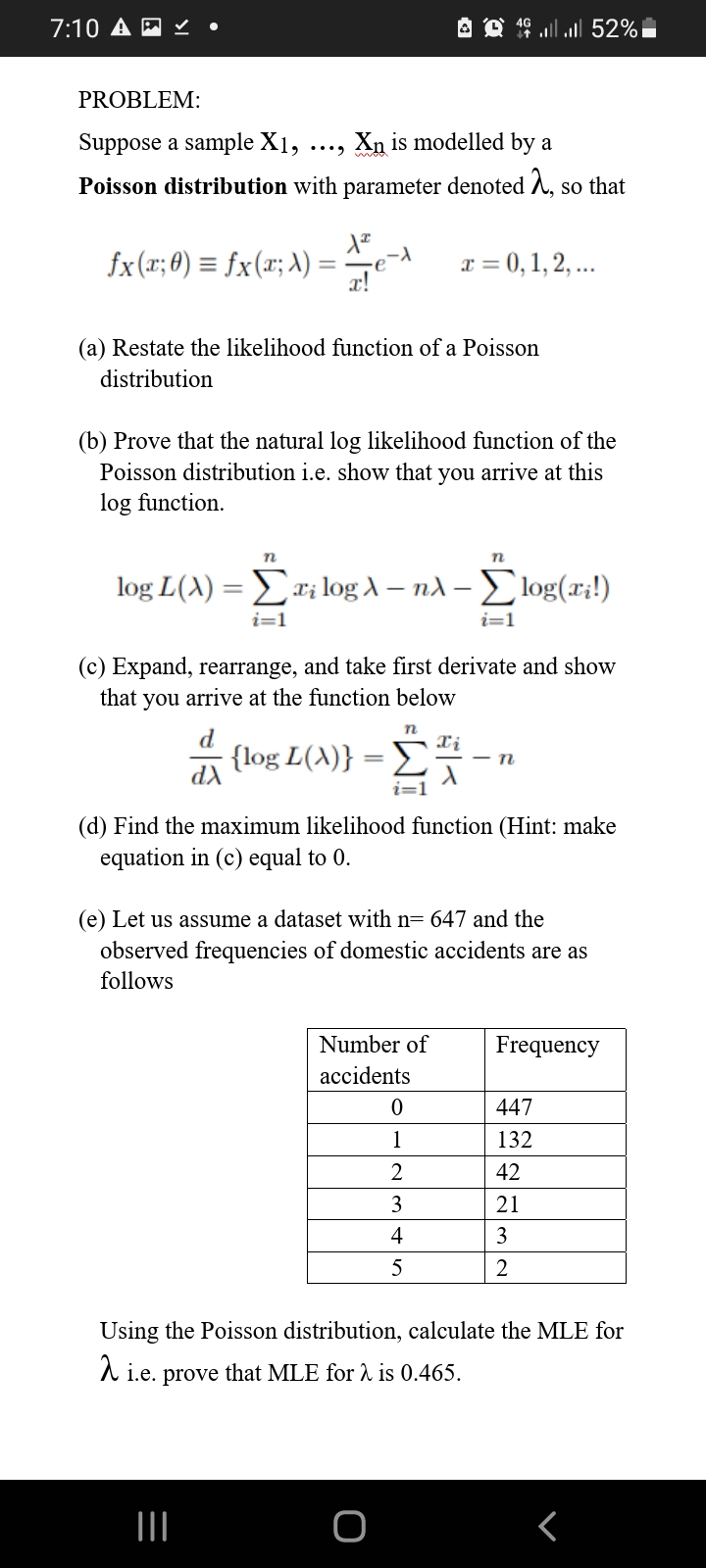
7:10 A Py . @ 4 1. 52% PROBLEM: Suppose a sample X1, ..., Xn is modelled by a Poisson distribution with parameter denoted , so that fx(x;0) = fx(x; )) = - T = 0, 1, 2, ... (a) Restate the likelihood function of a Poisson distribution (b) Prove that the natural log likelihood function of the Poisson distribution i.e. show that you arrive at this log function. n n log L(A) = ri log And - _log(ri!) i=1 i=1 (c) Expand, rearrange, and take first derivate and show that you arrive at the function below ax {log L(X)} = E n (d) Find the maximum likelihood function (Hint: make equation in (c) equal to 0. (e) Let us assume a dataset with n= 647 and the observed frequencies of domestic accidents are as follows Number of Frequency accidents 0 447 132 2 42 3 21 4 3 5 2 Using the Poisson distribution, calculate the MLE for i.e. prove that MLE for A is 0.465. III O <
Step by Step Solution
There are 3 Steps involved in it

Get step-by-step solutions from verified subject matter experts
 Study Help