







Question: They argue that just because the coin is balanced, each outcome (the result of three tosses) must have probability 1/8. Note that a coin is
They argue that just because the coin is balanced, each outcome (the result of three tosses) must have probability 1/8. Note that a coin is balanced if P(H)=P(T)=0.5 at each toss. It is enough to CRITICIZE THE REASONING by considering just a two-toss experiment, for which WMS would (incorrectly) argue that the probability of each pair of outcomes is automatically 1/4 , FROM THE FAIRNESS OF THE COIN ALONE. This mistake is made in many introductory statistics books. Criticize the reasoning of Example 2.3.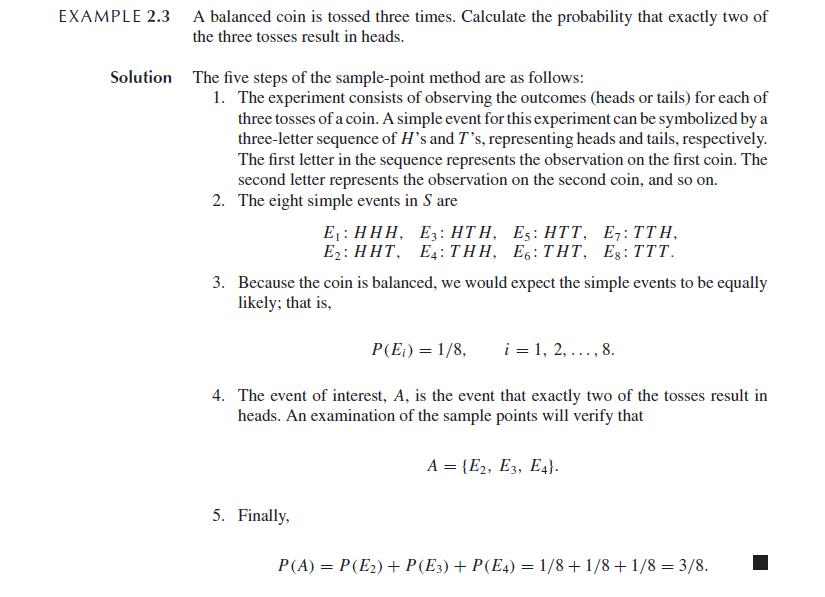
EXAMPLE 2.3 A balanced coin is tossed three times. Calculate the probability that exactly two of the three tosses result in heads. Solution The five steps of the sample-point method are as follows: 1. The experiment consists of observing the outcomes (heads or tails) for each of three tosses of a coin. A simple event for this experiment can be symbolized by a three-letter sequence of H's and T's, representing heads and tails, respectively. The first letter in the sequence represents the observation on the first coin. The second letter represents the observation on the second coin, and so on. 2. The eight simple events in S are E: HHH, E3: HTH, E: HHT, E4: THH, ES: HTT, E: TTH, E6: THT, Eg: TTT. 3. Because the coin is balanced, we would expect the simple events to be equally likely; that is, 5. Finally, P (E) = 1/8, i = 1, 2, ..., 8. 4. The event of interest, A, is the event that exactly two of the tosses result in heads. An examination of the sample points will verify that A = {E2, E3, E4). P(A) = P(E) + P(E3) + P(E4) = 1/8 + 1/8 + 1/8 = 3/8.
Step by Step Solution
3.58 Rating (166 Votes )
There are 3 Steps involved in it
Solo Let X the number of heads appeared in two coin tosses PX... View full answer

Get step-by-step solutions from verified subject matter experts
 Study Help