







Question: NOTE that significant marks will be lost if your answer does not include the NUMERICAL FORMULA. Final answer should be rounded to two decimal places
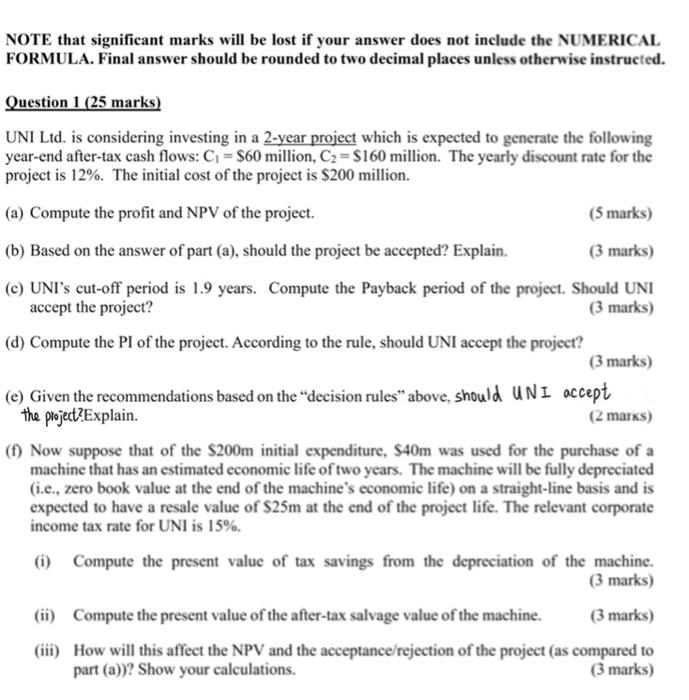
NOTE that significant marks will be lost if your answer does not include the NUMERICAL FORMULA. Final answer should be rounded to two decimal places unless otherwise instructed. Question 1 (25 marks) UNI Ltd. is considering investing in a 2-year project which is expected to generate the following year-end after-tax cash flows: C = $60 million, C2 = $160 million. The yearly discount rate for the project is 12%. The initial cost of the project is $200 million. (a) Compute the profit and NPV of the project. (5 marks) (b) Based on the answer of part (a), should the project be accepted? Explain. (3 marks) (C) UNI's cut-off period is 1.9 years. Compute the Payback period of the project. Should UNI accept the project? (3 marks) (d) Compute the PI of the project. According to the rule, should UNI accept the project? (3 marks) (e) Given the recommendations based on the decision rules" above, should UNI accept the project?Explain. (2 marks) (1) Now suppose that of the $200m initial expenditure, S40m was used for the purchase of a machine that has an estimated economic life of two years. The machine will be fully depreciated (i.e., zero book value at the end of the machine's economic life) on a straight-line basis and is expected to have a resale value of $25m at the end of the project life. The relevant corporate income tax rate for UNI is 15%. (1) Compute the present value of tax savings from the depreciation of the machine. (3 marks) (ii) Compute the present value of the after-tax salvage value of the machine. (3 marks) (iii) How will this affect the NPV and the acceptance/rejection of the project (as compared to part (a))? Show your calculations
Step by Step Solution
There are 3 Steps involved in it

Get step-by-step solutions from verified subject matter experts
 Study Help