







Question: Note: The a s and b s can be in any order. Your regular expression should handle this. b . L 2 = { w
Note: The as and bs can be in any order. Your regular expression should handle this.
b L w in : w is the binary representation of a prime number between and Justify your answer.
c L anbm: n m Justify your answer.
Problem Let Sigma ab
a Prove that raabababb is a regular expression using the inductive
definition of regular expressions. Use the techniques on slide in Chap power point.
b Give a simple English description of the strings in Lr
c Create an NFA M such that LrLM Create and test your NFA on Jflap. Submit the
jflap diagram for M and the testing diagram for M
d Testcases: aa bb aabb, abbaba, bbaaab, a b ababbb, baaababa
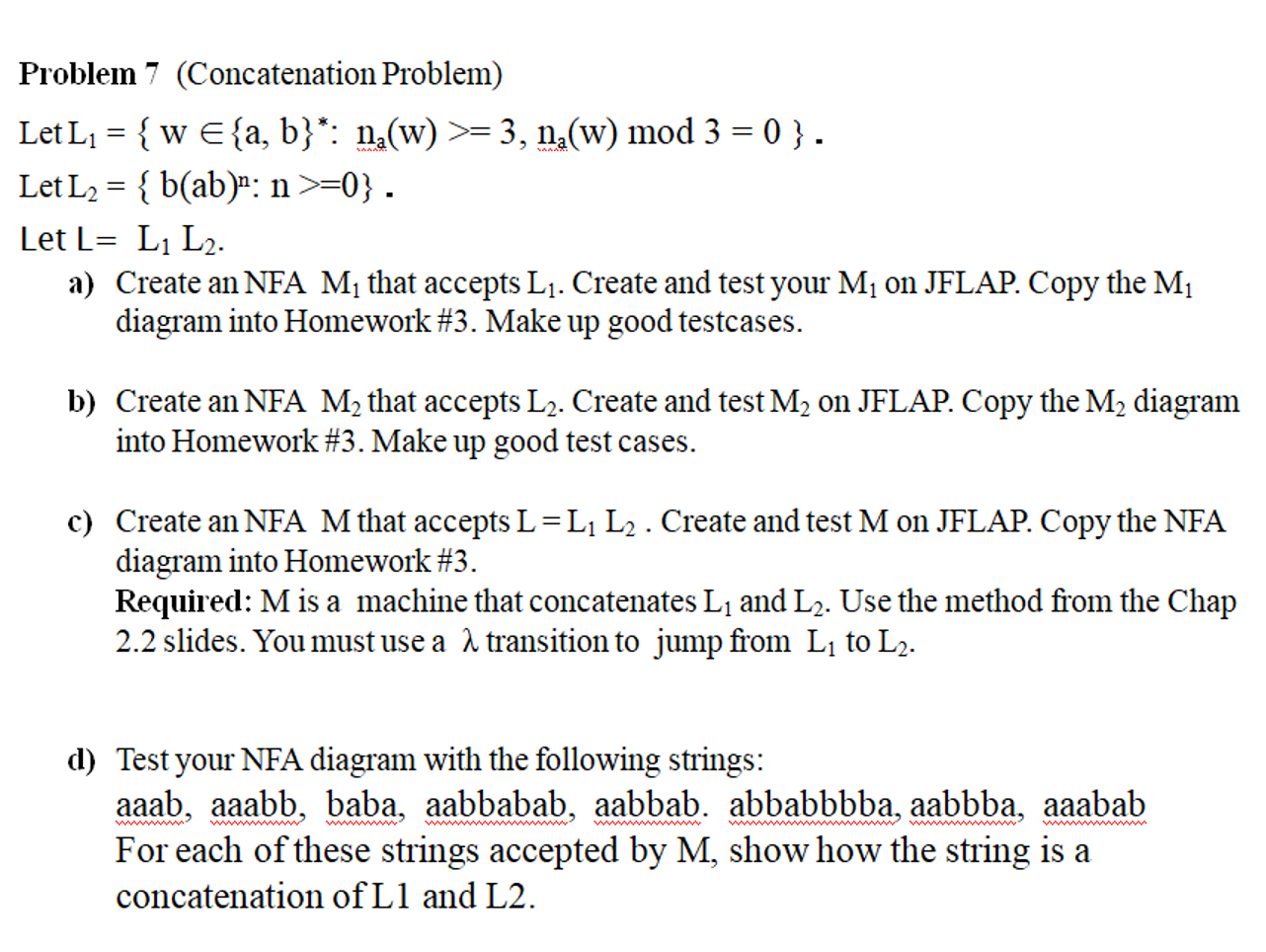
Problem Concatenation Problem
Let Lwinab:nawnawmod
Let Lbabn:n
Let LLL
aM that accepts L Create and test your M on JFLAP. Copy the M
diagram into Homework # Make up good testcases.
bM that accepts L Create and test M on JFLAP. Copy the M diagram
into Homework # Make up good test cases.
cLLL Create and test M on JFLAP. Copy the NFA
diagram into Homework #
Required: M is a machine that concatenates L and L Use the method from the Chap
slides. You must use a lambda transition to jump from L to L
d
Step by Step Solution
There are 3 Steps involved in it
1 Expert Approved Answer
Step: 1 Unlock

Question Has Been Solved by an Expert!
Get step-by-step solutions from verified subject matter experts
Step: 2 Unlock
Step: 3 Unlock
 Study Help