







Question: (Note: The data in this question may not be the same as that in the previous question and you may need to recompute the critical
(Note: The data in this question may not be the same as that in the previous question and you may need to recompute the critical path)
A company must perform a maintenance project consisting of seven activities. The activities, their predecessors, and their respective time estimates are presented below:
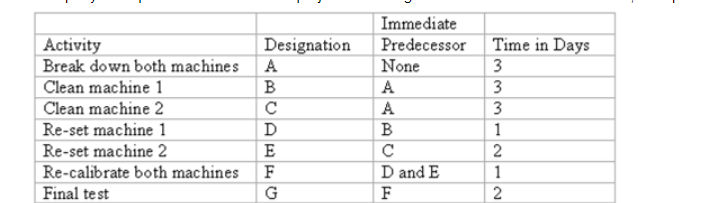
The shortest path is A-B-D-F-G with ten days. Assuming the data on activity times and their predecessor relationships are correct, what can you tell a manager who requests the project to be done in ten days, using the shortest path?
| Yes, it can be accomplished by following the path A-B-D-F-G | ||
| It can be done, but it would be prudent to provide some slack time for unforeseen delays | ||
| It cannot be done since F cannot start until A-C-E is completed, which itself takes 8 days | ||
| It cannot be done because the activity times add to 15 days |
\begin{tabular}{|l|l|l|l|} \hline & & Immediate & \\ \hline Activity & Designation & Predecessor & Time in Days \\ \hline Break down both machines & A & None & 3 \\ \hline Clean machine 1 & B & A & 3 \\ \hline Clean machine 2 & C & A & 3 \\ \hline Re-set machine 1 & D & B & 1 \\ \hline Re-set machine 2 & E & C & 2 \\ \hline Re-calibrate both machines & F & D and E & 1 \\ \hline Final test & G & F & 2 \\ \hline \end{tabular}
Step by Step Solution
There are 3 Steps involved in it

Get step-by-step solutions from verified subject matter experts
 Study Help