







Question: Note: The following Matlab functions are mentionedeeded in problem. Math 128A: Homework 7 Due: August 2 1. In this problem, we will study the evolution
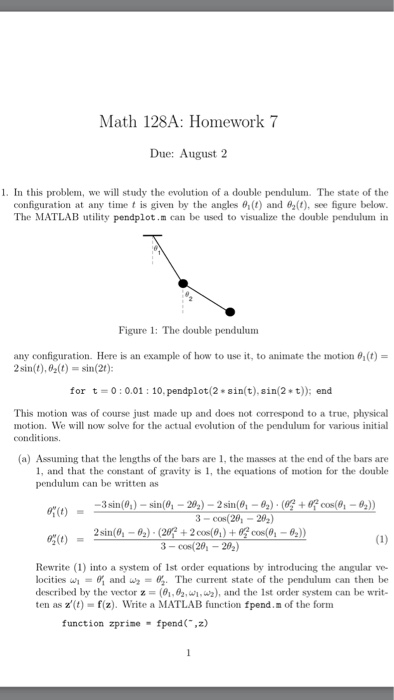
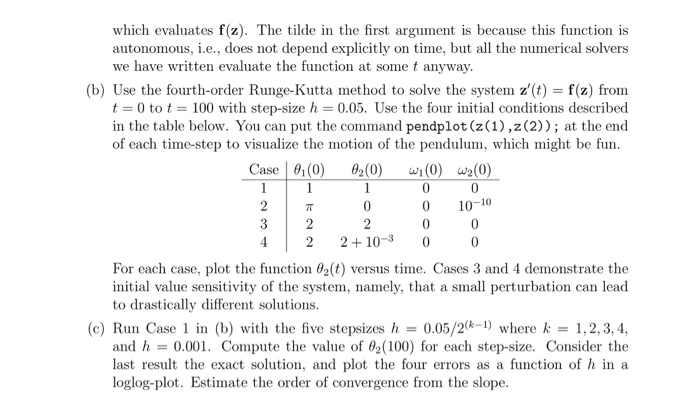
Note: The following Matlab functions are mentionedeeded in problem.
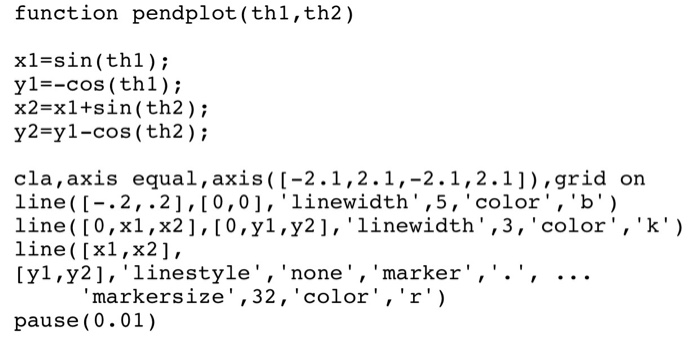
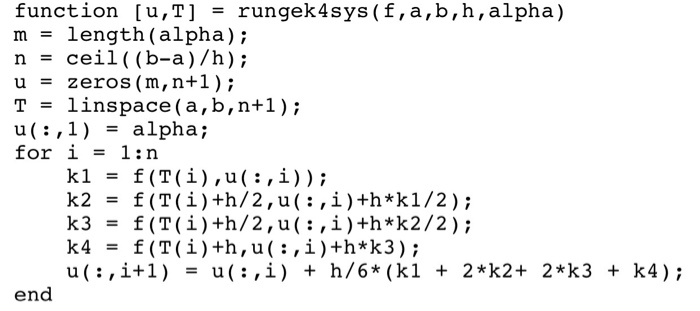
Math 128A: Homework 7 Due: August 2 1. In this problem, we will study the evolution of a double pendulum. The state of the configuration at any time t is given by the angles 1(t) and 64(t), see figure below. The MATLAB utility pendplot.m can be used to visualize the double pendulum in Figure 1: The double pendulum any configuration. Here is an example of how to use it, to animate the motion 1(t)- 2sin(t).@g(t) = sin(2t): for t 0 : 0.01 : 10. pendplot(2 * 81n(t), 81n(2 * t)); end This motion was of course just made up and does not correspond to a true, physical motion. We will now solve for the actual evolution of the pendulum for various initial conditions. (a) Assuming that the lengths of the bars are1, the masses at the end of the bars are 1, and that the constant of gravity is 1, the equations of motion for the double pendulum can be written as -3sin(6, ) _ sin(91-2%) _ 2 sin(91-82) . (e? + cos(81-82)) 3- cos(20-20) gu) 3-cos(20-202) Rewrite (1) into a system of 1st order equations by introducing the angular ve- locities = and w2 = 0, The current state of the pendulum can then be described by the vector z = (o,.02.11.12), and the 1st order system can be writ- ten as z'(t) = f(z). Write a MATLAB function fpend.n of the form function zprine fpend,z)
Step by Step Solution
There are 3 Steps involved in it

Get step-by-step solutions from verified subject matter experts
 Study Help