







Question: Note: This is individual assignment, so collaboration is not allowed. Late submission is not acceptable. Question 1 [ 7 . 5 marks ] In the
Note: This is individual assignment, so collaboration is not allowed. Late submission is not acceptable.
Question marks
In the graph shown below, is the starting node and is the goal node. The value on each edge
represents the cost of traversing the edge. The value on each node represents the heuristic estimate
of the cost from the node to the goal.
Using a table similar to the one shown below, trance the execution of each of the following
searching techniques until the goal is reached. At the end of the search, state the path found
and the cost of the path.
a BreadthFirst Search BFS
b DepthFirst Search DFS
c Uniform Cost Search UCS
d Greedy BestFirst Search
e A Search
Notes:
Use the graph version of the algorithm in which a node is explored only once
Use alphabetical ordering to resolve any tie.
Note: This is individual assignment, so collaboration is not allowed. Late submission is not acceptable.
Question marks
In the graph shown below, is the starting node and is the goal node. The value on each edge
represents the cost of traversing the edge. The value on each node represents the heuristic estimate
of the cost from the node to the goal.
Using a table similar to the one shown below, trance the execution of each of the following
searching techniques until the goal is reached. At the end of the search, state the path found
and the cost of the path.
a BreadthFirst Search BFS
b DepthFirst Search DFS
c Uniform Cost Search UCS
d Greedy BestFirst Search
e A Search
Notes:
Use the graph version of the algorithm in which a node is explored only once
Use alphabetical ordering to resolve any tie.
Question marks
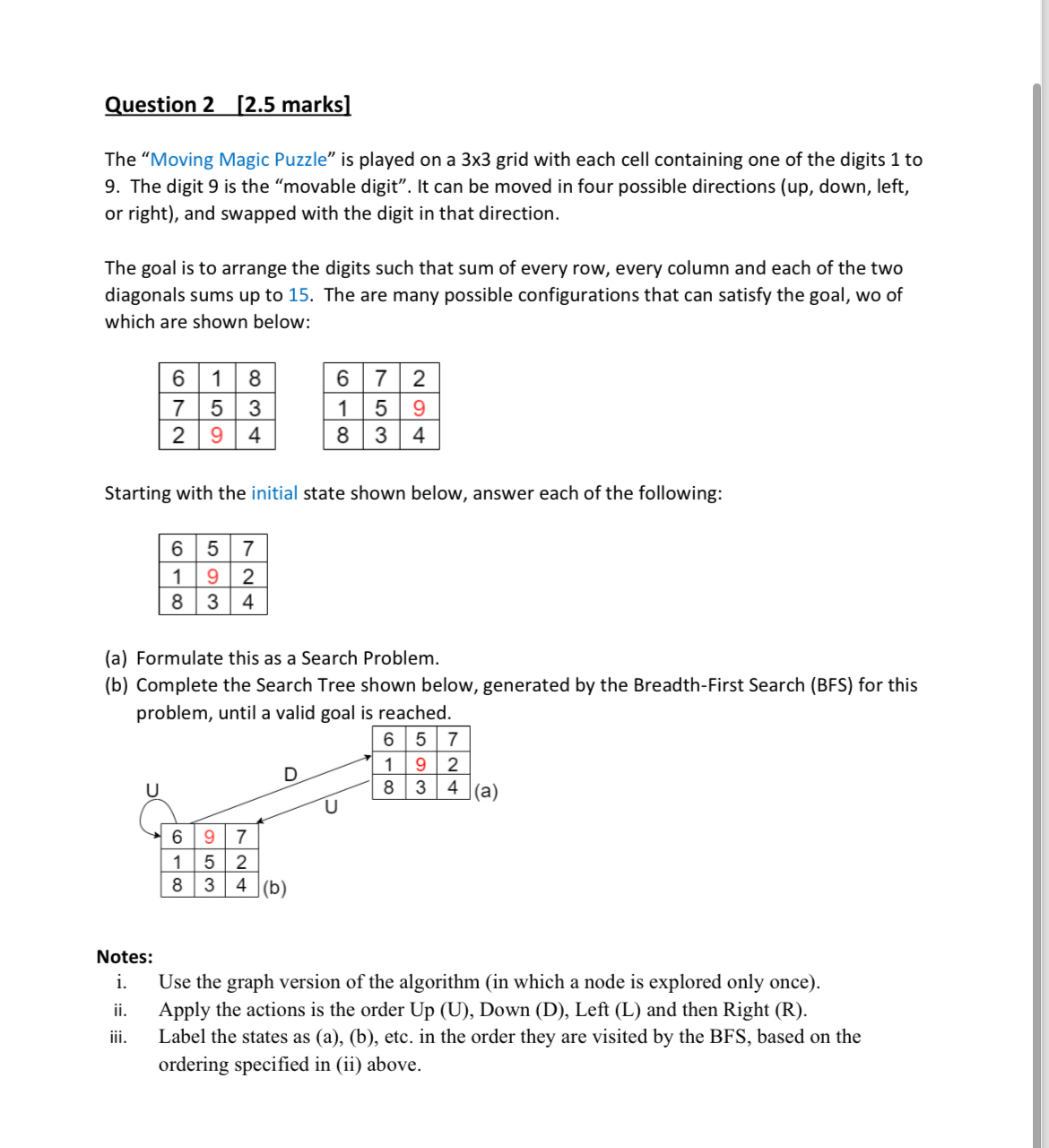
The "Moving Magic Puzzle" is played on a grid with each cell containing one of the digits to
The digit is the "movable digit". It can be moved in four possible directions up down, left,
or right and swapped with the digit in that direction.
The goal is to arrange the digits such that sum of every row, every column and each of the two
diagonals sums up to The are many possible configurations that can satisfy the goal, wo of
which are shown below:
Starting with the initial state shown below, answer each of the following:
a Formulate this as a Search Problem.
b Complete the Search Tree shown below, generated by the BreadthFirst Search BFS for this
problem, until a valid goal is reached.
Notes:
i Use the graph version of the algorithm in which a node is explored only once
ii Apply the actions is the order Up U Down D Left L and then Right R
iii. Label the states as ab etc. in the order they are visited by the BFS based on the
ordering specified in ii above.
Step by Step Solution
There are 3 Steps involved in it
1 Expert Approved Answer
Step: 1 Unlock

Question Has Been Solved by an Expert!
Get step-by-step solutions from verified subject matter experts
Step: 2 Unlock
Step: 3 Unlock
 Study Help