







Question: (Note: this problem is difficult. You must attempt it to get credit, but dont spend hours agonizing over the correct answer, if you struggle. If
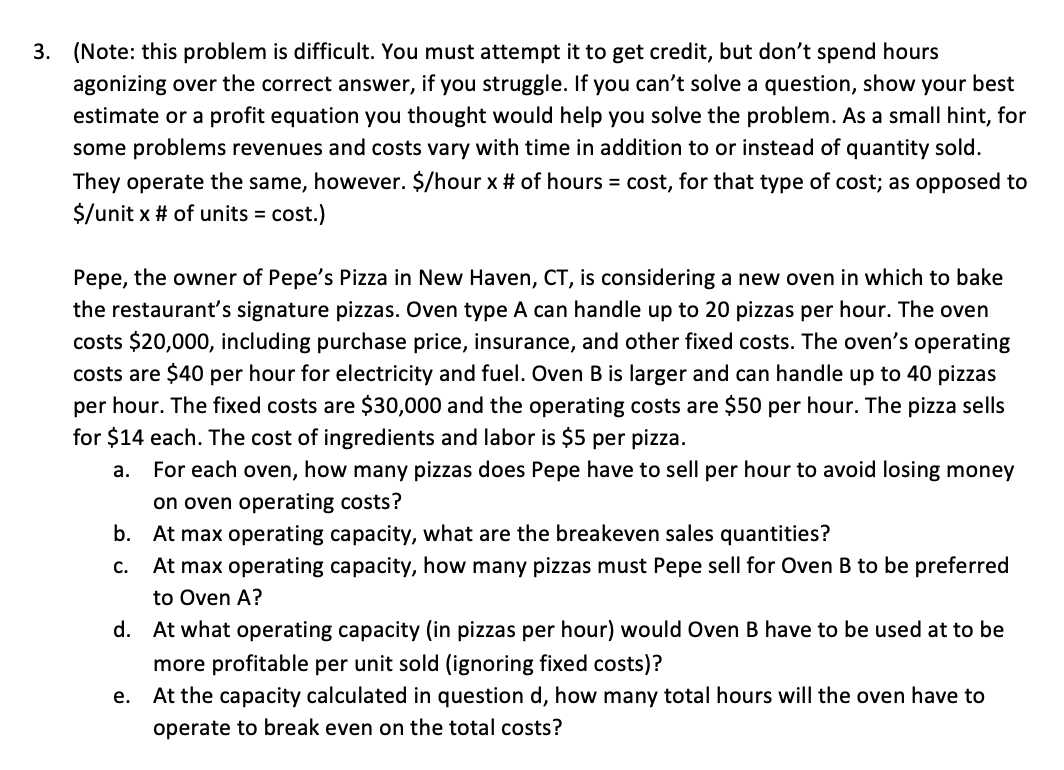
- (Note: this problem is difficult. You must attempt it to get credit, but dont spend hours agonizing over the correct answer, if you struggle. If you cant solve a question, show your best estimate or a profit equation you thought would help you solve the problem. As a small hint, for some problems revenues and costs vary with time in addition to or instead of quantity sold. They operate the same, however. $/hour x # of hours = cost, for that type of cost; as opposed to $/unit x # of units = cost.) Pepe, the owner of Pepes Pizza in New Haven, CT, is considering a new oven in which to bake the restaurants signature pizzas. Oven type A can handle up to 20 pizzas per hour. The oven costs $20,000, including purchase price, insurance, and other fixed costs. The ovens operating costs are $40 per hour for electricity and fuel. Oven B is larger and can handle up to 40 pizzas per hour. The fixed costs are $30,000 and the operating costs are $50 per hour. The pizza sells for $14 each. The cost of ingredients and labor is $5 per pizza.
- For each oven, how many pizzas does Pepe have to sell per hour to avoid losing money on oven operating costs?
- At max operating capacity, what are the breakeven sales quantities?
- At max operating capacity, how many pizzas must Pepe sell for Oven B to be preferred to Oven A?
- At what operating capacity (in pizzas per hour) would Oven B have to be used at to be more profitable per unit sold (ignoring fixed costs)?
At the capacity calculated in question d, how many total hours will the oven have to operate to break even on the total costs?
3. (Note: this problem is difficult. You must attempt it to get credit, but don't spend hours agonizing over the correct answer, if you struggle. If you can't solve a question, show your best estimate or a profit equation you thought would help you solve the problem. As a small hint, for some problems revenues and costs vary with time in addition to or instead of quantity sold. They operate the same, however. $/hour x # of hours = cost, for that type of cost; as opposed to $/unit x # of units = cost.) Pepe, the owner of Pepe's Pizza in New Haven, CT, is considering a new oven in which to bake the restaurant's signature pizzas. Oven type A can handle up to 20 pizzas per hour. The oven costs $20,000, including purchase price, insurance, and other fixed costs. The oven's operating costs are $40 per hour for electricity and fuel. Oven B is larger and can handle up to 40 pizzas per hour. The fixed costs are $30,000 and the operating costs are $50 per hour. The pizza sells for $14 each. The cost of ingredients and labor is $5 per pizza. a. For each oven, how many pizzas does Pepe have to sell per hour to avoid losing money on oven operating costs? b. At max operating capacity, what are the breakeven sales quantities? At max operating capacity, how many pizzas must Pepe sell for Oven B to be preferred to Oven A? d. At what operating capacity (in pizzas per hour) would Oven B have to be used at to be more profitable per unit sold (ignoring fixed costs)? At the capacity calculated in question d, how many total hours will the oven have to operate to break even on the total costs? C. eStep by Step Solution
There are 3 Steps involved in it
1 Expert Approved Answer
Step: 1 Unlock

Question Has Been Solved by an Expert!
Get step-by-step solutions from verified subject matter experts
Step: 2 Unlock
Step: 3 Unlock
 Study Help