







Question: Note: this week's VC valuation problems are very similar to what you did last week except for one small difference. nstead of being given the
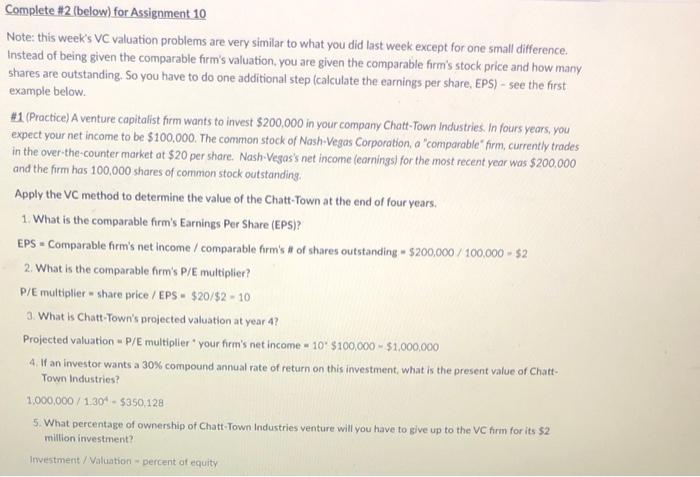
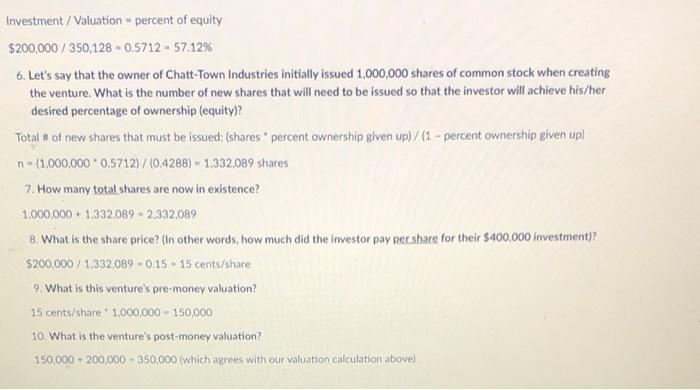
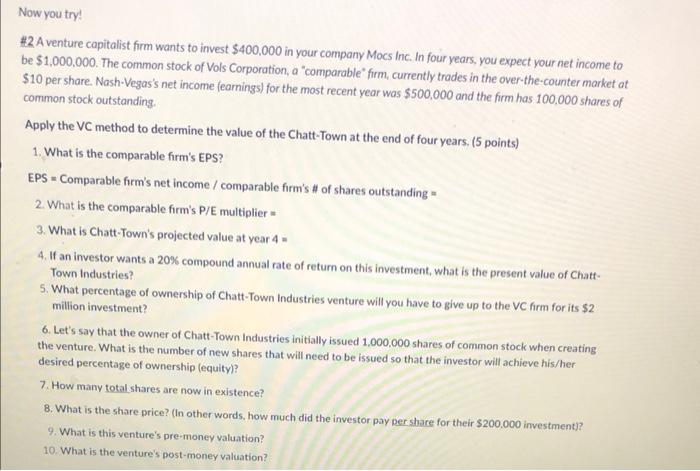
Note: this week's VC valuation problems are very similar to what you did last week except for one small difference. nstead of being given the comparable firm's valuation, you are given the comparable firm's stock price and how many shares are outstanding. So you have to do one additional step (calculate the earnings per share, EPS) - see the first example below. \#1 (Practice) A venture capitalist firm wants to invest $200,000 in your company Chatt-Town Industries. In fours years, you expect your net income to be $100,000. The common stock of Nash-Vegas Corporation, a "comparable" firm, currently trades in the over-the-counter market at $20 per share. Nash-Vesas's net income (earnings) for the most recent year was $200,000 and the firm has 100,000 shares of common stock outstanding. Apply the VC method to determine the value of the Chatt-Town at the end of four years. 1. What is the comparable firm's Earnings Per Share (EPS)? EPS = Comparable firm's net income / comparable firm's A of shares outstanding =$200,000/100,000=$2 2. What is the comparable firm's P/E multiplier? P/E multiplier = share price /EPS=$20/$2=10 3. What is Chatt-Town's projected valuation at year 4 ? Projected valuation = P/ multiplier your firm's net income =10$100,000=$1,000,000 4. If an investor wants a 30% compound annual rate of return on this investment, what is the present value of ChattTown Industries? 1,000,000/1.304=5350,128 5. What percentage of ownership of Chatt-Town Industries venture will you have to give up to the VC furm for its $2 million investment? Investment / Valuation - percent of equity $200,000/350,128=0.5712=57.12% 6. Let's say that the owner of Chatt-Town Industries initially issued 1,000,000 shares of common stock when creating the venture. What is the number of new shares that will need to be issued so that the investor will achieve his/her desired percentage of ownership (equity)? Total \# of new shares that must be issued: (shares " percent ownership given up) / ( 1 - percent ownership given up) n=(1,000.0000.5712)/(0.4288)=1.332.089 shares 7. How many total shares are now in existence? 1,000,000+1,332,089=2,332,089 8. What is the share price? (In other words, how much did the investor pay per share for their $400,000 investment)? $200.000/1,332,089=0.1515 cents/share 9. What is this venture's pre-money valuation? 15 cents/share 1.000,000=150,000 10. What is the venture's post-money valuation? 150.000+200.000350.000 (which agrees with our valuation calculation above) \#2 A venture capitalist firm wants to invest $400,000 in your company Mocs Inc. In four years, you expect your net income to be $1,000.000. The common stock of Vols Corporation, a "comparable" firm, currently trades in the over-the.counter market at $10 per share. Nash-Vegas's net income (earnings) for the most recent year was $500,000 and the firm has 100,000 shares of common stock outstanding. Apply the VC method to determine the value of the Chatt-Town at the end of four years. ( 5 points) 1. What is the comparable firm's EPS? EPS = Comparable firm's net income / comparable firm's \# of shares outstanding = 2. What is the comparable firm's P/E multiplier = 3. What is Chatt-Town's projected value at year 4= 4. If an investor wants a 20% compound annual rate of return on this investment, what is the present value of ChattTown Industries? 5. What percentage of ownership of Chatt-Town Industries venture will you have to give up to the VC firm for its $2 million investment? 6. Let's say that the owner of Chatt-Town Industries initially issued 1,000,000 shares of common stock when creating the venture. What is the number of new shares that will need to be issued so that the investor will achieve his/her desired percentage of ownership (equity)? 7. How many total shares are now in existence? 8. What is the share price? (In other words, how much did the investor pay per share for their $200.000 investment)? 9. What is this venture's pre-money valuation? 10. What is the venture's post-money valuation
Step by Step Solution
There are 3 Steps involved in it

Get step-by-step solutions from verified subject matter experts
 Study Help