







Question: Notes : Type I error means rejecting the null hypothesis when it's actually true, while a Type II error means failing to reject the null
Notes :
Type I error means rejecting the null hypothesis when it's actually true, while a Type II error means failing to reject the null hypothesis when it's actually false. ... This means that your results only have a 5% chance of occurring, or less, if the null hypothesis is actually true.
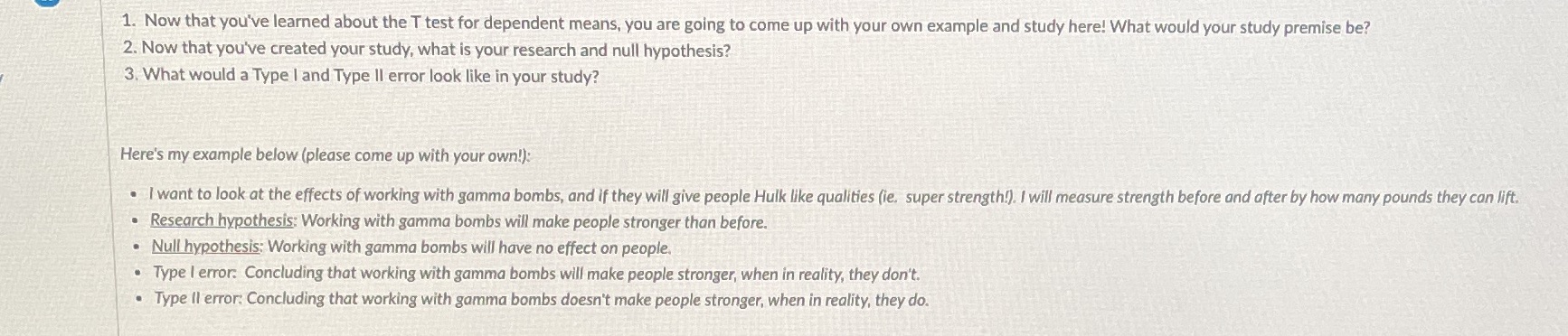
1. Now that you've learned about the T test for dependent means, you are going to come up with your own example and study here! What would your study premise be? 2. Now that you've created your study, what is your research and null hypothesis? 3. What would a Type I and Type II error look like in your study? Here's my example below (please come up with your own!): . I want to look at the effects of working with gamma bombs, and if they will give people Hulk like qualities (ie. super strength!). I will measure strength before and after by how many pounds they can lift. . Research hypothesis: Working with gamma bombs will make people stronger than before. . Null hypothesis: Working with gamma bombs will have no effect on people. . Type | error. Concluding that working with gamma bombs will make people stronger, when in reality, they don't. . Type II error: Concluding that working with gamma bombs doesn't make people stronger, when in reality, they do
Step by Step Solution
There are 3 Steps involved in it

Get step-by-step solutions from verified subject matter experts
 Study Help