



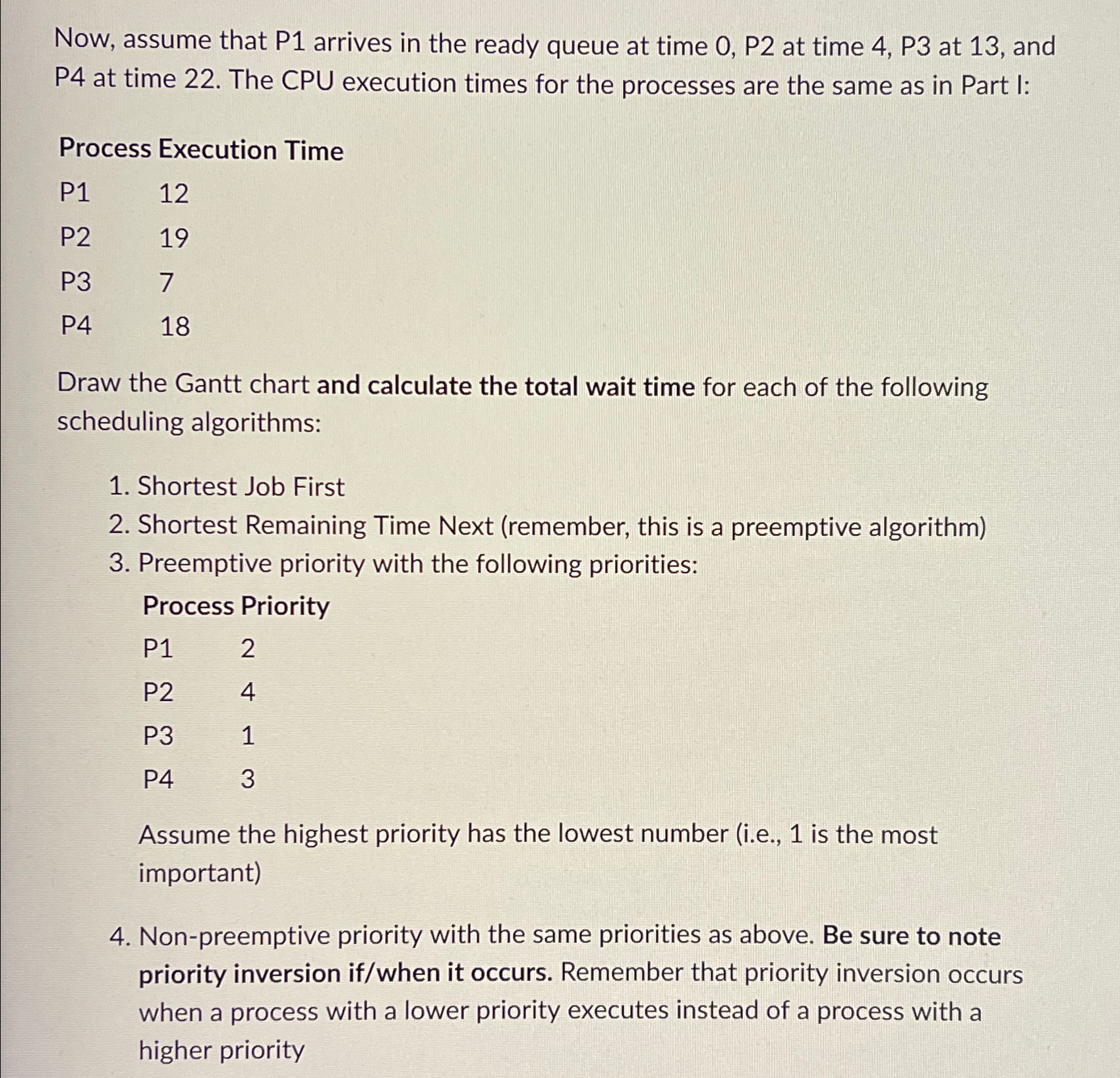
Question: Now, assume that P 1 arrives in the ready queue at time 0 , P 2 at time 4 , P 3 at 1 3
Now, assume that P arrives in the ready queue at time at time at and P at time The CPU execution times for the processes are the same as in Part I:
Process Execution Time
tablePPPP
Draw the Gantt chart and calculate the total wait time for each of the following scheduling algorithms:
Shortest Job First
Shortest Remaining Time Next remember this is a preemptive algorithm
Preemptive priority with the following priorities:
Process Priority
tablePPPP
Assume the highest priority has the lowest number ie is the most important
Nonpreemptive priority with the same priorities as above. Be sure to note priority inversion ifwhen it occurs. Remember that priority inversion occurs when a process with a lower priority executes instead of a process with a higher priority
Step by Step Solution
There are 3 Steps involved in it
1 Expert Approved Answer
Step: 1 Unlock

Question Has Been Solved by an Expert!
Get step-by-step solutions from verified subject matter experts
Step: 2 Unlock
Step: 3 Unlock