


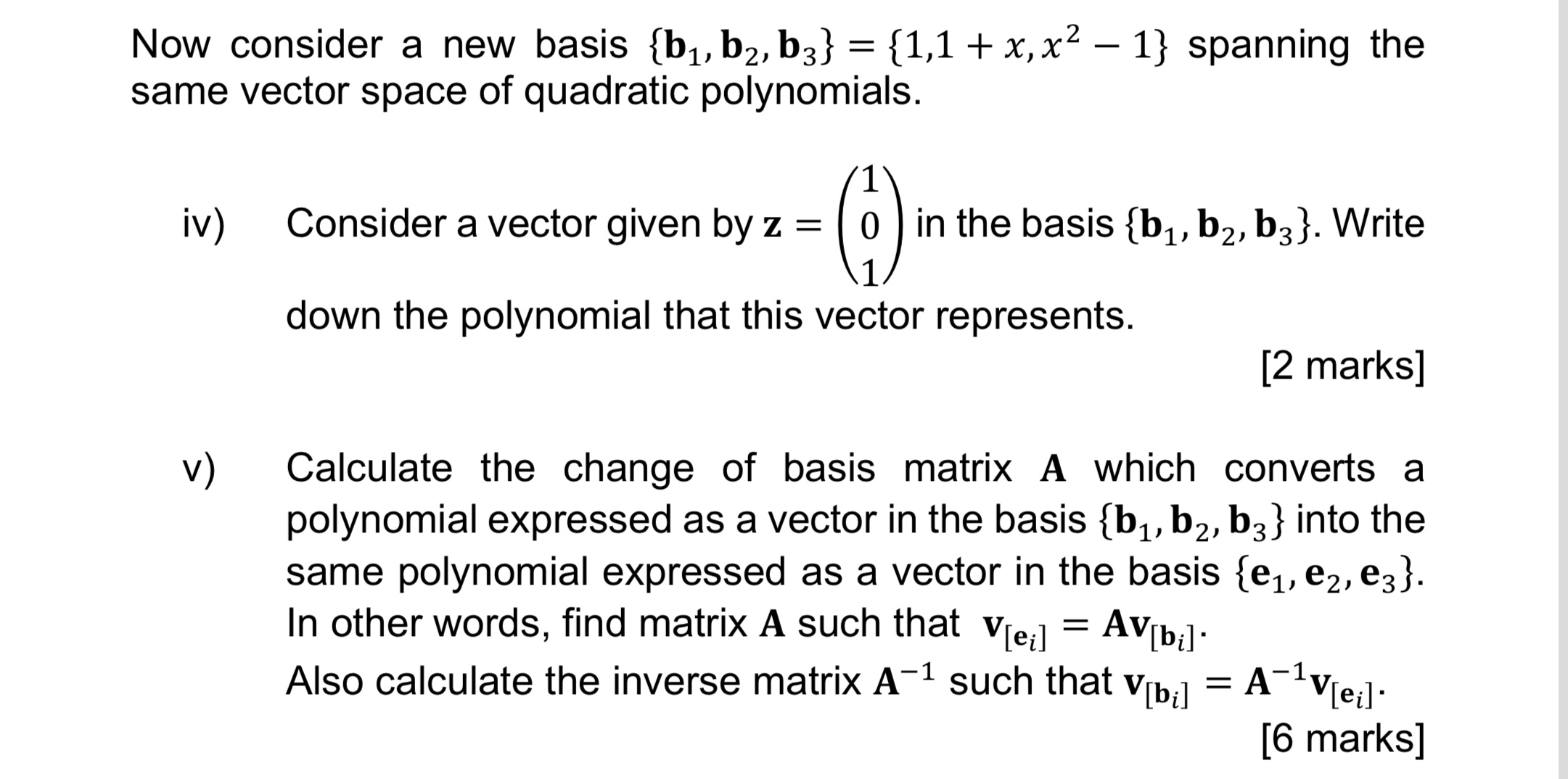
Question: Now consider a new basis {b1,b2,b3} = {1,1 +x,x2 1} spanning the same vector space of quadratic polynomials. iv) 1 Consider a vector given by
Now consider a new basis {b1,b2,b3} = {1,1 +x,x2Now consider a new basis {b1,b2,b3} = {1,1 +x,x2
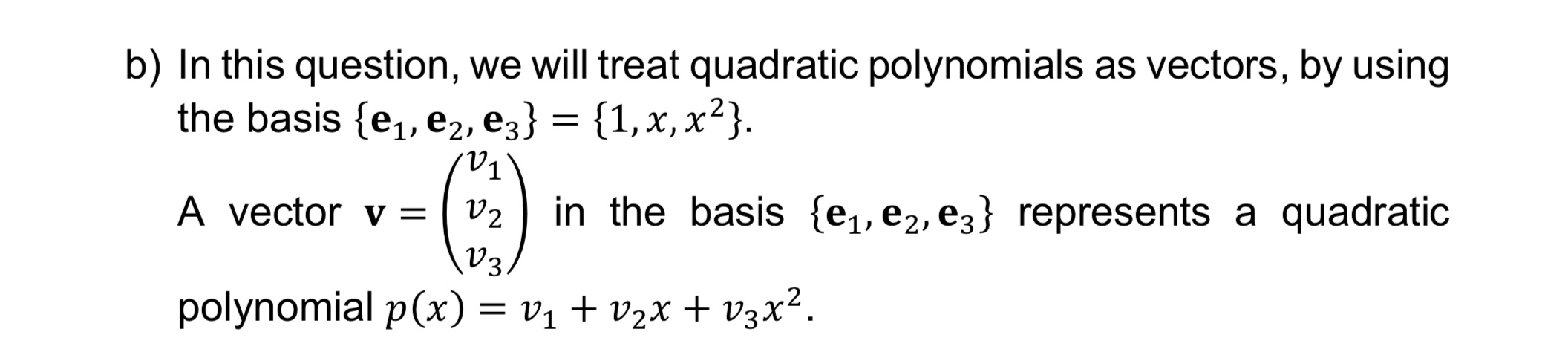
Now consider a new basis {b1,b2,b3} = {1,1 +x,x2 1} spanning the same vector space of quadratic polynomials. iv) 1 Consider a vector given by z = (0) in the basis {b1, b2, b3}. Write 1 down the polynomial that this vector represents. [2 marks] Calculate the change of basis matrix A which converts a polynomial expressed as a vector in the basis {b1,b2, b3} into the same polynomial expressed as a vector in the basis {e1,e2,e3}. In other words, find matrix A such that v[ei] = Av[bi]. Also calculate the inverse matrix A'1 such that v[bi] = A'1v[ei]. [6 marks] b) In this question, we will treat quadratic polynomials as vectors, by using the basis {e1, e2, e3} = {1,x,x2}. 171 A vector v = (192) in the basis {e1,e2,e3} represents a quadratic v3 polynomial 1900 = 171 + vzx + V3x2

Step by Step Solution

There are 3 Steps involved in it

1 Expert Approved Answer
Step: 1 Unlock blur-text-image

Question Has Been Solved by an Expert!

Get step-by-step solutions from verified subject matter experts

Step: 2 Unlock
Step: 3 Unlock

Students Have Also Explored These Related Mathematics Questions!