



Question: Now here is my case and after reading the case, then answer should be given. supporting, and who are they funded by? 5. Should the

Now here is my case and after reading the case, then answer should be given.
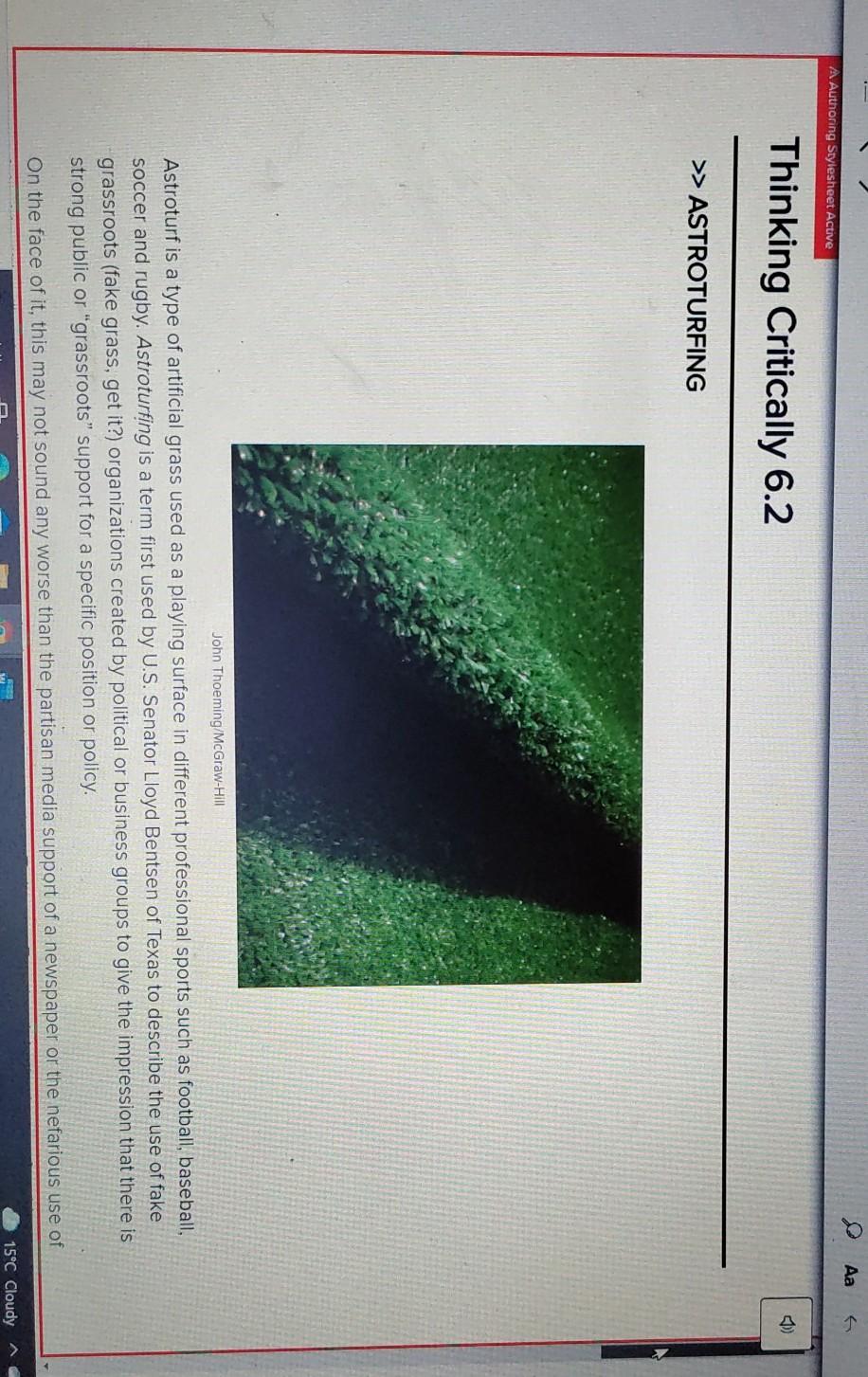
supporting, and who are they funded by? 5. Should the government get involved with some form of regulation or permit program to establish the legitimacy of these organizations? Why or why not? If you Aa A Authoring Stylesheet Active Thinking Critically 6.2 >> ASTROTURFING John Thoeming/McGraw-Hill Astroturf is a type of artificial grass used as a playing surface in different professional sports such as football, baseball, soccer and rugby. Astroturfing is a term first used by U.S. Senator Lloyd Bentsen of Texas to describe the use of fake grassroots (fake grass, get it?) organizations created by political or business groups to give the impression that there is strong public or "grassroots" support for a specific position or policy. On the face of it, this may not sound any worse than the partisan media support of a newspaper or the nefarious use of 15C Cloudy A On the face of it, this may not sound any worse than the partisan media support of a newspaper or the nefarious use of fake identities ("sockpuppets") or bots to aggressively promote content on Twitter or Facebook in the hope of making a message go viral. The reality is much more toxic. The greater the perceived presence of a message, the greater the likelihood that the general public or target audience of the astroturfing campaign will believe that the position being promoted is the commonly held one. Many critics attribute Donald Trump's surprise win in the 2016 US Presidential election to the activities of Russian hackers promoting anti-Hillary Clinton messages and memes and creating the impression that there was a groundswell of support for Trump. Public relations firms have been quick to recognize the opportunity, and now there are multiple companies that specialize in such campaigns for any client that can afford their fees. Page 128 Fake Patriotism . . In recent years, astroturfing has taken an even more cynical turn by incorporating patriotic themes in the naming of their astroturf organizations. Consider the following examples: North Texans for Natural Gas-funded by a group of pro-fracking Texas energy companies. The Alliance of Australian Retailers-created by tobacco company Philip Morris to campaign against repackaging cigarettes with health warnings. Working Families for Walmart-a pro-Walmart blog created by the public relations firm Edelman, of which Walmart was a client. National Wetlands Coalition-works on behalf of oil companies and real estate developers. American Council on Science and Health-challenges new science reporting on behalf of fracking companies, soda companies, chemical manufacturers and even e-cigarette manufacturers. Americans Against Food Taxes-represented the food and beverage industry in its campaign against a soda tax. Citizens for Fire Safety-protested the removal of fire-retardant chemicals that had been linked to cancer on behalf of the three largest fire retardant manufacturers in the world 15C Cloudy . DU-511864 180453480389d5dabbeaceedd4 !!! 6 Fake Crowds Where a strong physical presence is needed to validate the perception that a specific campaign represents the commonly held belief, astroturfers have that problem covered too. They simply hire paid actors or extras to show up at city council meetings to loudly oppose votes on new legislation or to disrupt open hearings with carefully scripted comments. A company called Crowds on Demand (COD) (www.crowdsondemand.com) proudly portrays itself as "Your home for protests, rallies, advocacy, audiences, PR stunts and political events. Services available nationwide." In 2017, Entergy, a Louisiana-based electricity production and distribution company, contracted with PR firm The Hawthorne Group "to assist with organizing local grassroots support. The contract specified that 75 supporters would show up at one meeting, and 30 at another. Hawthorne hired Crowds on Demand (COD) to deliver those protesters to actively support a proposed bill for a new power plant. CoD even included specific talking points for those "protesters" to use if they were able to get in front of a microphone. When the involvement of Hawthorne and CoD was revealed, Entergy claimed that they knew nothing about the contract with COD, telling an NPR reporter that the company does not normally pay firms to turn out supporters: "However, in this case, we contracted with a firm we believed would act ethically and honestly in that effort, based on their national reputation and our prior experience with them." Toxic Cynicism Watching an Entergy spokesperson scramble to establish plausible denlability about the unethical practice of hiring fake crowds may be entertaining, but there is a much deeper problem here. Skepticism about the true motives of protesters and previously unheard-of campaign organizations can be healthy, but at some point, that skepticism will turn into jaded cynicism, which represents a very serious threat to public discourse. How will the real grassroots organizations with real grassroots support and genuine protesters convince people that they are the real deal? QUESTIONS supporting, and who are they funded by? 5. Should the government get involved with some form of regulation or permit program to establish the legitimacy of these organizations? Why or why not? If you Aa A Authoring Stylesheet Active Thinking Critically 6.2 >> ASTROTURFING John Thoeming/McGraw-Hill Astroturf is a type of artificial grass used as a playing surface in different professional sports such as football, baseball, soccer and rugby. Astroturfing is a term first used by U.S. Senator Lloyd Bentsen of Texas to describe the use of fake grassroots (fake grass, get it?) organizations created by political or business groups to give the impression that there is strong public or "grassroots" support for a specific position or policy. On the face of it, this may not sound any worse than the partisan media support of a newspaper or the nefarious use of 15C Cloudy A On the face of it, this may not sound any worse than the partisan media support of a newspaper or the nefarious use of fake identities ("sockpuppets") or bots to aggressively promote content on Twitter or Facebook in the hope of making a message go viral. The reality is much more toxic. The greater the perceived presence of a message, the greater the likelihood that the general public or target audience of the astroturfing campaign will believe that the position being promoted is the commonly held one. Many critics attribute Donald Trump's surprise win in the 2016 US Presidential election to the activities of Russian hackers promoting anti-Hillary Clinton messages and memes and creating the impression that there was a groundswell of support for Trump. Public relations firms have been quick to recognize the opportunity, and now there are multiple companies that specialize in such campaigns for any client that can afford their fees. Page 128 Fake Patriotism . . In recent years, astroturfing has taken an even more cynical turn by incorporating patriotic themes in the naming of their astroturf organizations. Consider the following examples: North Texans for Natural Gas-funded by a group of pro-fracking Texas energy companies. The Alliance of Australian Retailers-created by tobacco company Philip Morris to campaign against repackaging cigarettes with health warnings. Working Families for Walmart-a pro-Walmart blog created by the public relations firm Edelman, of which Walmart was a client. National Wetlands Coalition-works on behalf of oil companies and real estate developers. American Council on Science and Health-challenges new science reporting on behalf of fracking companies, soda companies, chemical manufacturers and even e-cigarette manufacturers. Americans Against Food Taxes-represented the food and beverage industry in its campaign against a soda tax. Citizens for Fire Safety-protested the removal of fire-retardant chemicals that had been linked to cancer on behalf of the three largest fire retardant manufacturers in the world 15C Cloudy . DU-511864 180453480389d5dabbeaceedd4 !!! 6 Fake Crowds Where a strong physical presence is needed to validate the perception that a specific campaign represents the commonly held belief, astroturfers have that problem covered too. They simply hire paid actors or extras to show up at city council meetings to loudly oppose votes on new legislation or to disrupt open hearings with carefully scripted comments. A company called Crowds on Demand (COD) (www.crowdsondemand.com) proudly portrays itself as "Your home for protests, rallies, advocacy, audiences, PR stunts and political events. Services available nationwide." In 2017, Entergy, a Louisiana-based electricity production and distribution company, contracted with PR firm The Hawthorne Group "to assist with organizing local grassroots support. The contract specified that 75 supporters would show up at one meeting, and 30 at another. Hawthorne hired Crowds on Demand (COD) to deliver those protesters to actively support a proposed bill for a new power plant. CoD even included specific talking points for those "protesters" to use if they were able to get in front of a microphone. When the involvement of Hawthorne and CoD was revealed, Entergy claimed that they knew nothing about the contract with COD, telling an NPR reporter that the company does not normally pay firms to turn out supporters: "However, in this case, we contracted with a firm we believed would act ethically and honestly in that effort, based on their national reputation and our prior experience with them." Toxic Cynicism Watching an Entergy spokesperson scramble to establish plausible denlability about the unethical practice of hiring fake crowds may be entertaining, but there is a much deeper problem here. Skepticism about the true motives of protesters and previously unheard-of campaign organizations can be healthy, but at some point, that skepticism will turn into jaded cynicism, which represents a very serious threat to public discourse. How will the real grassroots organizations with real grassroots support and genuine protesters convince people that they are the real deal? QUESTIONS
Step by Step Solution
There are 3 Steps involved in it
1 Expert Approved Answer
Step: 1 Unlock

Question Has Been Solved by an Expert!
Get step-by-step solutions from verified subject matter experts
Step: 2 Unlock
Step: 3 Unlock