







Question: Now, let's use Calculus to solve: Notice that the quantity to be maximized is the s, and its equation is s = 144t - 16.0t
Now, let's use Calculus to solve:
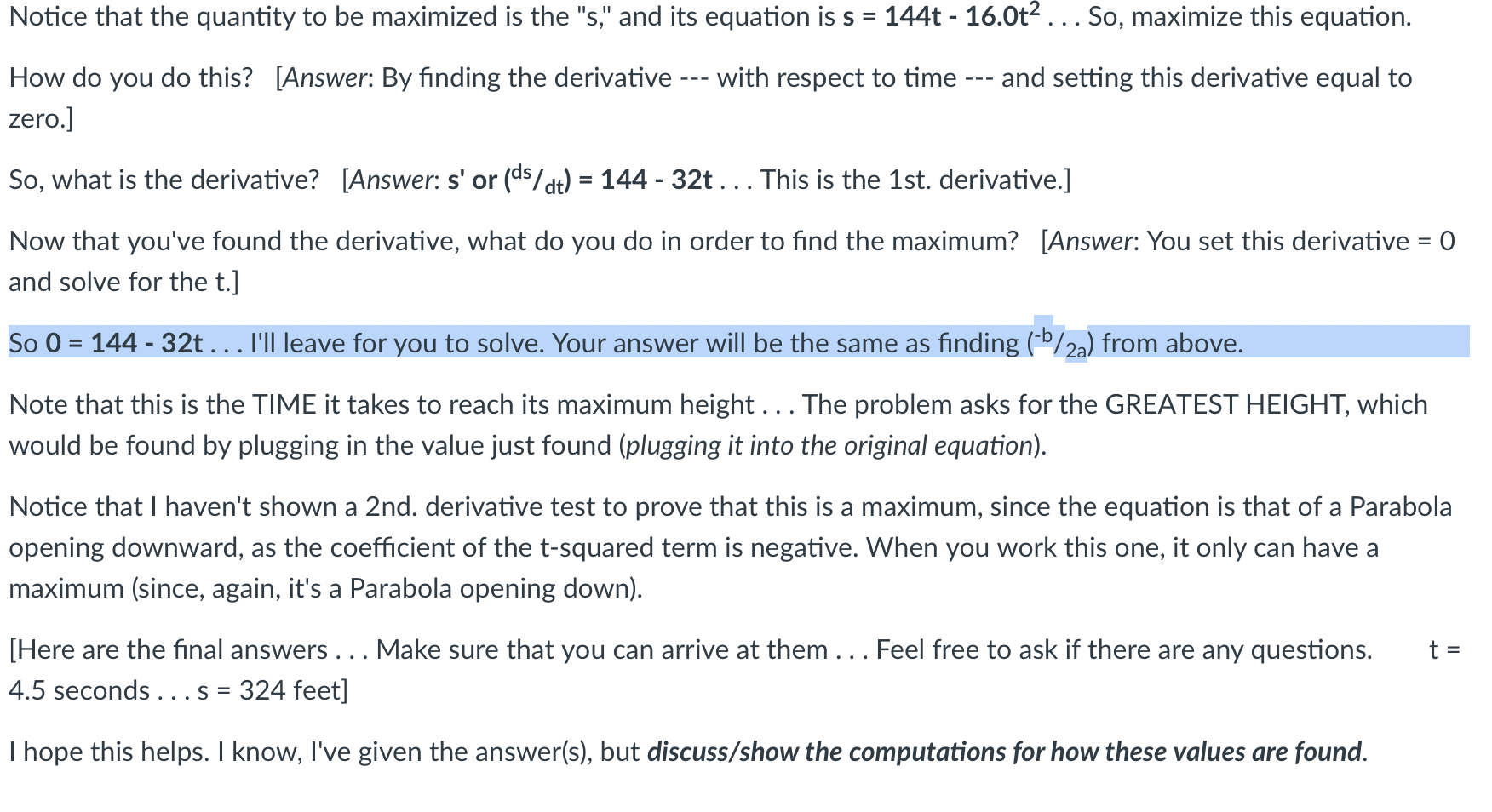
Notice that the quantity to be maximized is the "s," and its equation is s = 144t - 16.0t .. . So, maximize this equation. How do you do this? [Answer: By finding the derivative --- with respect to time --- and setting this derivative equal to zero.] So, what is the derivative? [Answer: s' or (s/ at) = 144 - 32t . .. This is the 1st. derivative.] Now that you've found the derivative, what do you do in order to find the maximum? [Answer: You set this derivative = 0 and solve for the t.] So 0 = 144 - 32t . . . I'll leave for you to solve. Your answer will be the same as finding (/2a) from above. Note that this is the TIME it takes to reach its maximum height . . . The problem asks for the GREATEST HEIGHT, which would be found by plugging in the value just found (plugging it into the original equation). Notice that I haven't shown a 2nd. derivative test to prove that this is a maximum, since the equation is that of a Parabola opening downward, as the coefficient of the t-squared term is negative. When you work this one, it only can have a maximum (since, again, it's a Parabola opening down). [Here are the final answers . . . Make sure that you can arrive at them . . . Feel free to ask if there are any questions. t = 4.5 seconds .. . s = 324 feet] I hope this helps. I know, I've given the answer(s), but discuss/show the computations for how these values are found
Step by Step Solution
There are 3 Steps involved in it

Get step-by-step solutions from verified subject matter experts
 Study Help