Question: Now, review Module 10. For this homework assignment, the topic, approach, and format are up to you. It is intended to be a creative thinking
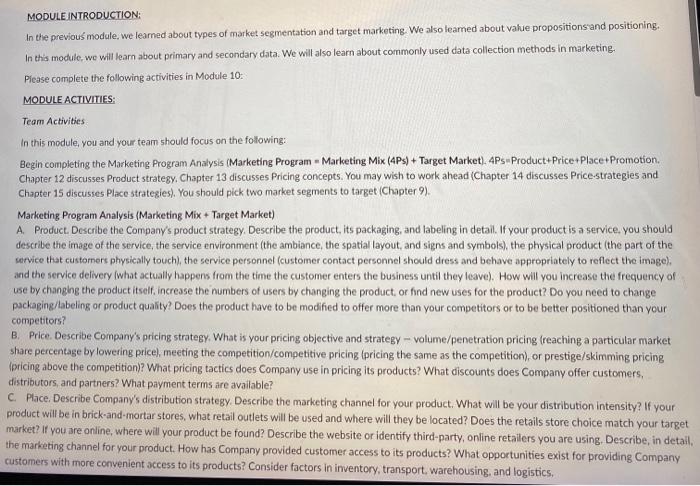
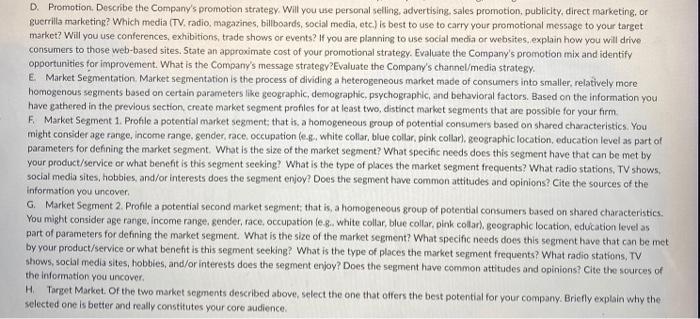
Now, review Module 10. For this homework assignment, the topic, approach, and format are up to you. It is intended to be a creative thinking assignment that gives you the freedom to respond in a way that is interesting, relevant, and compelling. You should synthesize the content introduced in the module with the video you just watched. Using your insight experience, and understanding of the course content, teach me something. You can submit a written or video response. Written responses should be 2-3 pages (typed, double-spaced, 12-point, Times New Roman, 1" margins). Video responses should be 2-3 minutes, MODULE INTRODUCTION: In the previous module, we learned about types of market segmentation and target marketing. We also leamed about value propositions and positioning. In this module, we will learn about primary and secondary data. We will also learn about commonly used data collection methods in marketing Please complete the following activities in Module 10 MODULE ACTIVITIES: Team Activities In this module, you and your team should focus on the following: Begin completing the Marketing Program Analysis (Marketing Program Marketing Mix (4Ps) + Target Market). 4Ps Product Price+Place+Promotion Chapter 12 discusses Product strategy. Chapter 13 discusses Pricing concepts. You may wish to work ahead (Chapter 14 discusses Price-strategies and Chapter 15 discusses Place strategies). You should pick two market segments to target (Chapter 9). Marketing Program Analysis (Marketing Mix + Target Market) A Product Describe the Company's product strategy. Describe the product, its packaging, and labeling in detail. If your product is a service, you should describe the image of the service, the service environment (the ambiance, the spatial layout, and signs and symbols) the physical product (the part of the service that customers physically touch, the service personnel (customer contact personnel should dress and behave appropriately to reflect the image), and the service delivery (what actually happens from the time the customer enters the business until they leave). How will you increase the frequency of use by changing the product itself, increase the numbers of users by changing the product, or find new uses for the product? Do you need to change packaging/labeling or product quality? Does the product have to be modified to offer more than your competitors or to be better positioned than your competitors? B. Price. Describe company's pricing strategy. What is your pricing objective and strategy - volume/penetration pricing (reaching a particular market share percentage by lowering price), meeting the competition/competitive pricing (pricing the same as the competition), or prestige/skimming pricing (pricing above the competition)? What pricing tactics does Company use in pricing its products? What discounts does Company offer customers, distributors and partners? What payment terms are available? C. Place. Describe Company's distribution strategy. Describe the marketing channel for your product. What will be your distribution intensity? If your product will be in brick-and-mortar stores, what retail outlets will be used and where will they be located? Does the retails store choice match your target market? If you are online, where will your product be found? Describe the website or identify third-party, online retailers you are using. Describe, in detail the marketing channel for your product. How has Company provided customer access to its products? What opportunities exist for providing Company customers with more convenient access to its products? Consider factors in inventory, transport, warehousing, and logistics. D. Promotion, Describe the Company's promotion strategy. Will you use personal selling, advertising, sales promotion, publicity, direct marketing, or guerrilla marketing? Which media (TV, radio, magazines, billboards, social media, etc.) is best to use to carry your promotional message to your target market? Will you use conferences, exhibitions, trade shows or events? If you are planning to use social media or websites, explain how you will drive consumers to those web-based sites. State an approximate cost of your promotional strategy. Evaluate the Company's promotion mix and identify opportunities for improvement. What is the Company's message strategy?Evaluate the Company's channel/media strategy. E Market Segmentation Market segmentation is the process of dividing a heterogeneous market made of consumers into smaller, relatively more homogenous segments based on certain parameters like geographic, demographic, psychographic, and behavioral factors. Based on the information you have gathered in the previous section, create market segment profiles for at least two, clistinct market segments that are possible for your form Market Segment 1. Profile a potential market segment; that is, a homogeneous group of potential consumers based on shared characteristics. You might consider age range, income range, gender, race occupation (eg, white collar, blue collar, pink collar), geographic location, education level as part of parameters for defining the market segment What is the size of the market segment? What specific needs does this segment have that can be met tyy your product/service or what benefit is this segment seeking? What is the type of places the market segment frequents? What radio stations. TV shows, social media sites, hobbies, and/or interests does the segment enjoy? Does the segment have common attitudes and opinions? Cite the sources of the Information you uncover G Market Segment 2. Profle a potential second market segment that is, a homogeneous group of potential consumers based on shared characteristics. You might consider age range, Income range, gender, race, occupation le 8., white collar, blue collar, pink collar) geographic location, education level as part of parameters for defining the market segment. What is the size of the market segment? What specific needs does this segment have that can be met by your product/service or what benefit is this segment seeking? What is the type of places the market segment frequents? What radio stations, TV shows, social media sites, hobbles, and/or interests does the segment enjoy? Does the segment have common attitudes and opinions? Cite the sources of the information you uncover Target Market. Of the two market sepments described above select the one that offers the best potential for your company. Briefly explain why the selected one is better and really constitutes your core audience. . Now, review Module 10. For this homework assignment, the topic, approach, and format are up to you. It is intended to be a creative thinking assignment that gives you the freedom to respond in a way that is interesting, relevant, and compelling. You should synthesize the content introduced in the module with the video you just watched. Using your insight experience, and understanding of the course content, teach me something. You can submit a written or video response. Written responses should be 2-3 pages (typed, double-spaced, 12-point, Times New Roman, 1" margins). Video responses should be 2-3 minutes, MODULE INTRODUCTION: In the previous module, we learned about types of market segmentation and target marketing. We also leamed about value propositions and positioning. In this module, we will learn about primary and secondary data. We will also learn about commonly used data collection methods in marketing Please complete the following activities in Module 10 MODULE ACTIVITIES: Team Activities In this module, you and your team should focus on the following: Begin completing the Marketing Program Analysis (Marketing Program Marketing Mix (4Ps) + Target Market). 4Ps Product Price+Place+Promotion Chapter 12 discusses Product strategy. Chapter 13 discusses Pricing concepts. You may wish to work ahead (Chapter 14 discusses Price-strategies and Chapter 15 discusses Place strategies). You should pick two market segments to target (Chapter 9). Marketing Program Analysis (Marketing Mix + Target Market) A Product Describe the Company's product strategy. Describe the product, its packaging, and labeling in detail. If your product is a service, you should describe the image of the service, the service environment (the ambiance, the spatial layout, and signs and symbols) the physical product (the part of the service that customers physically touch, the service personnel (customer contact personnel should dress and behave appropriately to reflect the image), and the service delivery (what actually happens from the time the customer enters the business until they leave). How will you increase the frequency of use by changing the product itself, increase the numbers of users by changing the product, or find new uses for the product? Do you need to change packaging/labeling or product quality? Does the product have to be modified to offer more than your competitors or to be better positioned than your competitors? B. Price. Describe company's pricing strategy. What is your pricing objective and strategy - volume/penetration pricing (reaching a particular market share percentage by lowering price), meeting the competition/competitive pricing (pricing the same as the competition), or prestige/skimming pricing (pricing above the competition)? What pricing tactics does Company use in pricing its products? What discounts does Company offer customers, distributors and partners? What payment terms are available? C. Place. Describe Company's distribution strategy. Describe the marketing channel for your product. What will be your distribution intensity? If your product will be in brick-and-mortar stores, what retail outlets will be used and where will they be located? Does the retails store choice match your target market? If you are online, where will your product be found? Describe the website or identify third-party, online retailers you are using. Describe, in detail the marketing channel for your product. How has Company provided customer access to its products? What opportunities exist for providing Company customers with more convenient access to its products? Consider factors in inventory, transport, warehousing, and logistics. D. Promotion, Describe the Company's promotion strategy. Will you use personal selling, advertising, sales promotion, publicity, direct marketing, or guerrilla marketing? Which media (TV, radio, magazines, billboards, social media, etc.) is best to use to carry your promotional message to your target market? Will you use conferences, exhibitions, trade shows or events? If you are planning to use social media or websites, explain how you will drive consumers to those web-based sites. State an approximate cost of your promotional strategy. Evaluate the Company's promotion mix and identify opportunities for improvement. What is the Company's message strategy?Evaluate the Company's channel/media strategy. E Market Segmentation Market segmentation is the process of dividing a heterogeneous market made of consumers into smaller, relatively more homogenous segments based on certain parameters like geographic, demographic, psychographic, and behavioral factors. Based on the information you have gathered in the previous section, create market segment profiles for at least two, clistinct market segments that are possible for your form Market Segment 1. Profile a potential market segment; that is, a homogeneous group of potential consumers based on shared characteristics. You might consider age range, income range, gender, race occupation (eg, white collar, blue collar, pink collar), geographic location, education level as part of parameters for defining the market segment What is the size of the market segment? What specific needs does this segment have that can be met tyy your product/service or what benefit is this segment seeking? What is the type of places the market segment frequents? What radio stations. TV shows, social media sites, hobbies, and/or interests does the segment enjoy? Does the segment have common attitudes and opinions? Cite the sources of the Information you uncover G Market Segment 2. Profle a potential second market segment that is, a homogeneous group of potential consumers based on shared characteristics. You might consider age range, Income range, gender, race, occupation le 8., white collar, blue collar, pink collar) geographic location, education level as part of parameters for defining the market segment. What is the size of the market segment? What specific needs does this segment have that can be met by your product/service or what benefit is this segment seeking? What is the type of places the market segment frequents? What radio stations, TV shows, social media sites, hobbles, and/or interests does the segment enjoy? Does the segment have common attitudes and opinions? Cite the sources of the information you uncover Target Market. Of the two market sepments described above select the one that offers the best potential for your company. Briefly explain why the selected one is better and really constitutes your core audience.










 Study Help