







Question: nts The information will be used for the first five questions. You, as an investor, are comparing two bonds: a corporate and a municipal. They
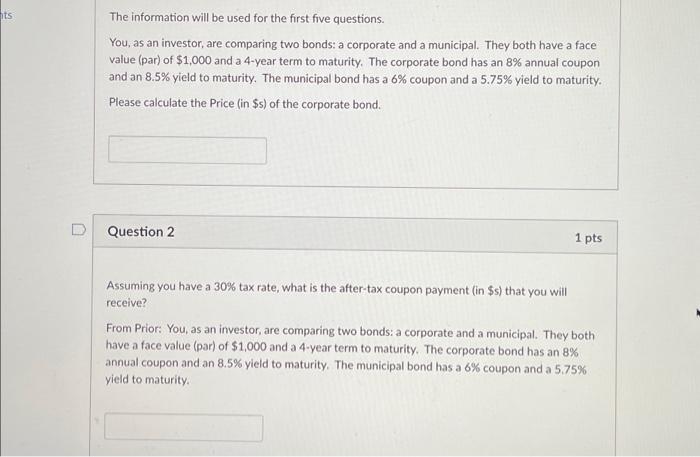
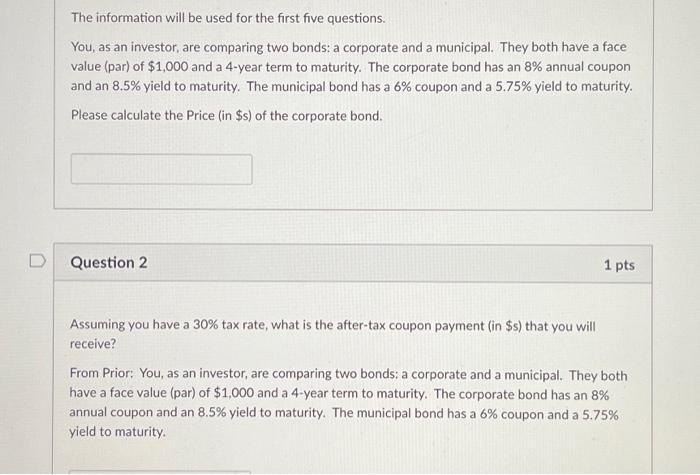
The information will be used for the first five questions. You, as an investor, are comparing two bonds: a corporate and a municipal. They both have a face value (par) of $1,000 and a 4 -year term to maturity. The corporate bond has an 8% annual coupon and an 8.5% yield to maturity. The municipal bond has a 6% coupon and a 5.75% yield to maturity. Please calculate the Price (in \$s) of the corporate bond. Question 2 1 pts Assuming you have a 30% tax rate, what is the after-tax coupon payment (in \$s) that you will receive? From Prior: You, as an investor, are comparing two bonds: a corporate and a municipal. They both have a face value (par) of $1,000 and a 4 -year term to maturity. The corporate bond has an 8% annual coupon and an 8.5% yield to maturity. The municipal bond has a 6% coupon and a 5.75% yield to maturity. The information will be used for the first five questions. You, as an investor, are comparing two bonds: a corporate and a municipal. They both have a face value (par) of $1,000 and a 4 -year term to maturity. The corporate bond has an 8% annual coupon and an 8.5% yield to maturity. The municipal bond has a 6% coupon and a 5.75% yield to maturity. Please calculate the Price (in \$s) of the corporate bond. Question 2 1pts Assuming you have a 30% tax rate, what is the after-tax coupon payment (in \$s) that you will receive? From Prior: You, as an investor, are comparing two bonds: a corporate and a municipal. They both have a face value (par) of $1,000 and a 4 -year term to maturity. The corporate bond has an 8% annual coupon and an 8.5% yield to maturity. The municipal bond has a 6% coupon and a 5.75% yield to maturity
Step by Step Solution
There are 3 Steps involved in it

Get step-by-step solutions from verified subject matter experts
 Study Help