







Question: Number 1 Three items are drawn in randomly from a population of 7 items. The item drawn may be defective or non-defective. Random variable is
Number 1
Three items are drawn in randomly from a population of 7 items. The item drawn may be defective or non-defective. Random variable is the occurrence of non-defective items. Total defective items in the population are two.
a.Make a frequency distribution table of the random variable.
b.Find the expected value of non-defective items in the random experiment.
Number 2
Consider the following two random experiment scenarios and answer
Scenario 1
A basket contains 3 red and 4 green balls. A random experiment is performed such that a ball is randomly drawn from the basket, replaced back in the basket and then again a ball is randomly drawn from the basket. Let X is a random variable containing the count of red colored balls at the end of two trials.
Scenario 2
A basket contains 3 red and 4 green balls. A random experiment is performed such that a ball is randomly drawn from the basket, not replaced back in the basket and then again a ball is randomly drawn from the basket. Let X is a random variable containing the count of green colored balls at the end of two trials.
a)Compare the two scenarios by showing probability tree diagrams of the two.
b)Examine and comment on the shape of the distribution for the two scenarios.
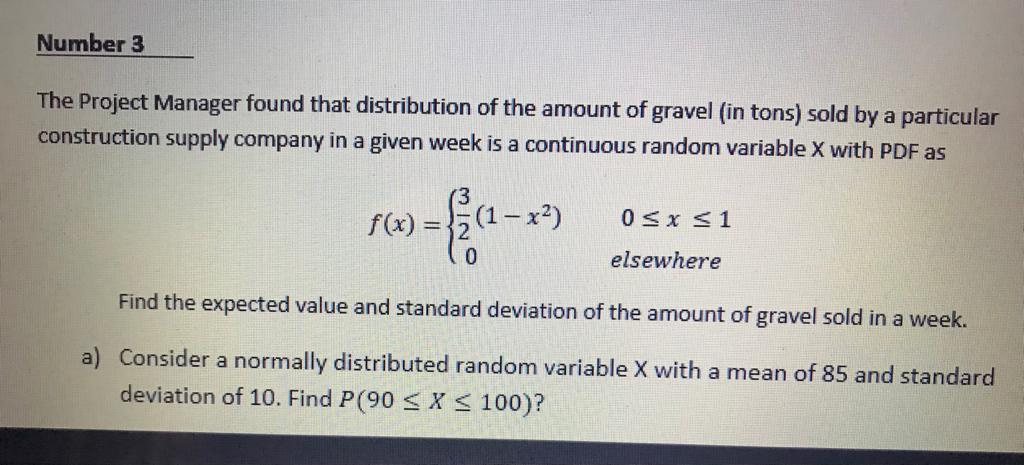
Number 3 The Project Manager found that distribution of the amount of gravel (in tons) sold by a particular construction supply company in a given week is a continuous random variable X with PDF as f ( x) = 5 (1 - x2) Ox $1 O elsewhere Find the expected value and standard deviation of the amount of gravel sold in a week. a) Consider a normally distributed random variable X with a mean of 85 and standard deviation of 10. Find P(90
Step by Step Solution
There are 3 Steps involved in it

Get step-by-step solutions from verified subject matter experts
 Study Help