







Question: Derive the binomial distribution in the following algebraic way, which does not involve any explicit combinatorial analysis. One is again interested in finding the
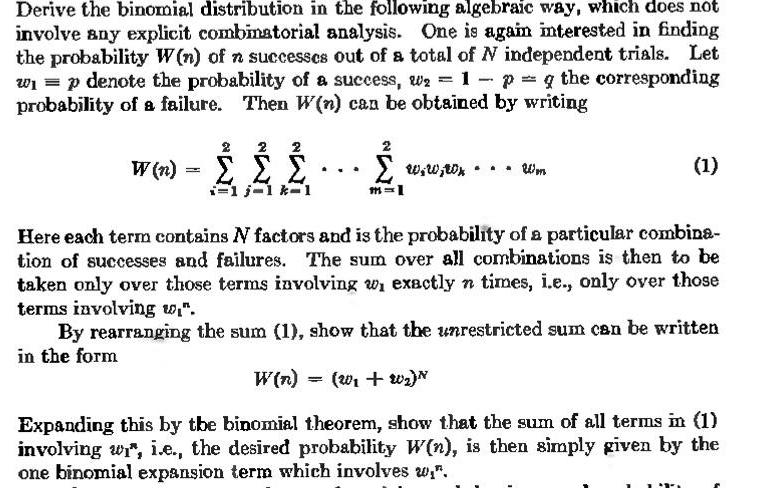
Derive the binomial distribution in the following algebraic way, which does not involve any explicit combinatorial analysis. One is again interested in finding the probability W(n) of n successes out of a total of N independent trials. Let w1 = p denote the probability of a success, w2 = 1- p g the corresponding probability of a failure. Then W(n) can be obtained by writing 2 2 W (n) = (1) =1 j-1 k-1 Here each term contains N factors and is the probability of a particular combina- tion of successes and failures. The sum over all combinations is then to be taken only over those terms iavolving w, exactly n times, i.e., only over those terms involving w". By rearranging the sum (1), show that the unrestricted sum can be written in the form W(n) (w1 + wi)N %3D Expanding this by tbe binomial theorem, show that the sum of all terms in (1) involving wr", i.e., the desired probability W(n), is then simply given by the one binomial expansion term which involves w,".
Step by Step Solution
3.53 Rating (160 Votes )
There are 3 Steps involved in it
Many types of probability problems have only two outcomes or they can be reduced to two outcomes For example when a coin is tossed it can land heads or tails when a baby is born it will be either male ... View full answer

Get step-by-step solutions from verified subject matter experts
 Study Help