







Question: Numerical Methods Indicate the correct response (i.e., place a, b, c, or d in the blank on the left) to each of the following questions
Numerical Methods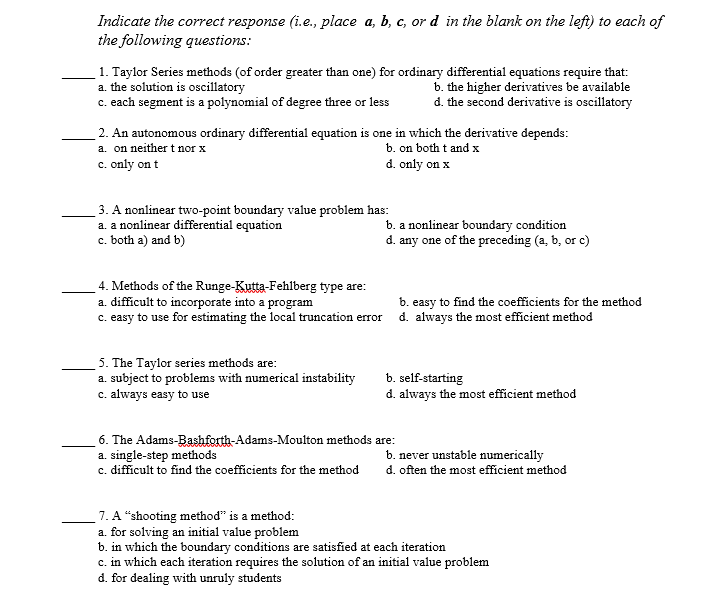
Indicate the correct response (i.e., place a, b, c, or d in the blank on the left) to each of the following questions 1. Taylor Series methods (of order greater than one) for ordinary differential equations require that: a. the solution is oscillatory c. each segment is a polynomial of degree three or less b. the higher derivatives be available d. the second derivative is oscillatory 2. An autonomous ordinary differential equation is one in which the derivative depends a, on neither t nor x b. on both t and x c. only on t d. only on:x 3. A nonlinear two-point boundary value problem has a. a nonlinear differential equation c. both a) and b) b. a nonlinear boundary condition d. any one of the preceding (a, b, or c) 4. Methods of the Runge-Kutta-Fehlberg type are a, difficult to incorporate into a program b. easy to find the coefficients for the method d. always the most efficient method c. easy to use for estimating the local truncation error 5. The Taylor series methods are a. subject to problems with numerical instabilityb. self-starting c. always easy to use d. always the most efficient method 6. The Adams-Rashfoxth-Adams-Moulton methods are a. single-step methods c. difficult to find the coefficients for the method d. often the most efficient method b. never unstable numerically 7. A "shooting method" is a method a, for solving an initial value problem b. in which the boundary conditions are satisfied at each iteration c. in which each iteration requires the solution of an initial value problem d. for dealing with unruly students
Step by Step Solution
There are 3 Steps involved in it

Get step-by-step solutions from verified subject matter experts
 Study Help