







Question: Numerical Methods Please use Matlab Assuming the drag is proportional to the square of velocity, we can model the velocity of a falling object like
Numerical Methods
Please use Matlab
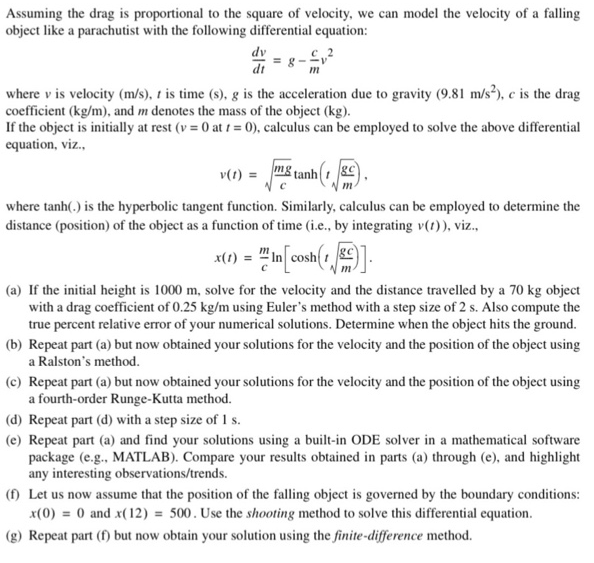
Assuming the drag is proportional to the square of velocity, we can model the velocity of a falling object like a parachutist with the following differential equation: dt in where vis velocity (m/s), 1 is time (s), g is the acceleration due to gravity (9.81 m/s*), ? is the drag coefficient (kg/m), and m denotes the mass of the object (kg) If the object is initially at rest (v 0a0), calculus can be employed to solve the above differential equation, viz where tanh) is the hyperbolic tangent function. Similarly, calculus can be employed to determine the distance (position) of the object as a function of time (i.e., by integrating v), viz (a) If the initial height is 1000 m, solve for the velocity and the distance travelled by a 70 kg object with a drag coefficient of 0.25 kg/m using Euler's method with a step size of 2 s. Also compute the true percent relative error of your numerical solutions. Determine when the object hits the ground. (b) Repeat part (a) but now obtained your solutions for the velocity and the position of the object using a Ralston's method (c) Repeat part (a) but now obtained your solutions for the velocity and the position of the object using a fourth-order Runge-Kutta method (d) Repeat part (d) with a step size of 1 s. (e) Repeat part (a) and find your solutions using a built-in ODE solver in a mathematical software package (e.g.. MATLAB). Compare your results obtained in parts (a) through (e), and highlight any interesting observations/trends. (f) Let us now assume that the position of the falling object is governed by the boundary conditions: x(0) # 0 and x(12) 500 . Use the shooting method to solve this differential equation (g) Repeat part ( but now obtain your solution using the finite-difference method
Step by Step Solution
There are 3 Steps involved in it

Get step-by-step solutions from verified subject matter experts
 Study Help