







Question: // numi and num2 are integer arrays that are already sorted in increas order. m and n are the number of items in the arrays,
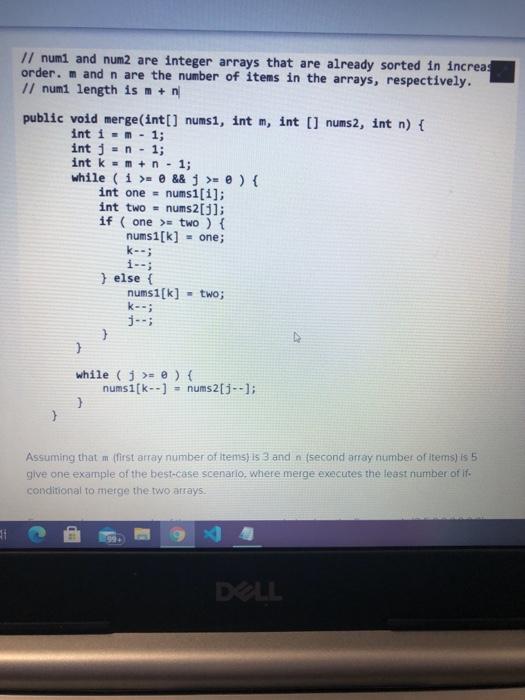
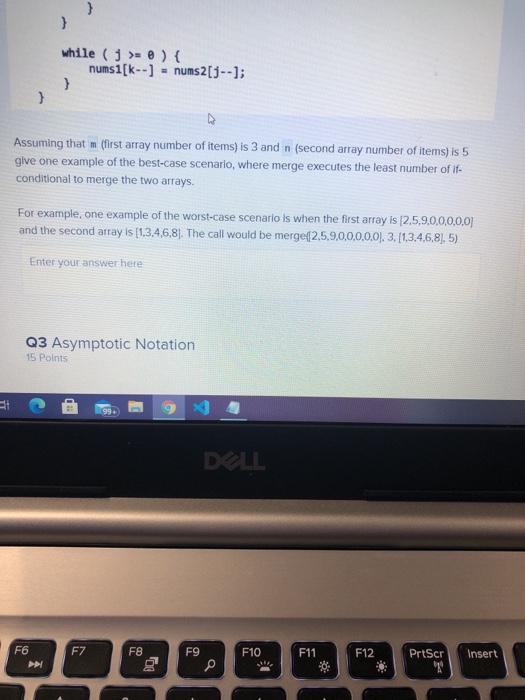
// numi and num2 are integer arrays that are already sorted in increas order. m and n are the number of items in the arrays, respectively. // num1 length is m un public void merge(int[] numsi, int m, int [] nums2, int n) { int i = m - 1; int j = n - 1; int k = m + n - 1; while ( i >= && 1 >= 0 ) { int one = nums1[1]; int two = nums 2[3]; if ( one >= two ) { nums1[k] - one; k; i--; } else { nums1[k] - two; K; --; } ) while (j >= ) { numsi[k-- ] = nums2[j--; } 3 Assuming that m (first array number of items) is 3 and n (second array number of items) is 5 give one example of the best-case scenario, where merge executes the least number of it conditional to merge the two arrays. 31 1994 } } while () >= 0){ numsi[k-- ] - nums2[j--); } } Assuming that m (first array number of items) is 3 and n (second array number of items) is 5 glve one example of the best-case scenario, where merge executes the least number of if- conditional to merge the two arrays. For example, one example of the worst-case scenario is when the first array is 2.5,9,0,0,0,0,0) and the second atray Is [1.3.4,6,8). The call would be merger[2.5.9,0,0,0,0,0). 3. 1,3,4,6,8), 5) Enter your answer here Q3 Asymptotic Notation 15 Points 9. DOL F6 F7 F8 F9 F10 F11 F12 PrtScr Insert
Step by Step Solution
There are 3 Steps involved in it

Get step-by-step solutions from verified subject matter experts
 Study Help