



Question: Flexible Budgets, Direct-Cost Variances, and Management Control Flexible Budget Brabham Enterprises manufactures tires for the Formula I motor racing circuit. The company's budgeted and
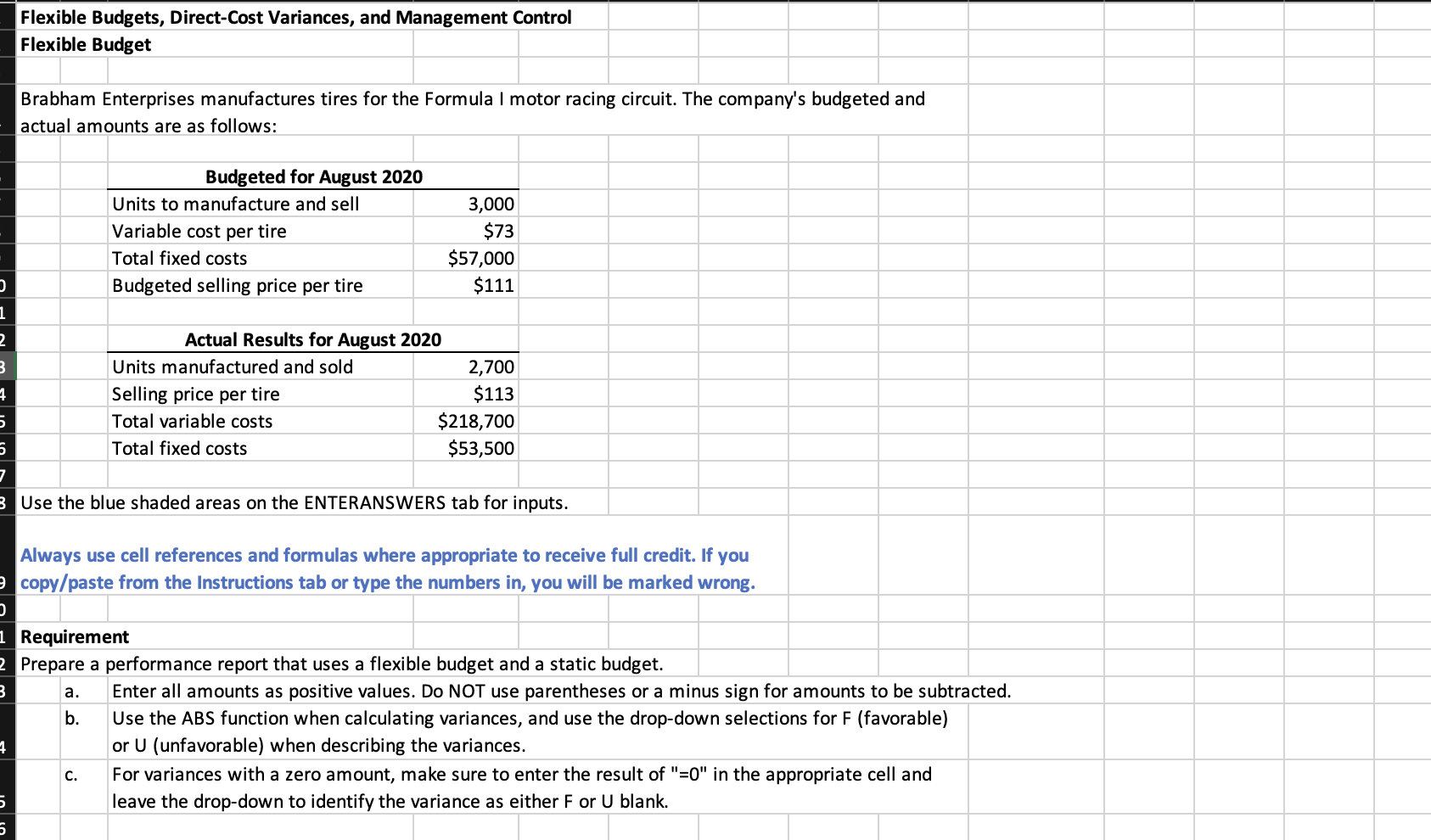

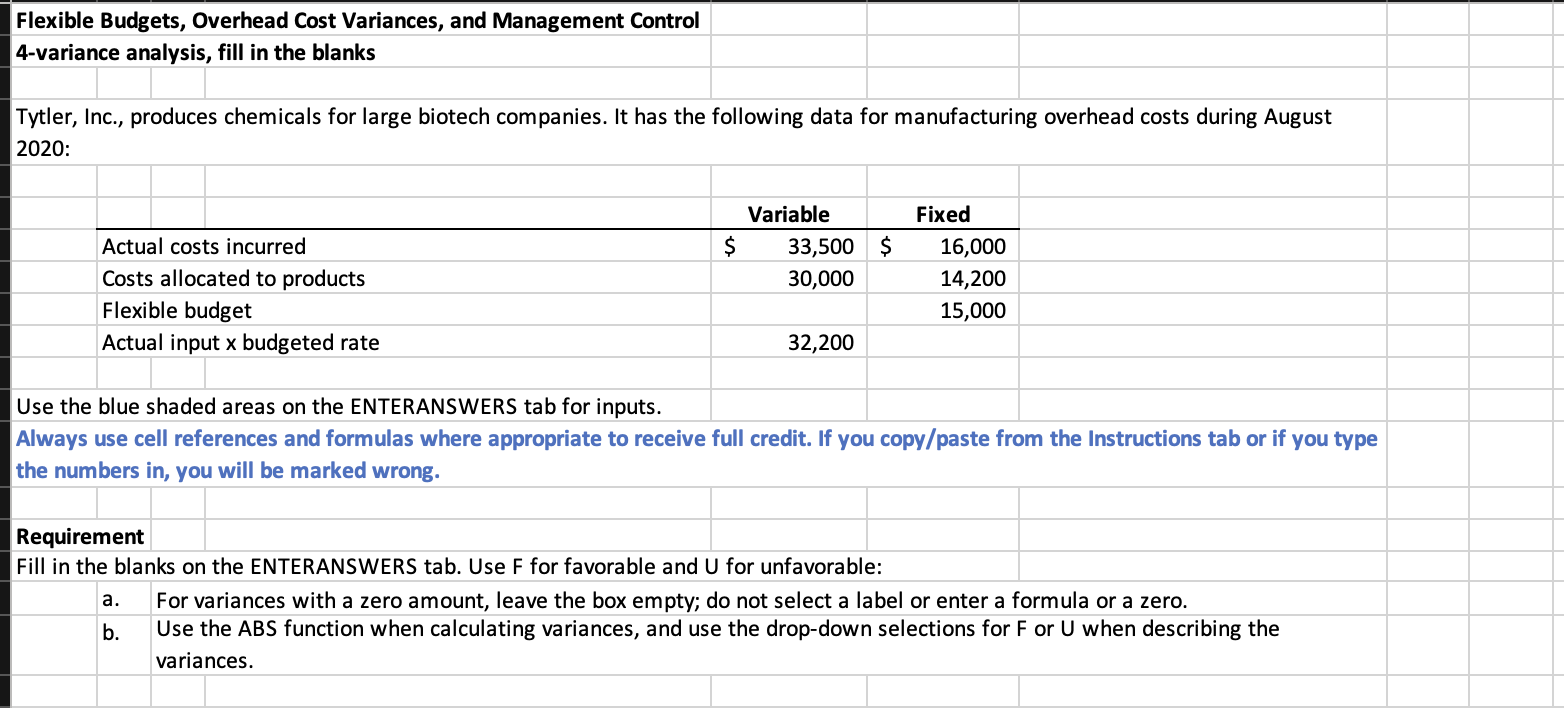
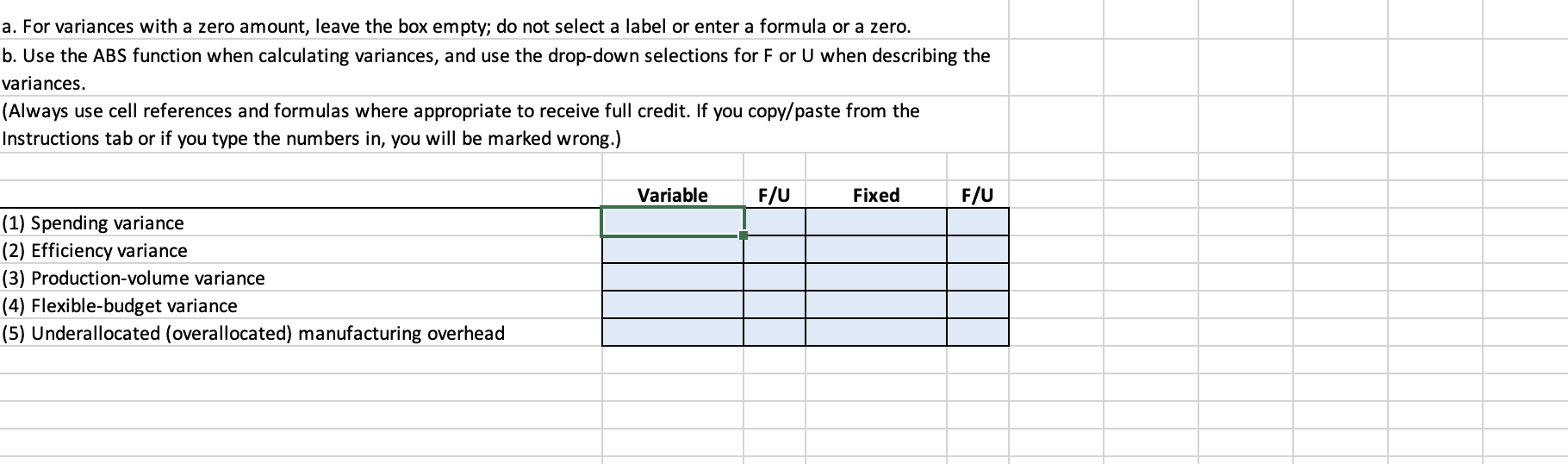
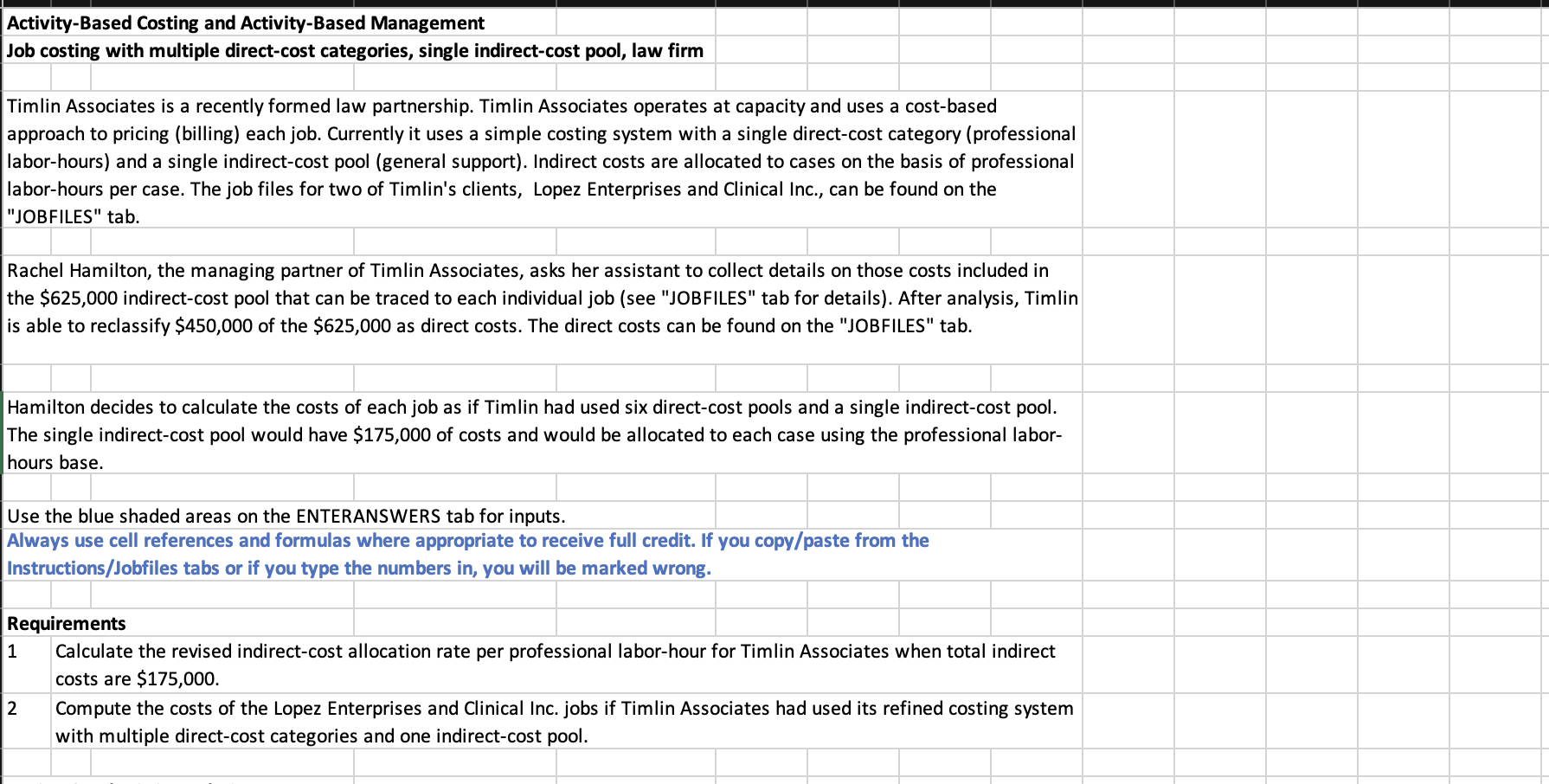
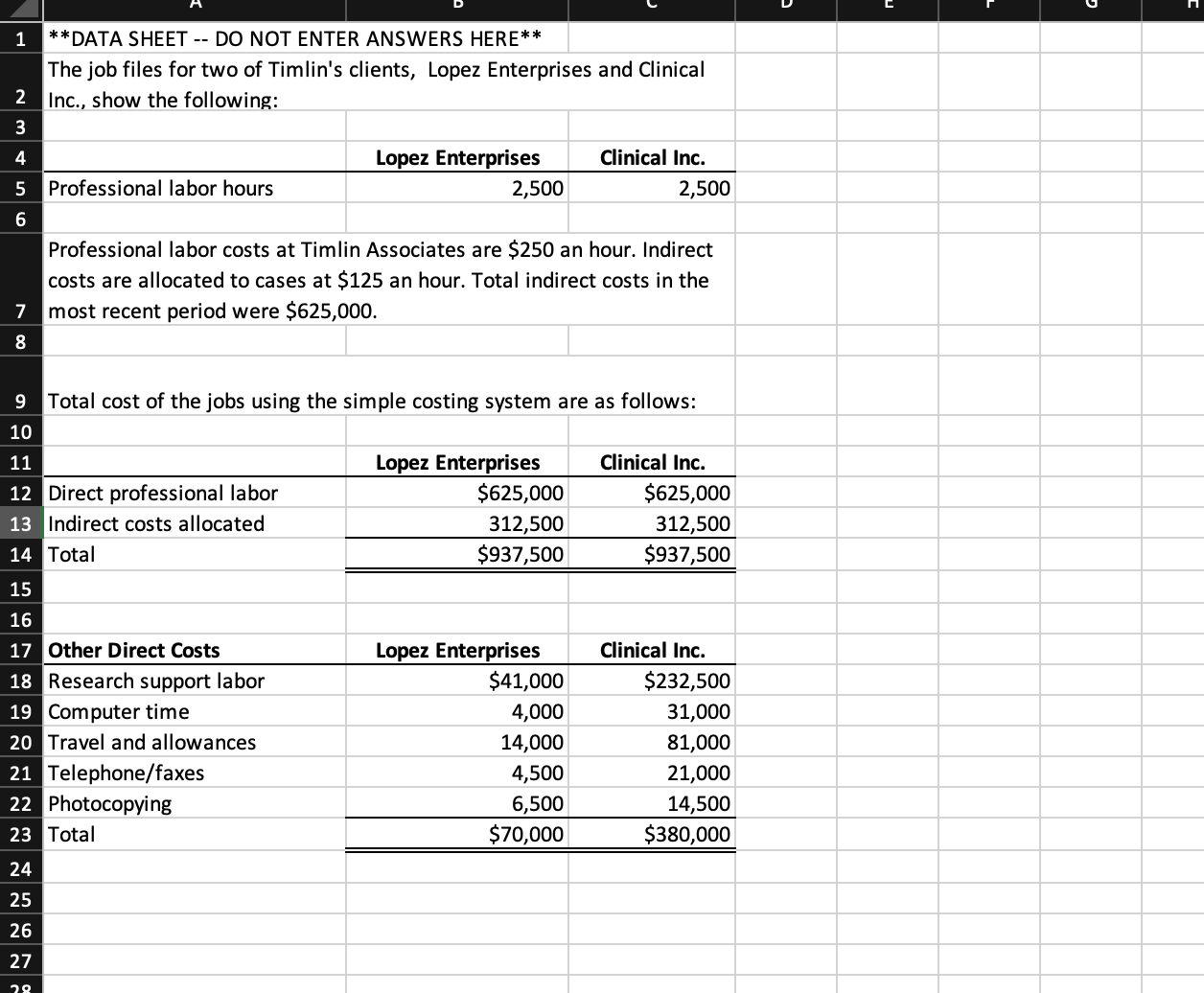
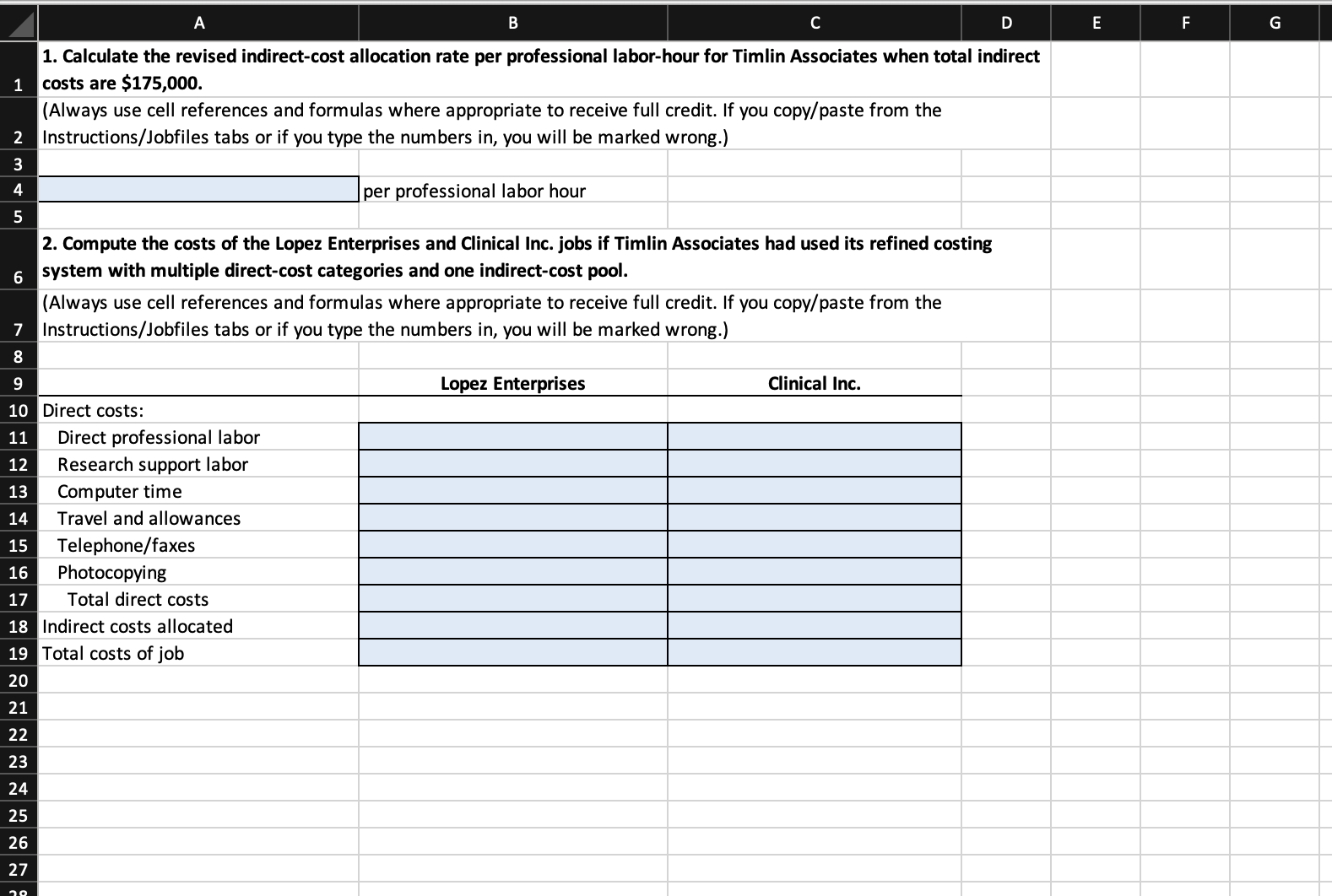
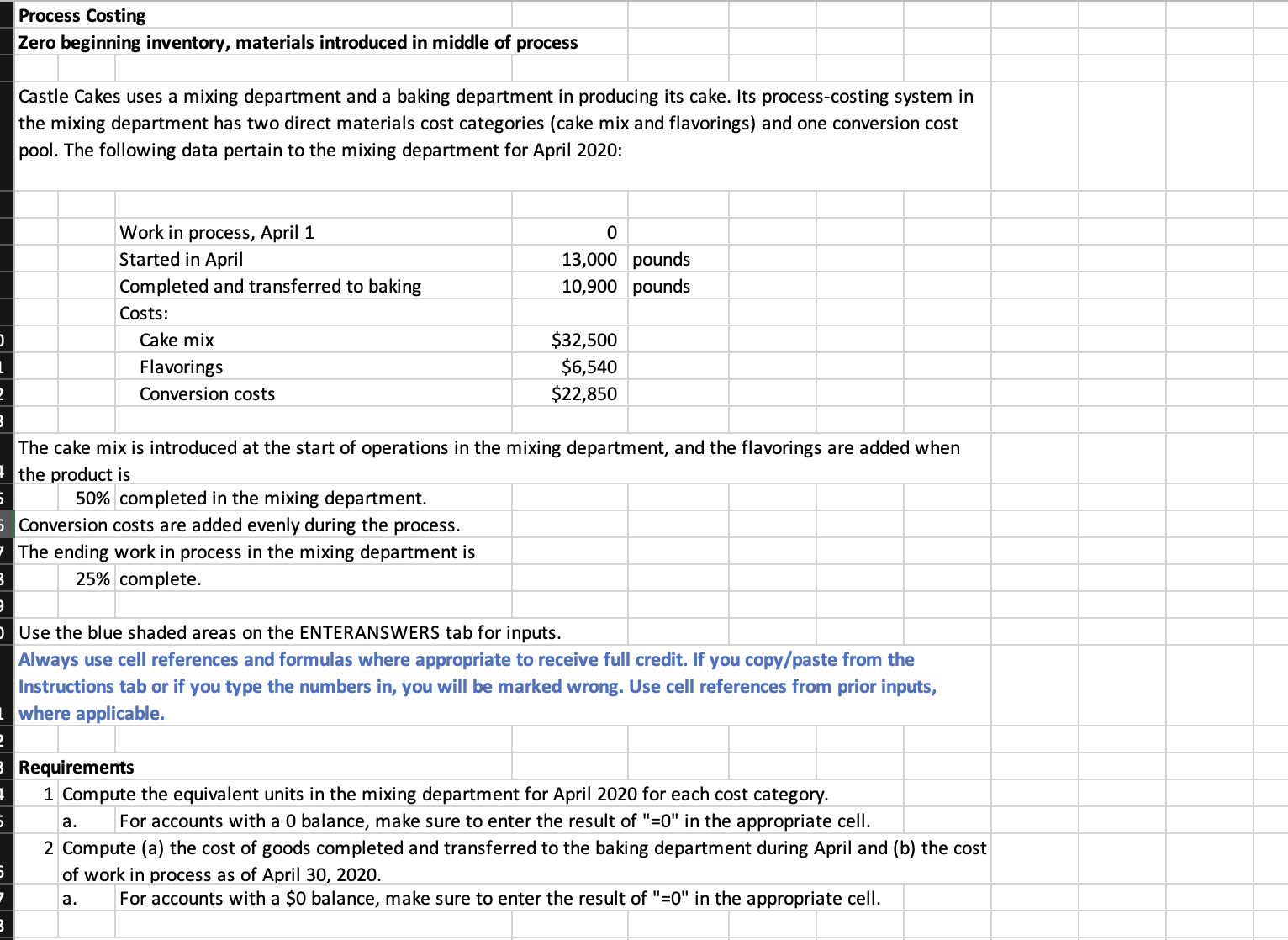
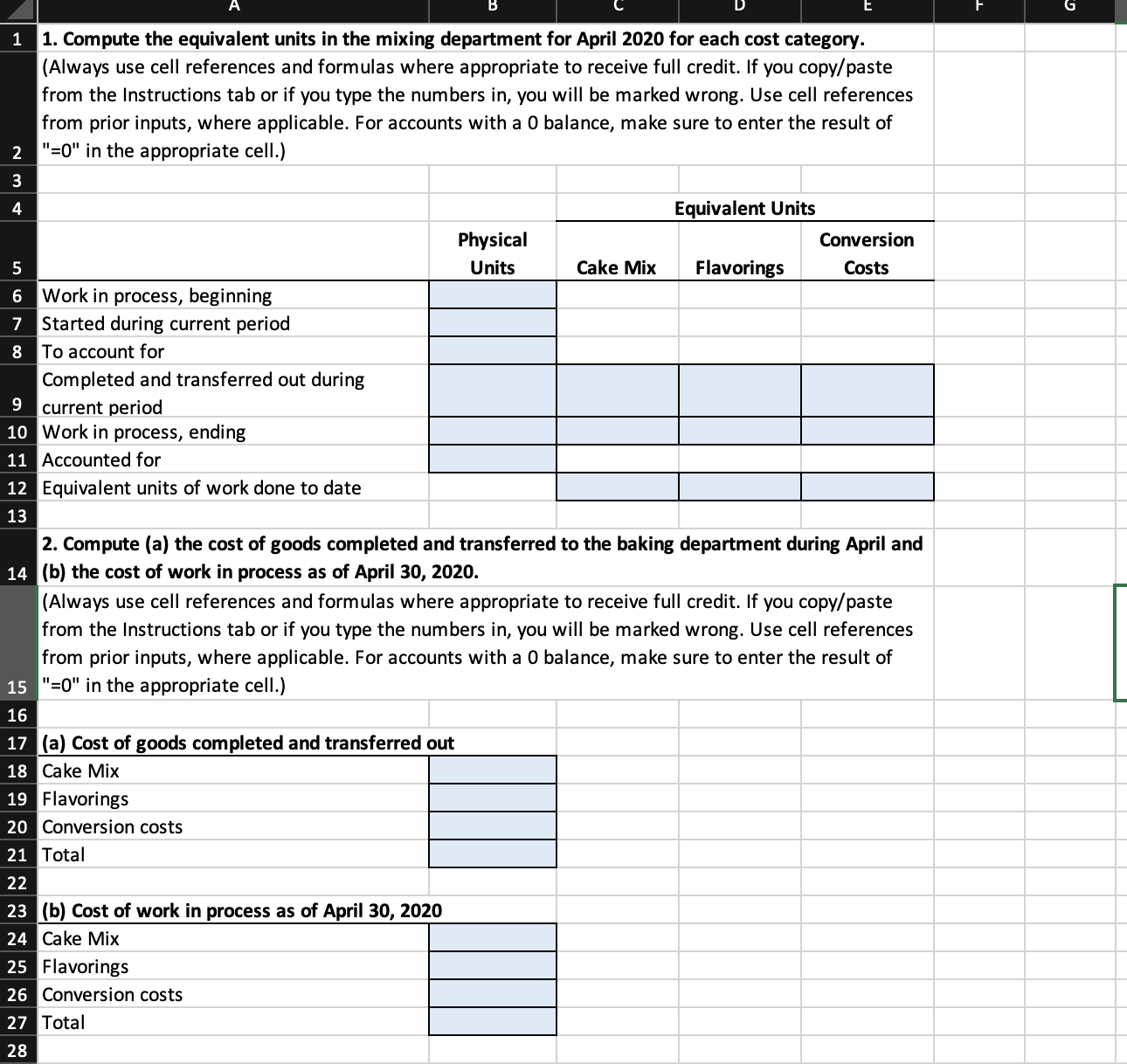
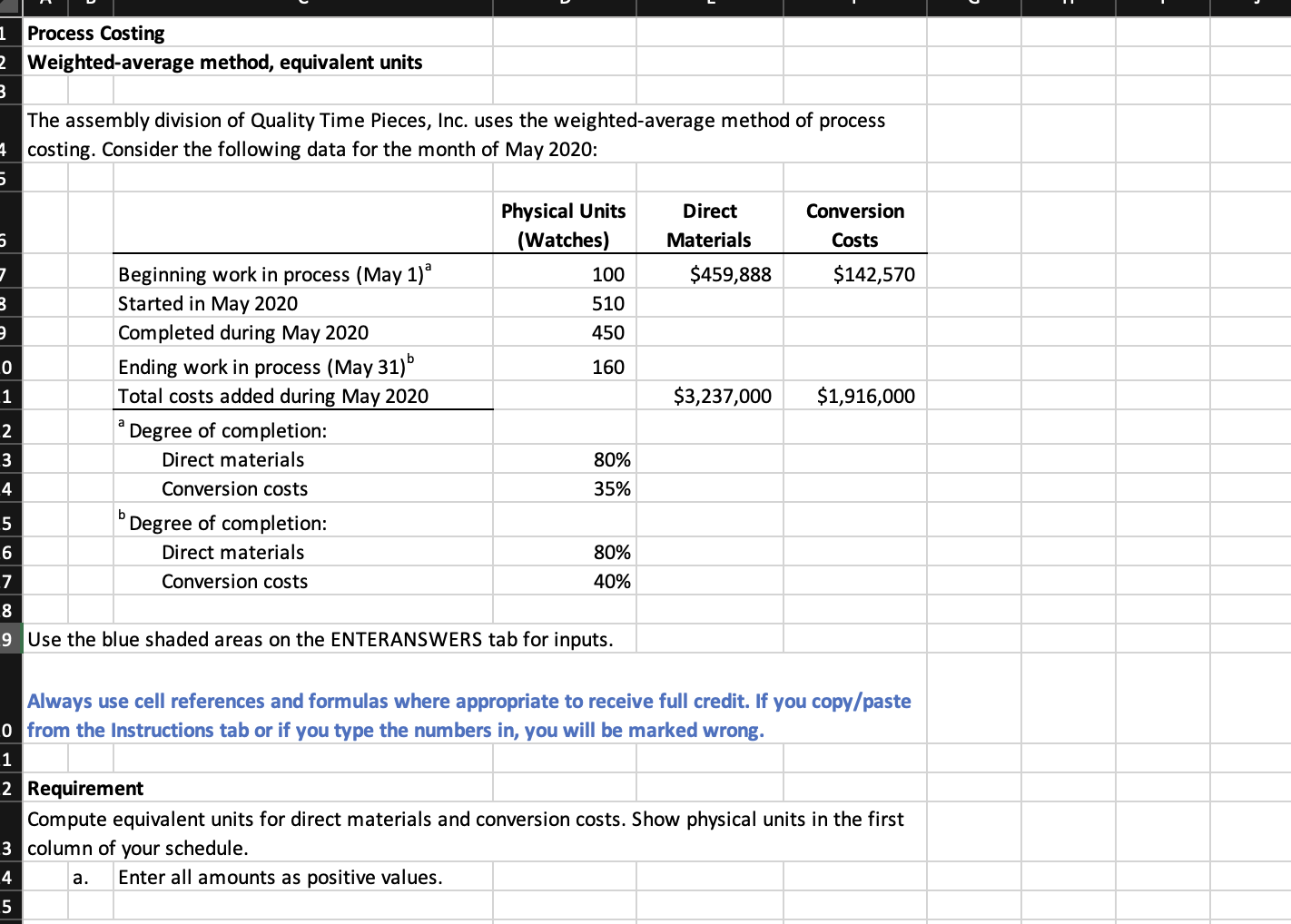
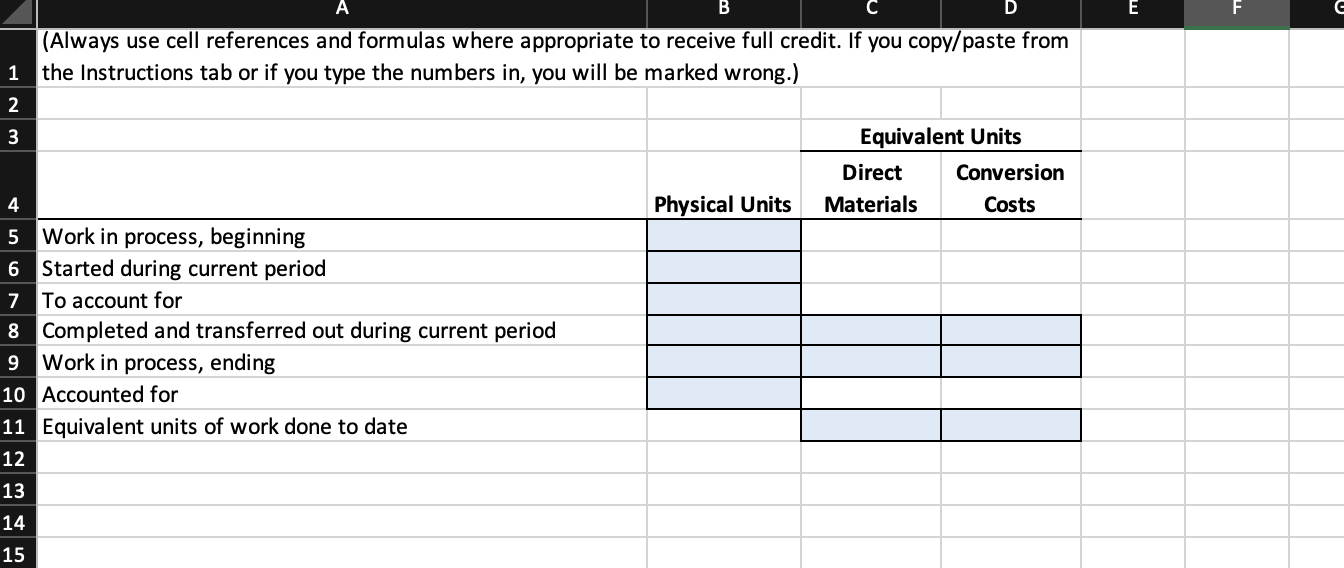
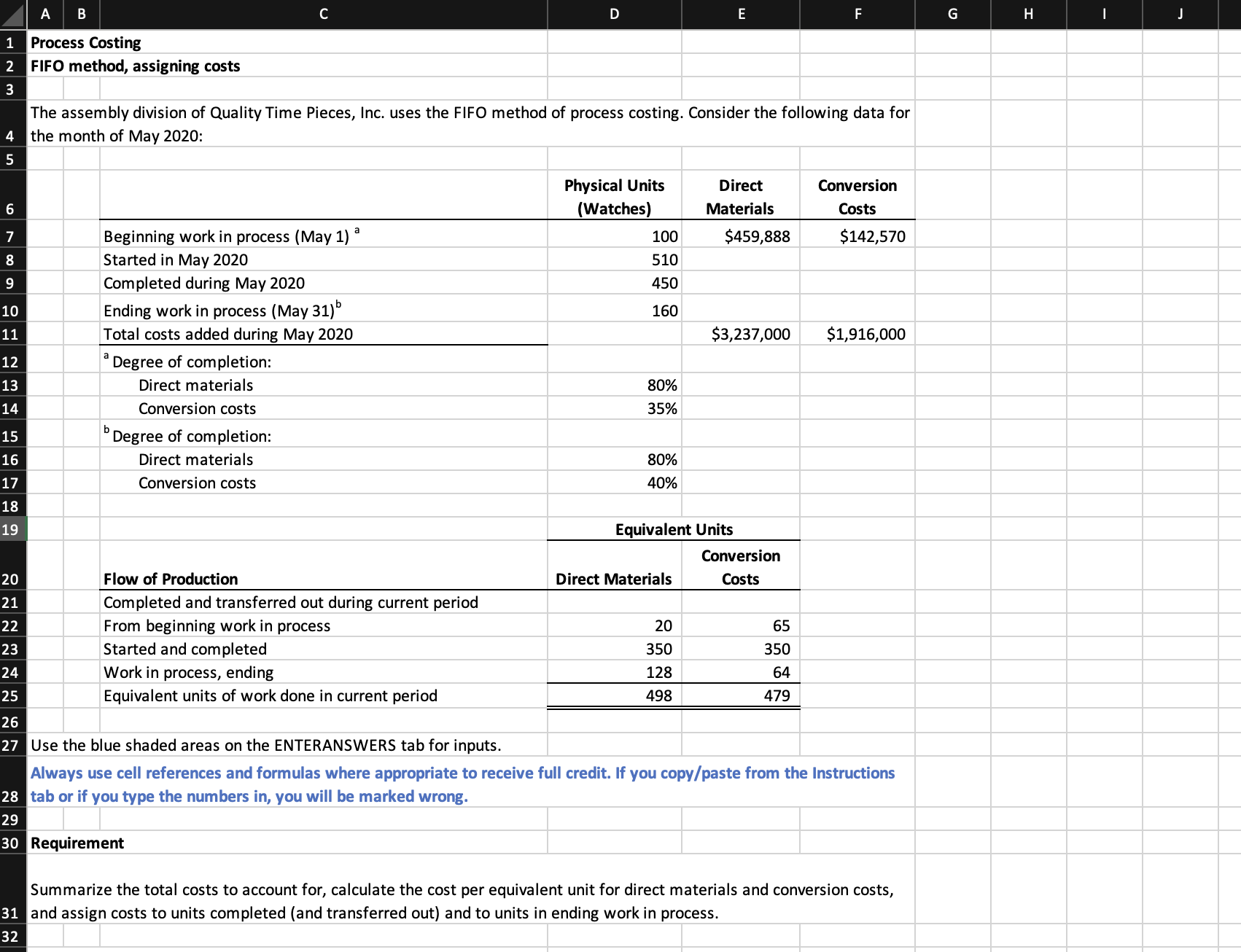
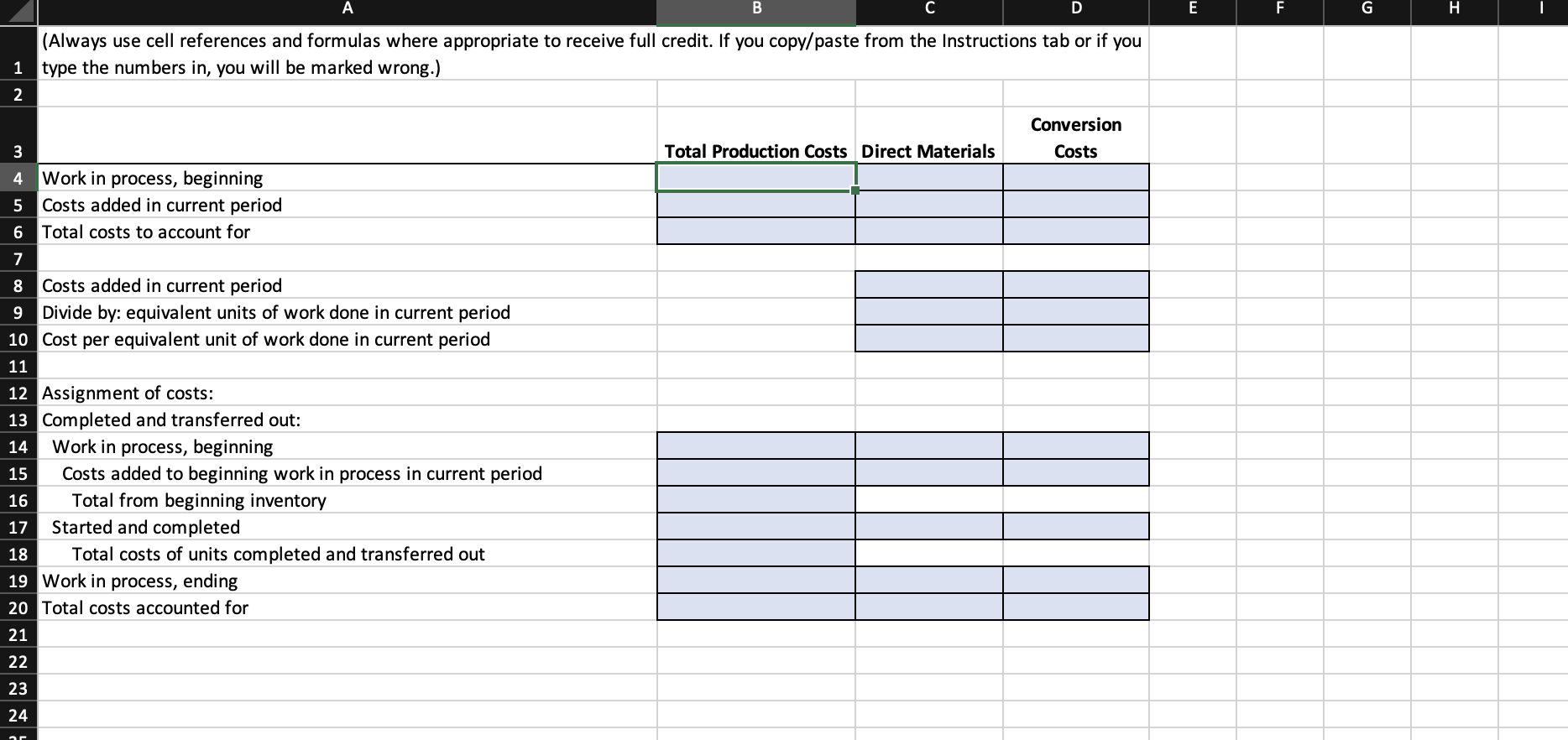
Flexible Budgets, Direct-Cost Variances, and Management Control Flexible Budget Brabham Enterprises manufactures tires for the Formula I motor racing circuit. The company's budgeted and actual amounts are as follows: Budgeted for August 2020 Units to manufacture and sell 3,000 Variable cost per tire $73 Total fixed costs $57,000 Budgeted selling price per tire $111 1 2 Actual Results for August 2020 3 Units manufactured and sold 2,700 4 Selling price per tire $113 = 5 Total variable costs $218,700 6 Total fixed costs $53,500 7 8 Use the blue shaded areas on the ENTERANSWERS tab for inputs. Always use cell references and formulas where appropriate to receive full credit. If you 9 copy/paste from the Instructions tab or type the numbers in, you will be marked wrong. Requirement 2 Prepare a performance report that uses a flexible budget and a static budget. B b. 4. a. Enter all amounts as positive values. Do NOT use parentheses or a minus sign for amounts to be subtracted. Use the ABS function when calculating variances, and use the drop-down selections for F (favorable) or U (unfavorable) when describing the variances. C. 5 For variances with a zero amount, make sure to enter the result of "=0" in the appropriate cell and leave the drop-down to identify the variance as either F or U blank. 5 Prepare a performance report that uses a flexible budget and a static budget. a. Enter all amounts as positive values. Do NOT use parentheses or a minus sign for amounts to be subtracted. b. Use the ABS function when calculating variances, and use the drop-down selections for F (favorable) or U (unfavorable) when describing the variances. c. For variances with a zero amount, make sure to enter the result of "=0" in the appropriate cell and leave the drop-down to identify the variance as either F or U blank. (Always use cell references and formulas where appropriate to receive full credit. If you copy/paste from the Instructions tab or type the numbers in, you will be marked wrong.) Flexible-Budget Actual Results Variance Flexible Budget Sales-Volume Variances Static Budget Units sold Revenues Variable costs Contribution margin Fixed costs Operating income Flexible Budgets, Overhead Cost Variances, and Management Control 4-variance analysis, fill in the blanks Tytler, Inc., produces chemicals for large biotech companies. It has the following data for manufacturing overhead costs during August 2020: Actual costs incurred Costs allocated to products Flexible budget Actual input x budgeted rate $ Variable 33,500 $ 30,000 Fixed 16,000 14,200 15,000 32,200 Use the blue shaded areas on the ENTERANSWERS tab for inputs. Always use cell references and formulas where appropriate to receive full credit. If you copy/paste from the Instructions tab or if you type the numbers in, you will be marked wrong. Requirement Fill in the blanks on the ENTERANSWERS tab. Use F for favorable and U for unfavorable: a. For variances with a zero amount, leave the box empty; do not select a label or enter a formula or a zero. b. Use the ABS function when calculating variances, and use the drop-down selections for F or U when describing the variances. a. For variances with a zero amount, leave the box empty; do not select a label or enter a formula or a zero. b. Use the ABS function when calculating variances, and use the drop-down selections for F or U when describing the variances. (Always use cell references and formulas where appropriate to receive full credit. If you copy/paste from the Instructions tab or if you type the numbers in, you will be marked wrong.) (1) Spending variance (2) Efficiency variance (3) Production-volume variance (4) Flexible-budget variance (5) Underallocated (overallocated) manufacturing overhead Variable F/U Fixed F/U Activity-Based Costing and Activity-Based Management Job costing with multiple direct-cost categories, single indirect-cost pool, law firm Timlin Associates is a recently formed law partnership. Timlin Associates operates at capacity and uses a cost-based approach to pricing (billing) each job. Currently it uses a simple costing system with a single direct-cost category (professional labor-hours) and a single indirect-cost pool (general support). Indirect costs are allocated to cases on the basis of professional labor-hours per case. The job files for two of Timlin's clients, Lopez Enterprises and Clinical Inc., can be found on the "JOBFILES" tab. Rachel Hamilton, the managing partner of Timlin Associates, asks her assistant to collect details on those costs included in the $625,000 indirect-cost pool that can be traced to each individual job (see "JOBFILES" tab for details). After analysis, Timlin is able to reclassify $450,000 of the $625,000 as direct costs. The direct costs can be found on the "JOBFILES" tab. Hamilton decides to calculate the costs of each job as if Timlin had used six direct-cost pools and a single indirect-cost pool. The single indirect-cost pool would have $175,000 of costs and would be allocated to each case using the professional labor- hours base. Use the blue shaded areas on the ENTERANSWERS tab for inputs. Always use cell references and formulas where appropriate to receive full credit. If you copy/paste from the Instructions/Jobfiles tabs or if you type the numbers in, you will be marked wrong. Requirements 1 2 Calculate the revised indirect-cost allocation rate per professional labor-hour for Timlin Associates when total indirect costs are $175,000. Compute the costs of the Lopez Enterprises and Clinical Inc. jobs if Timlin Associates had used its refined costing system with multiple direct-cost categories and one indirect-cost pool. 1 **DATA SHEET -- DO NOT ENTER ANSWERS HERE** The job files for two of Timlin's clients, Lopez Enterprises and Clinical 2 Inc., show the following: 3 4 5 Professional labor hours 6 Lopez Enterprises Clinical Inc. 2,500 2,500 Professional labor costs at Timlin Associates are $250 an hour. Indirect costs are allocated to cases at $125 an hour. Total indirect costs in the 7 most recent period were $625,000. 8 9 10 Total cost of the jobs using the simple costing system are as follows: 11 Lopez Enterprises Clinical Inc. 12 Direct professional labor $625,000 $625,000 13 Indirect costs allocated 312,500 312,500 $937,500 $937,500 14 Total 15 16 17 Other Direct Costs 18 Research support labor 19 Computer time 20 Travel and allowances 21 Telephone/faxes 22 Photocopying 23 Total 24 25 26 27 22220 Lopez Enterprises Clinical Inc. $41,000 $232,500 4,000 31,000 14,000 81,000 4,500 21,000 6,500 14,500 $70,000 $380,000 A B C D E F 1 1. Calculate the revised indirect-cost allocation rate per professional labor-hour for Timlin Associates when total indirect costs are $175,000. 2 (Always use cell references and formulas where appropriate to receive full credit. If you copy/paste from the Instructions/Jobfiles tabs or if you type the numbers in, you will be marked wrong.) 3 4 5 per professional labor hour 2. Compute the costs of the Lopez Enterprises and Clinical Inc. jobs if Timlin Associates had used its refined costing 6 system with multiple direct-cost categories and one indirect-cost pool. (Always use cell references and formulas where appropriate to receive full credit. If you copy/paste from the 7 Instructions/Jobfiles tabs or if you type the numbers in, you will be marked wrong.) 8 9 10 Direct costs: 11 Direct professional labor 12 Research support labor 13 Computer time 14 Travel and allowances 15 Telephone/faxes 16 17 Photocopying Total direct costs 18 Indirect costs allocated 19 Total costs of job 20 21 22 23 24 25 26 27 20 Lopez Enterprises Clinical Inc. G Process Costing Zero beginning inventory, materials introduced in middle of process Castle Cakes uses a mixing department and a baking department in producing its cake. Its process-costing system in the mixing department has two direct materials cost categories (cake mix and flavorings) and one conversion cost pool. The following data pertain to the mixing department for April 2020: 2 B 0 Work in process, April 1 Started in April 13,000 pounds Completed and transferred to baking 10,900 pounds Costs: ) $32,500 $6,540 $22,850 Cake mix Flavorings Conversion costs The cake mix is introduced at the start of operations in the mixing department, and the flavorings are added when the product is 50% completed in the mixing department. 5 Conversion costs are added evenly during the process. 5 The ending work in process in the mixing department is 25% complete. Use the blue shaded areas on the ENTERANSWERS tab for inputs. Always use cell references and formulas where appropriate to receive full credit. If you copy/paste from the Instructions tab or if you type the numbers in, you will be marked wrong. Use cell references from prior inputs, where applicable. Requirements 1 Compute the equivalent units in the mixing department for April 2020 for each cost category. a. For accounts with a 0 balance, make sure to enter the result of "=0" in the appropriate cell. 2 Compute (a) the cost of goods completed and transferred to the baking department during April and (b) the cost of work in process as of April 30, 2020. 5 7 a. 3 For accounts with a $0 balance, make sure to enter the result of "=0" in the appropriate cell. A B 1 1. Compute the equivalent units in the mixing department for April 2020 for each cost category. (Always use cell references and formulas where appropriate to receive full credit. If you copy/paste from the Instructions tab or if you type the numbers in, you will be marked wrong. Use cell references from prior inputs, where applicable. For accounts with a 0 balance, make sure to enter the result of "=0" in the appropriate cell.) 2 3 4 Equivalent Units Physical Units Cake Mix Flavorings Conversion Costs 5 6 Work in process, beginning 7 Started during current period 8 To account for Completed and transferred out during 9 current period 10 Work in process, ending 11 Accounted for 12 Equivalent units of work done to date 13 2. Compute (a) the cost of goods completed and transferred to the baking department during April and 14 (b) the cost of work in process as of April 30, 2020. (Always use cell references and formulas where appropriate to receive full credit. If you copy/paste from the Instructions tab or if you type the numbers in, you will be marked wrong. Use cell references from prior inputs, where applicable. For accounts with a 0 balance, make sure to enter the result of 15 "=0" in the appropriate cell.) 16 17 (a) Cost of goods completed and transferred out 18 Cake Mix 19 Flavorings 20 Conversion costs 21 Total 22 23 (b) Cost of work in process as of April 30, 2020 24 Cake Mix 25 Flavorings 26 Conversion costs 27 Total 28 1 Process Costing 2 Weighted-average method, equivalent units B The assembly division of Quality Time Pieces, Inc. uses the weighted-average method of process 4 costing. Consider the following data for the month of May 2020: 5 5 Physical Units (Watches) Direct Materials Conversion Costs 7 Beginning work in process (May 1) 100 $459,888 $142,570 B Started in May 2020 510 9 Completed during May 2020 450 0 Ending work in process (May 31)b 160 1 Total costs added during May 2020 $3,237,000 $1,916,000 23456789 a Degree of completion: b Direct materials Conversion costs Degree of completion: Direct materials Conversion costs 80% 35% 80% 40% 9 Use the blue shaded areas on the ENTERANSWERS tab for inputs. Always use cell references and formulas where appropriate to receive full credit. If you copy/paste 0 from the Instructions tab or if you type the numbers in, you will be marked wrong. 1 2 Requirement Compute equivalent units for direct materials and conversion costs. Show physical units in the first 3 column of your schedule. 345 a. Enter all amounts as positive values. 123 A B C D (Always use cell references and formulas where appropriate to receive full credit. If you copy/paste from the Instructions tab or if you type the numbers in, you will be marked wrong.) 4 5 Work in process, beginning 6 Started during current period 7 To account for 8 Completed and transferred out during current period 9 Work in process, ending 10 Accounted for 11 Equivalent units of work done to date 12 13 14 15 Equivalent Units Direct Conversion Physical Units Materials Costs E A B 1 Process Costing 2 FIFO method, assigning costs 3 4 5 C D E F G H | J The assembly division of Quality Time Pieces, Inc. uses the FIFO method of process costing. Consider the following data for the month of May 2020: 6 7892 Beginning work in process (May 1) a Started in May 2020 Completed during May 2020 10 Ending work in process (May 31) b 11 Total costs added during May 2020 12 'Degree of completion: 13 14 b 15 16 17 Direct materials Conversion costs Degree of completion: Direct materials Conversion costs 18 19 Physical Units (Watches) Direct Materials Conversion Costs 100 $459,888 $142,570 510 450 160 $3,237,000 $1,916,000 80% 35% 80% 40% Equivalent Units Conversion 20 Flow of Production Direct Materials Costs 21 Completed and transferred out during current period 22 From beginning work in process 23 Started and completed 24 Work in process, ending 25 Equivalent units of work done in current period 20 65 350 350 128 64 498 479 26 27 Use the blue shaded areas on the ENTERANSWERS tab for inputs. Always use cell references and formulas where appropriate to receive full credit. If you copy/paste from the Instructions 28 tab or if you type the numbers in, you will be marked wrong. 29 30 Requirement Summarize the total costs to account for, calculate the cost per equivalent unit for direct materials and conversion costs, 31 and assign costs to units completed (and transferred out) and to units in ending work in process. 32 1 2 3 A B D (Always use cell references and formulas where appropriate to receive full credit. If you copy/paste from the Instructions tab or if you type the numbers in, you will be marked wrong.) 4 Work in process, beginning 567 Costs added in current period Total costs to account for 8 Costs added in current period 9 Divide by: equivalent units of work done in current period 10 Cost per equivalent unit of work done in current period 11 12 Assignment of costs: 13 Completed and transferred out: 14 Work in process, beginning 15 Costs added to beginning work in process in current period 16 17 Started and completed 18 Total from beginning inventory Total costs of units completed and transferred out 19 Work in process, ending 20 Total costs accounted for 21 22 23 24 Conversion Total Production Costs Direct Materials Costs E F G H
Step by Step Solution
3.42 Rating (149 Votes )
There are 3 Steps involved in it
Lets fill in the calculations based on the provided data for each requirement Requirement 2 Flexible Budget and Static Budget Performance Report a Flexible Budget Units sold 2700 Revenues 2700 113 305... View full answer

Get step-by-step solutions from verified subject matter experts