Question: O Required information 1. Chapter Opening Case: The World's Largest Trade Deal Chapter Opening Case: The World's Largest Trade Deal You are about to read
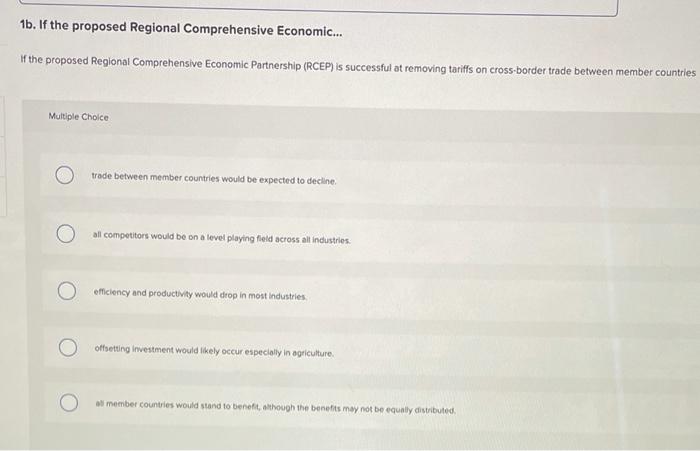
O Required information 1. Chapter Opening Case: The World's Largest Trade Deal Chapter Opening Case: The World's Largest Trade Deal You are about to read a short case exploring what could be the world's largest regional trade deal. If negotiations are successful, the Regional Comprehensive Economic Partnership (RCEP) will include the 10 countries that are part of the Association of Southeast Asian Nations (ASEAN), together with Australia, China, Japan, New Zealand, and South Korea, You will be asked to answer questions linking your knowledge from the chapter to the situation detailed in the case. This activity is important because as a manager, you must be able to understand regional economic agreements between countries, and in particular why they were formed and what they mean for trade between countries. Trade agreements like the proposed RCEP have Important Implications for firms and how they determine where they will locate production Managers need this information to make informed decisions for their companies. The goal of this activity is to demonstrate your understanding of the history and scope of important regional economic agreements, as well as the future prospects of those agreements Read the case and answer the questions that follow. For decades the European Union has been thought of as the world's largest regional trade deal measured by the number of countries involved and their combined gross domestic product (GDP)--but that may soon change. A group of 15 Asian Pacific countries are currently in final negotiations to complete what may become the world's largest regional trade deal Known as the Regional Comprehensive Economic Partnership (RCEP), the deal involves all 10 countries from the Association Southeast Asian Nations (ASEAN) and five of its major trading partners, Australia, China, Japan, New Zealand, and South Korea. If a deal is completed, the RCEP will include countries that account for one-third of the global population and GDP The primary Impact of the RCEP will be to progressively reduce tariffs on cross-border trade of goods between member states. In addition, the deal will allow businesses to sell the same goods within the bloc, without having to meet separate requirements and fill out separate paperwork for each country, which will significantly reduce the need for customizing products so that they meet local country regulations. On the other hand, the RCEP is not seen as a Thigh-quality" trade agreement because it does not cover many services and agricultural products. Moreover, tariffs are agreed between countries rather than harmonized across the board. For some countries, sensitive issues such as agriculture won't be touched. Despite these limitations, economic analysis by Australia's Productivity Commission has suggested that a deal would increase GOP between member states by as much as 4 percent, while a retreat into protectionism would lead to an 8 percent fall in GDP Naantintinnt on the BEED Carter when talle nimer at stahlishing anthor maior trademart-Trans Parit Partnershin Saved menti IUCHU. VECES LOUIS, ELIT his wy MUSUH TIULUVILY CONTRIOS Suyyesi UIOLO VEO would increase GDP between member states by as much as 4 percent, while a retreat into protectionism would lead to an 8 percent fall in GDP Negotiations on the RCEP started when talks almed at establishing another major trade pact-Trans Pacific Partnership (TTP)--were under way. China was not a party to the TPP, which at the time was slated to be the world's largest regional trade deal. Many observers considered the RCEP to be a way for Beijing to counter American influence in the region. When negotiations started back in 2012, India was also involved, but India pulled out over concerns that lowering tariffs on Chinese goods would only increase its yawning trade deficit with the country. India also worried that its poor farmers would be flooded out of the market by Australian grains and milk from New Zealand. Negotiations proceeded slowly until 2017 when President Donald Trump pulled the United States out of final negotiations to establish the TPP and slapped tariffs on many of America's trading partners, including China. One of the unintended consequences of that decision was that it gave negotiations to establish the RCEP added momentum. The negotiating countries quickly came to the conclusion that they needed to push back against growing protectionism, even as the United States chose that path. As academics at the Australian National University have noted: In signing RCEP, Asia has chosen openness over protectionism, regionalism over nationalism, cooperation over confrontation, and solidarity over suspicion. They have sent a clear and unambiguous signal to the world that Asla remains very much open for business, committed to the open regionalism Notably, the RCEP leaves out the kinds of provisions on the environment, labor, and state-owned enterprises that America Insisted be included in the TPP, before Trump pulled the country out of that deal. Because the RCEP includes China (and the TPP pointedly did not), the pact is often described as a "Beijing-led initiative to write the rules of globalization to its liking (as opposed to the TPP, which was an American-led initiative to write those rules). However, ASEAN members bristle at that notion. ASEAN has organized the negotiations-almost 30 rounds of them--and ASEAN representatives argue that even though the RCEP has been painted as a China-led Initiative, it has always been an ASEAN-led initiative. Be that as it may, there is no doubt that China will be the dominant economy in the RCEP and that the trade deal will do little to hold in check China's historic tendency to subsidize state-owned enterprises, many of which are exporters. Sources: "Asla's Trade Negotiators Decide They Can No Longer Wait for India." The Economist, November 7, 2019, M. Tostevin. "The World's Biggest Trade Pact Shapes Up without India," Reuters, November 5, 2019, P. Drysdale and A. Triggs. "Asia Pushed Back against Global Protectionism and Big Trade and Investment Deal" East Asia Forum, November 6, 2019 1b. If the proposed Regional Comprehensive Economic... If the proposed Regional Comprehensive Economic Partnership (RCEP) is successful at removing tariffs on cross-border trade between member countries Multiple Choice trade between member countries would be expected to decline. all competitors would be on a level playing field across alt industries efficiency and productivity would drop in most industries offsetting investment would likely occur especially in agriculture, oll member countries would stand to benefit, although the benefits may not be equally distributed









 Study Help