



Question: O Ti = TRF -bX (TM - TRF) O Ti = TRF +bx (rM - TRF) Hint: Recall that because the market is in equilibrium,
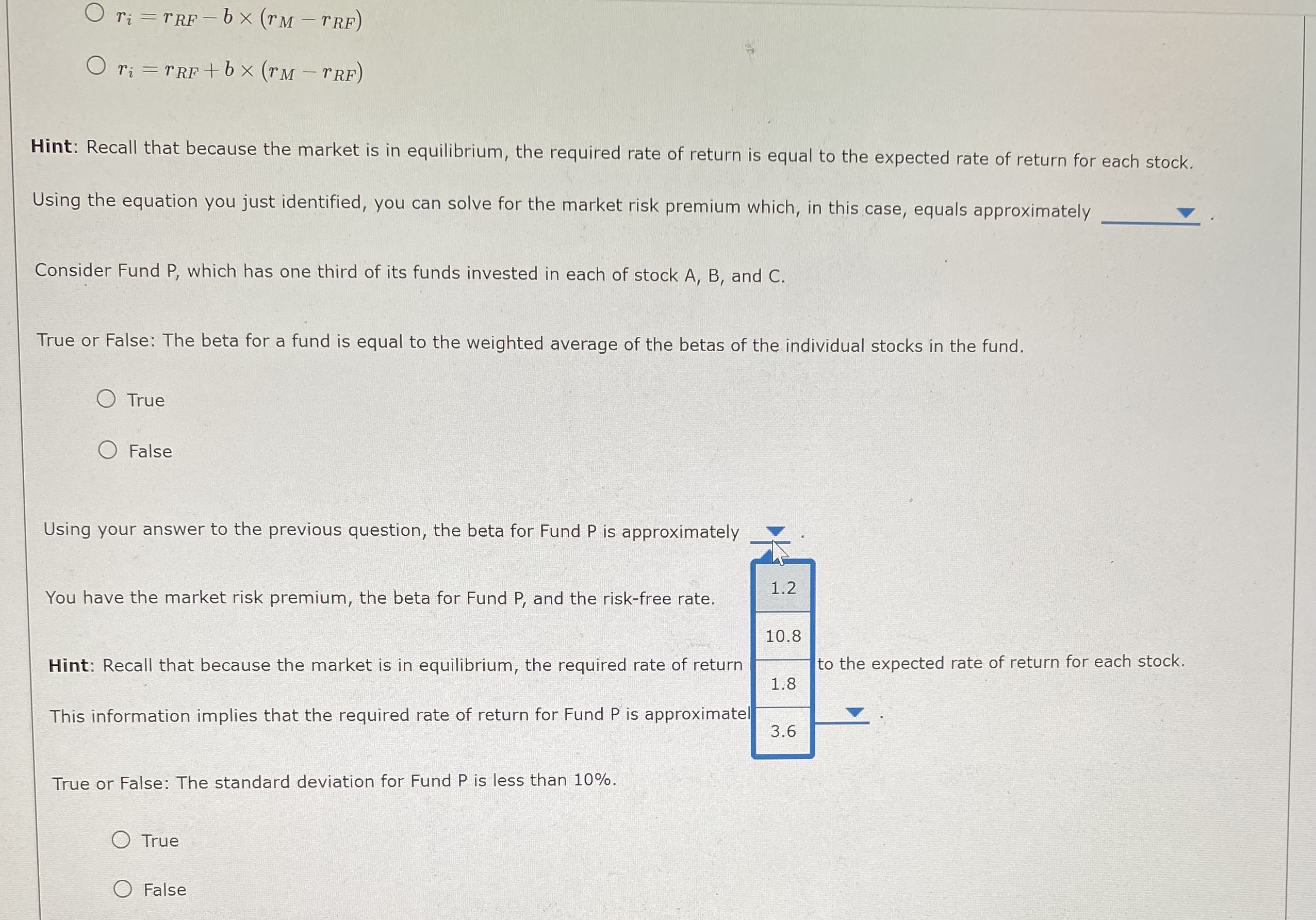
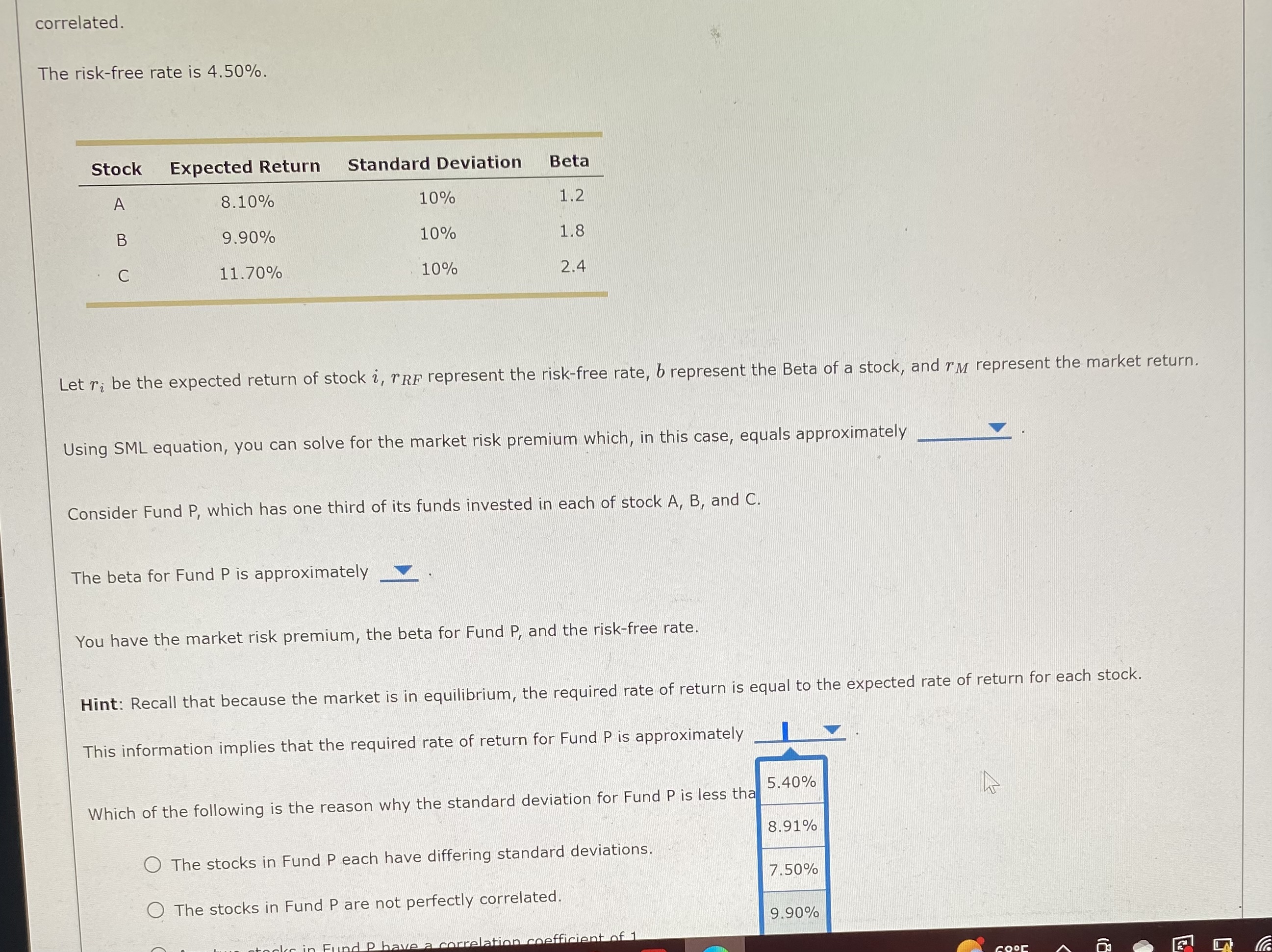
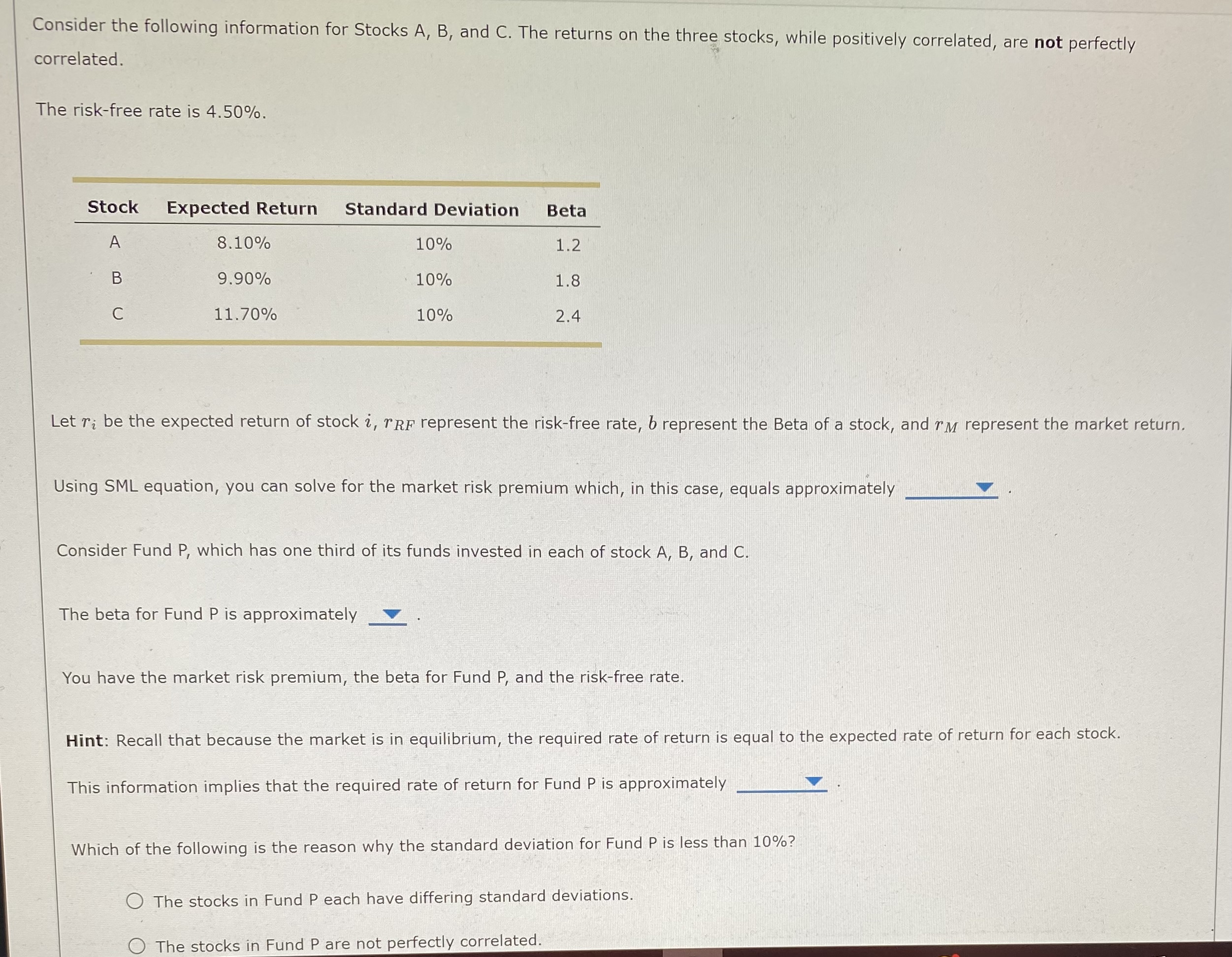
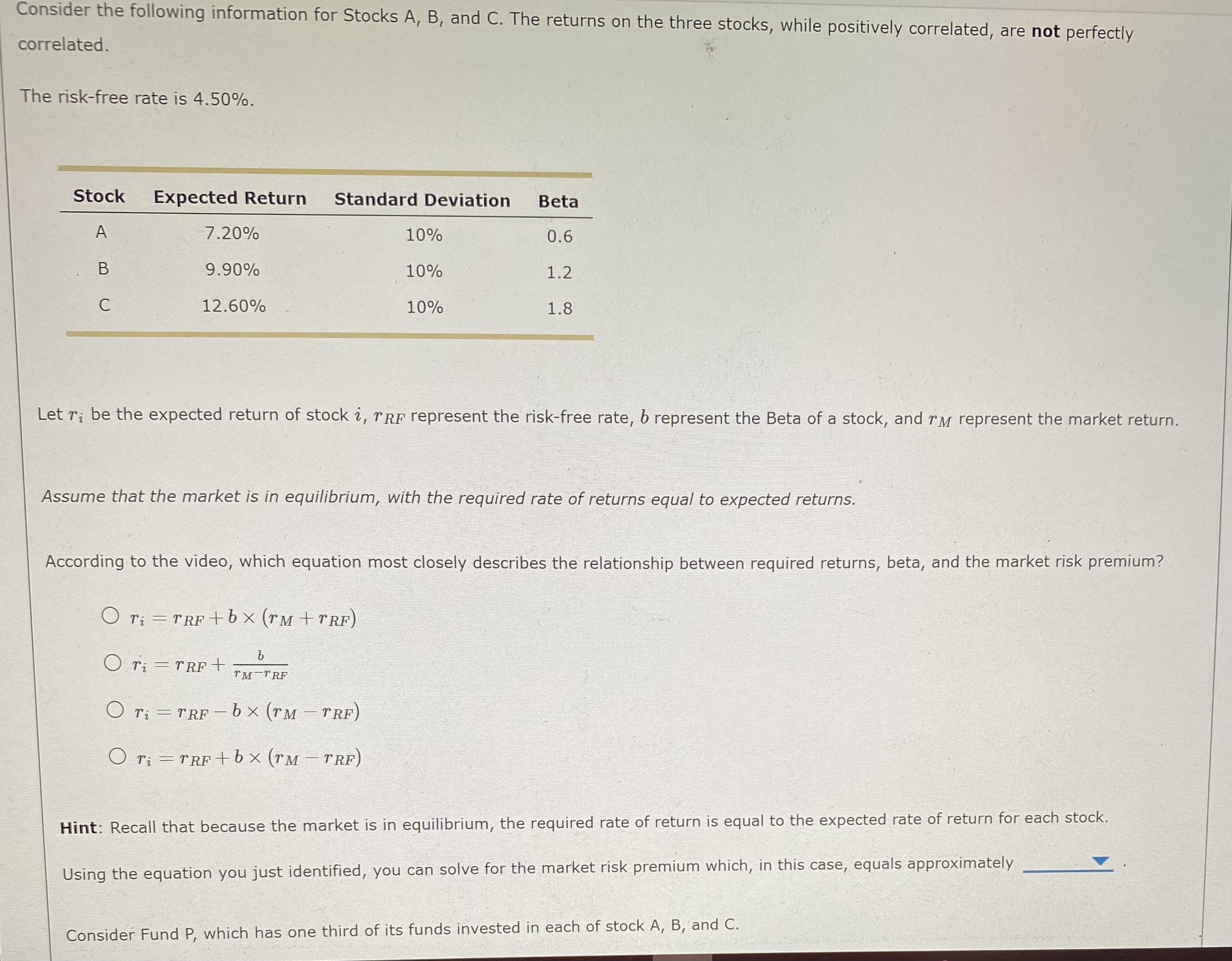
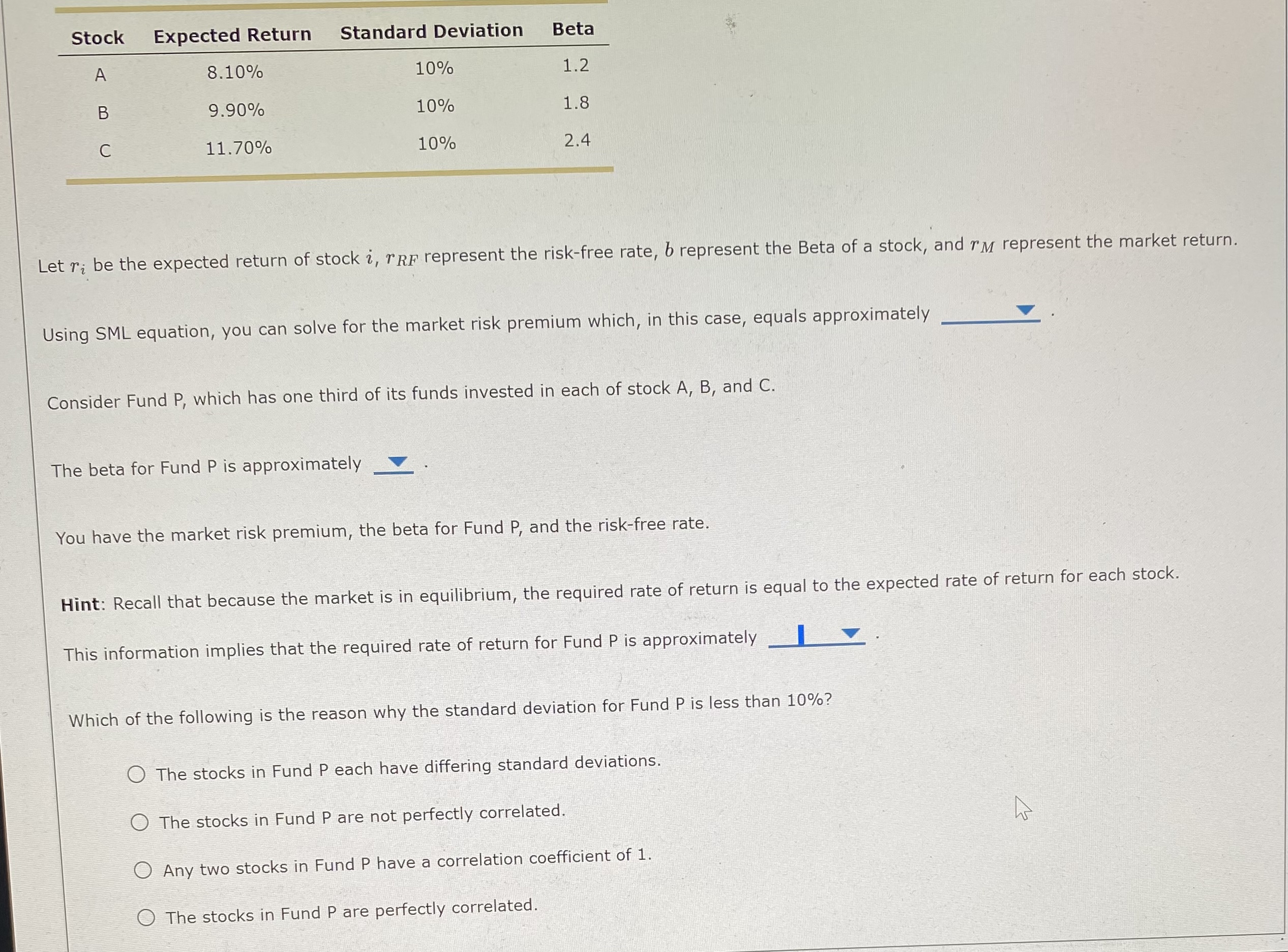
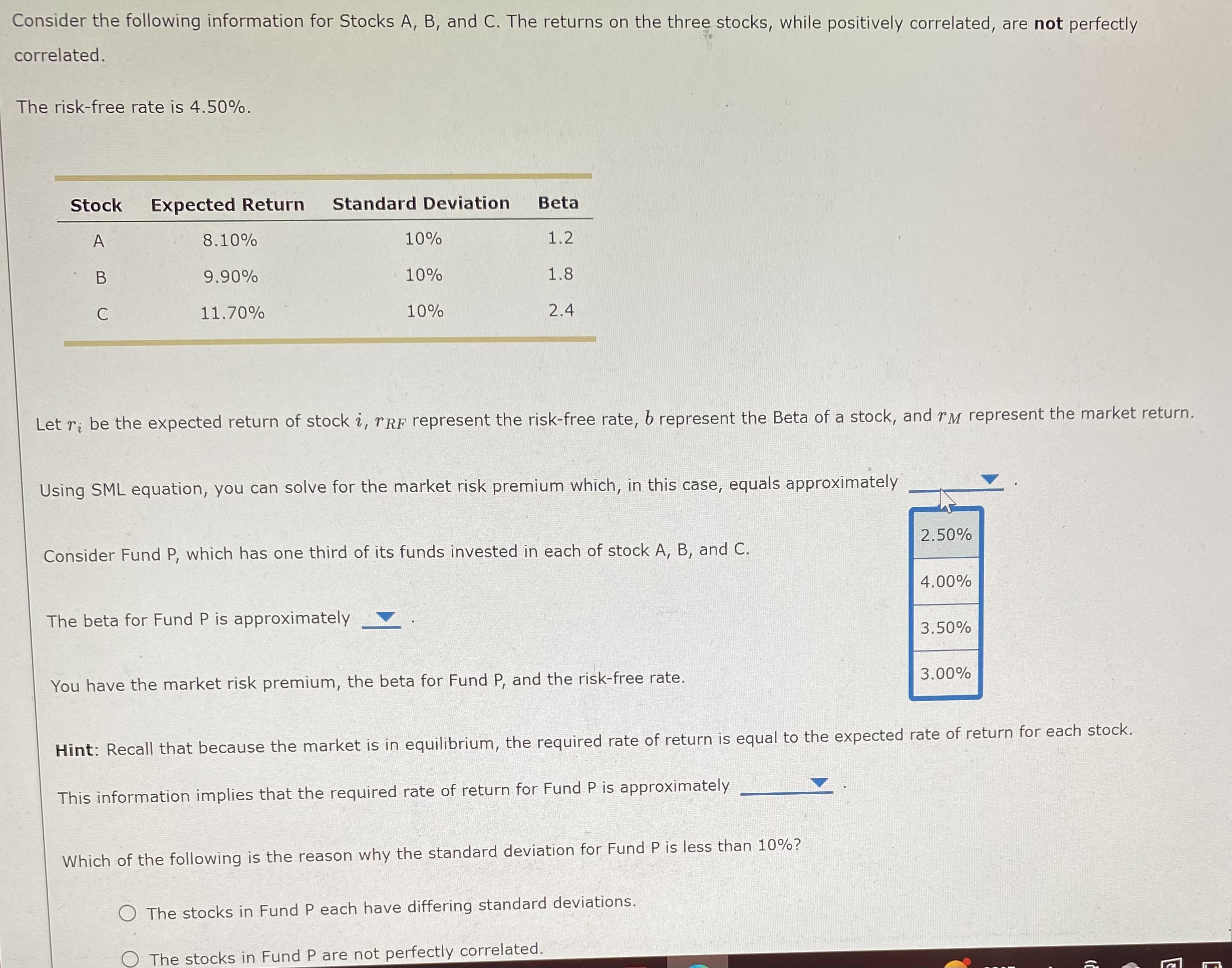
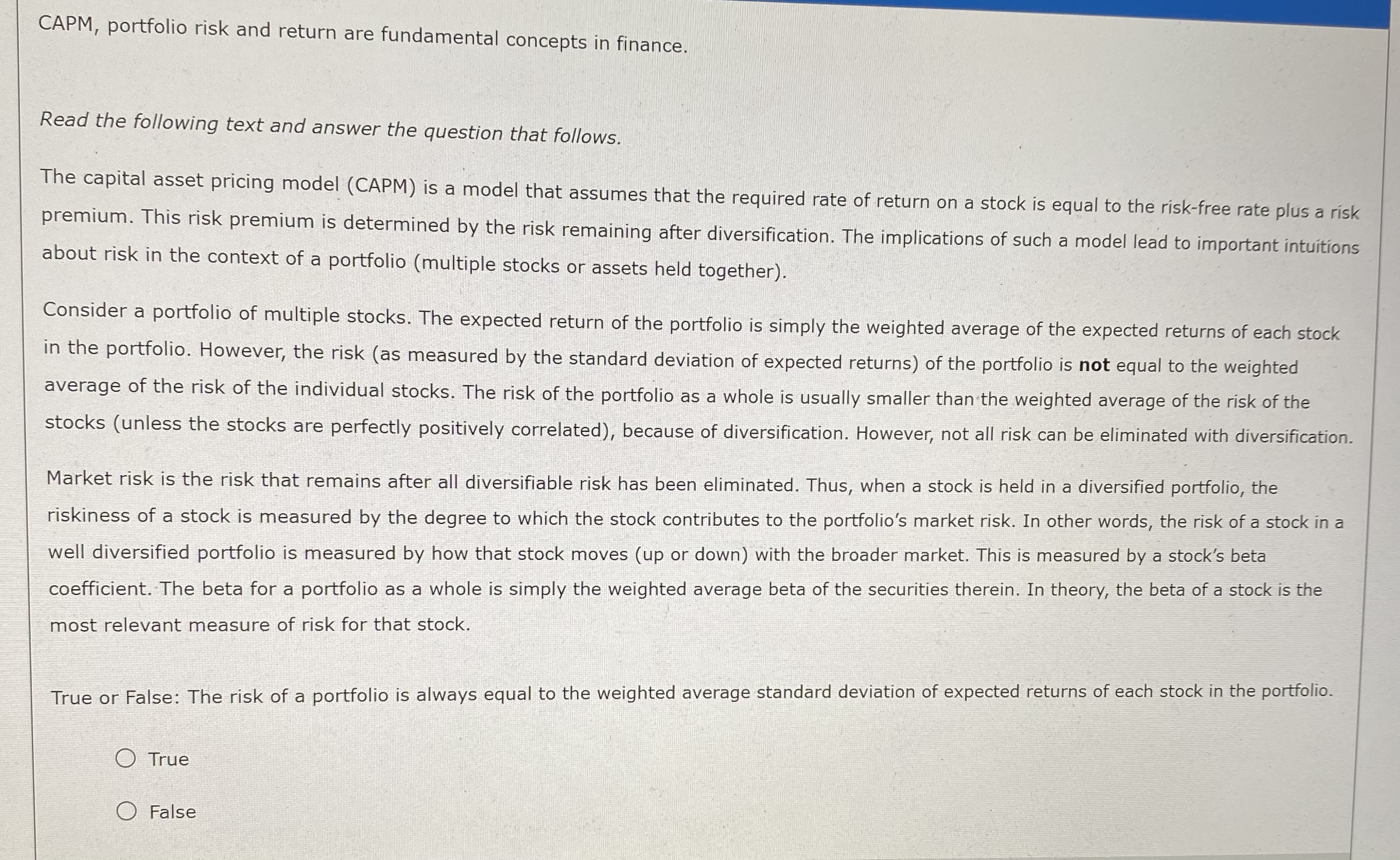
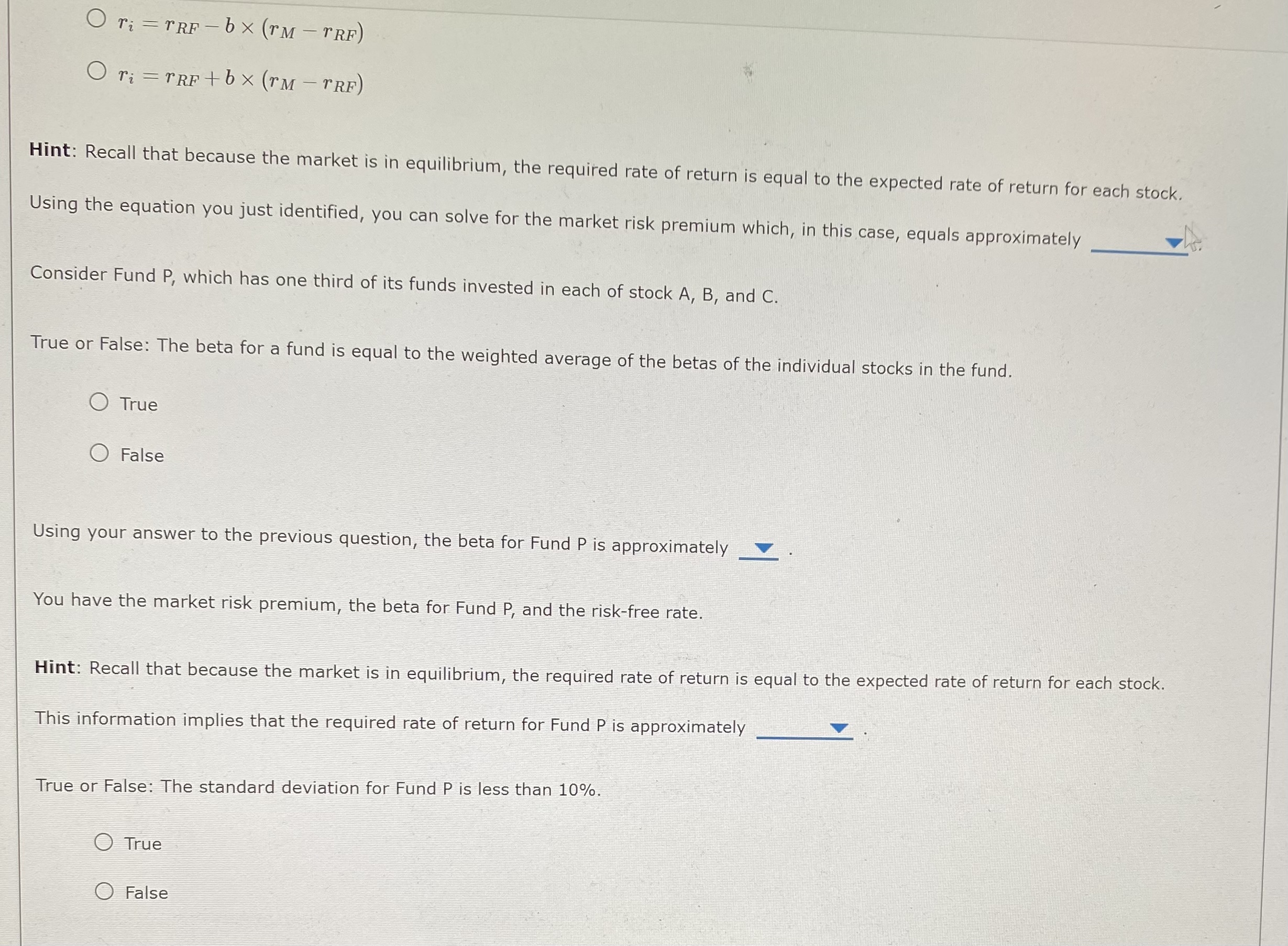
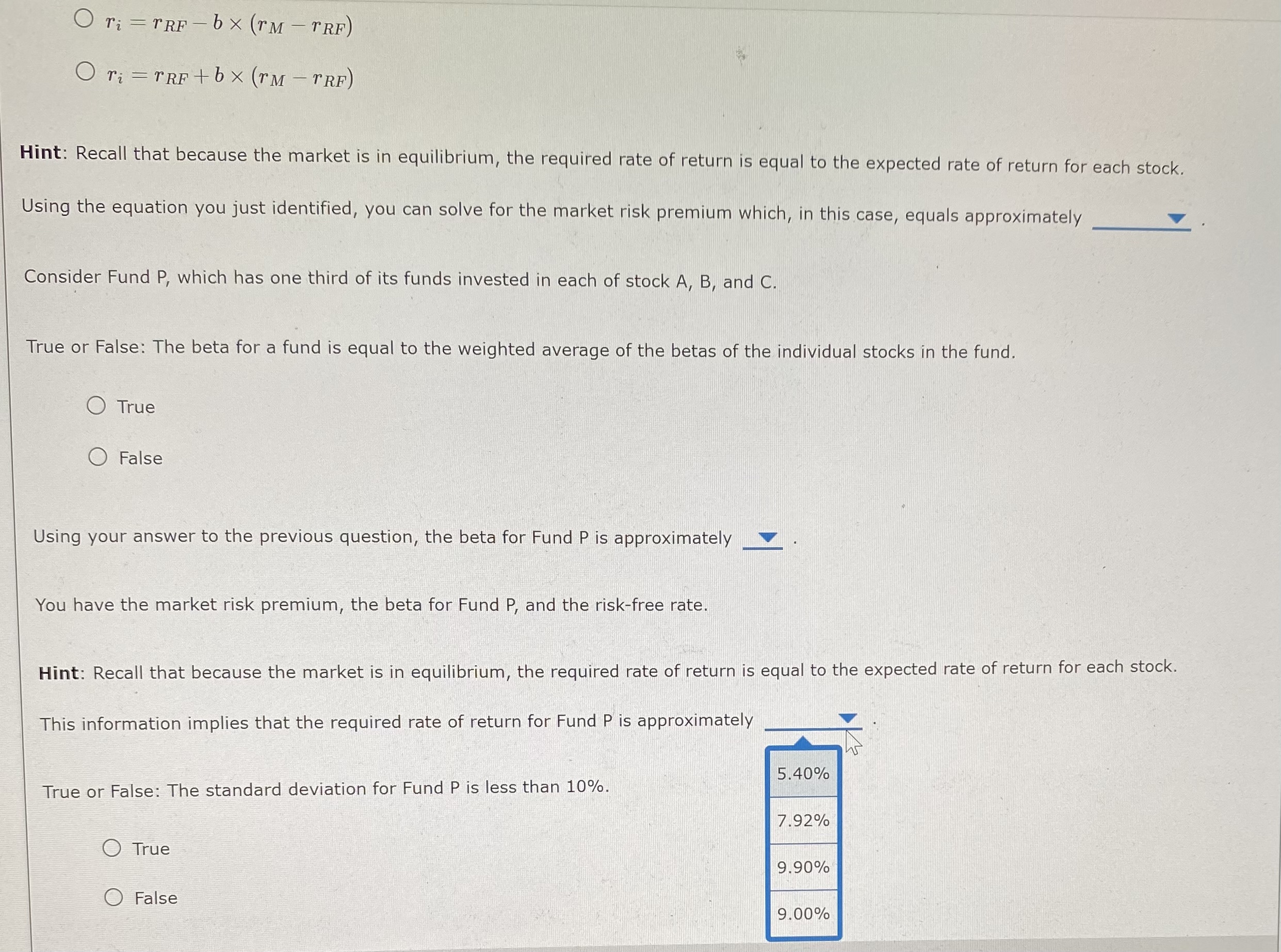
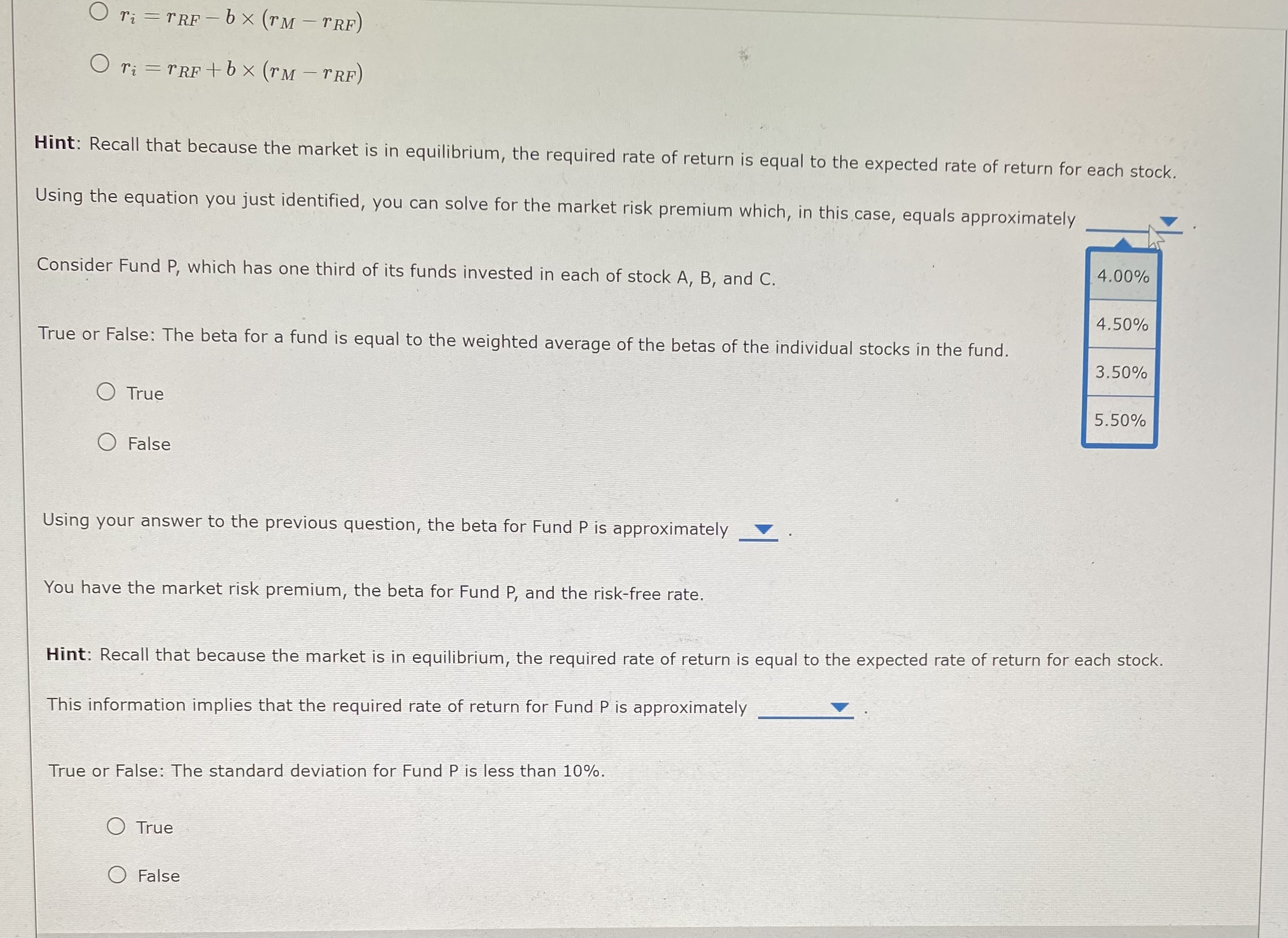
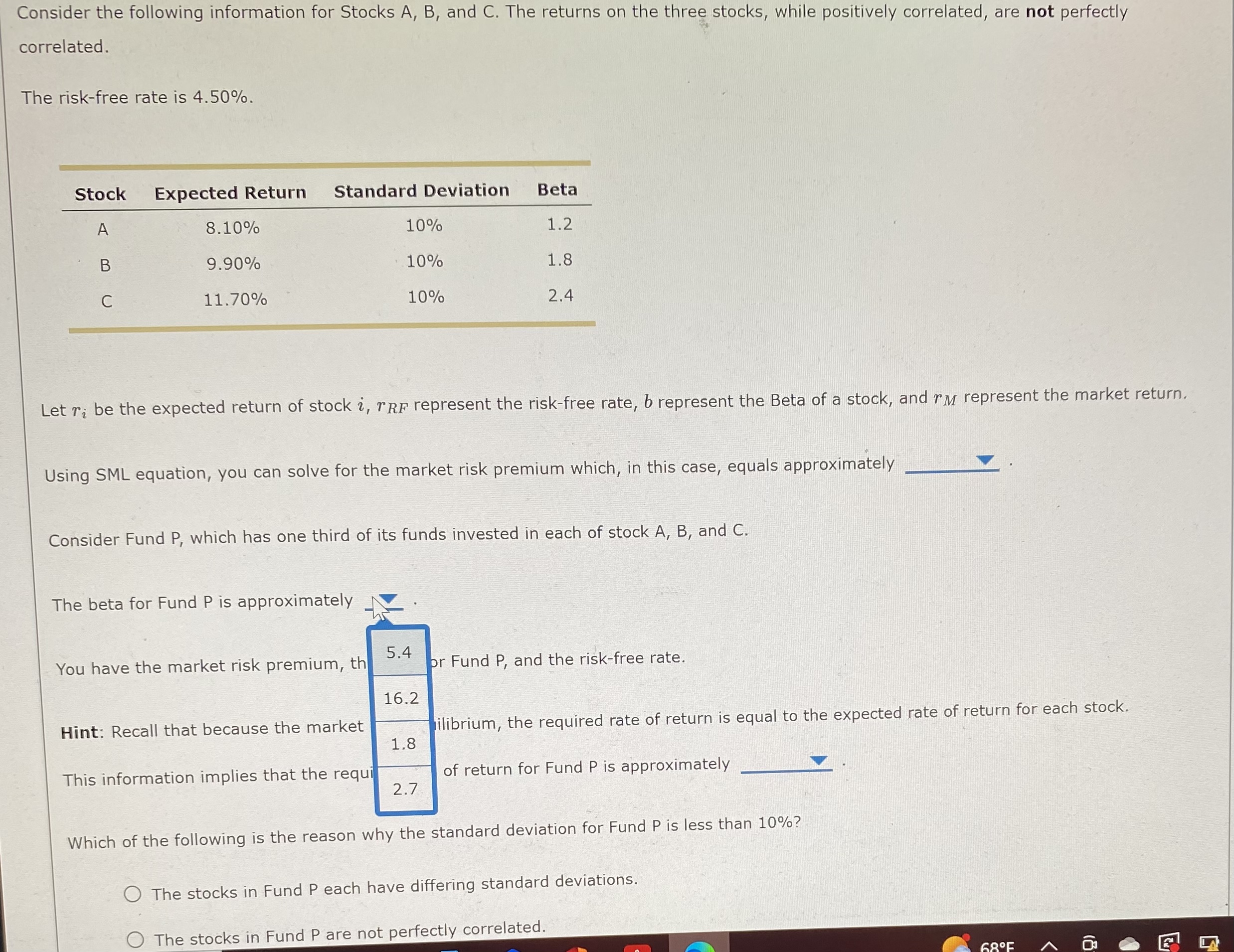
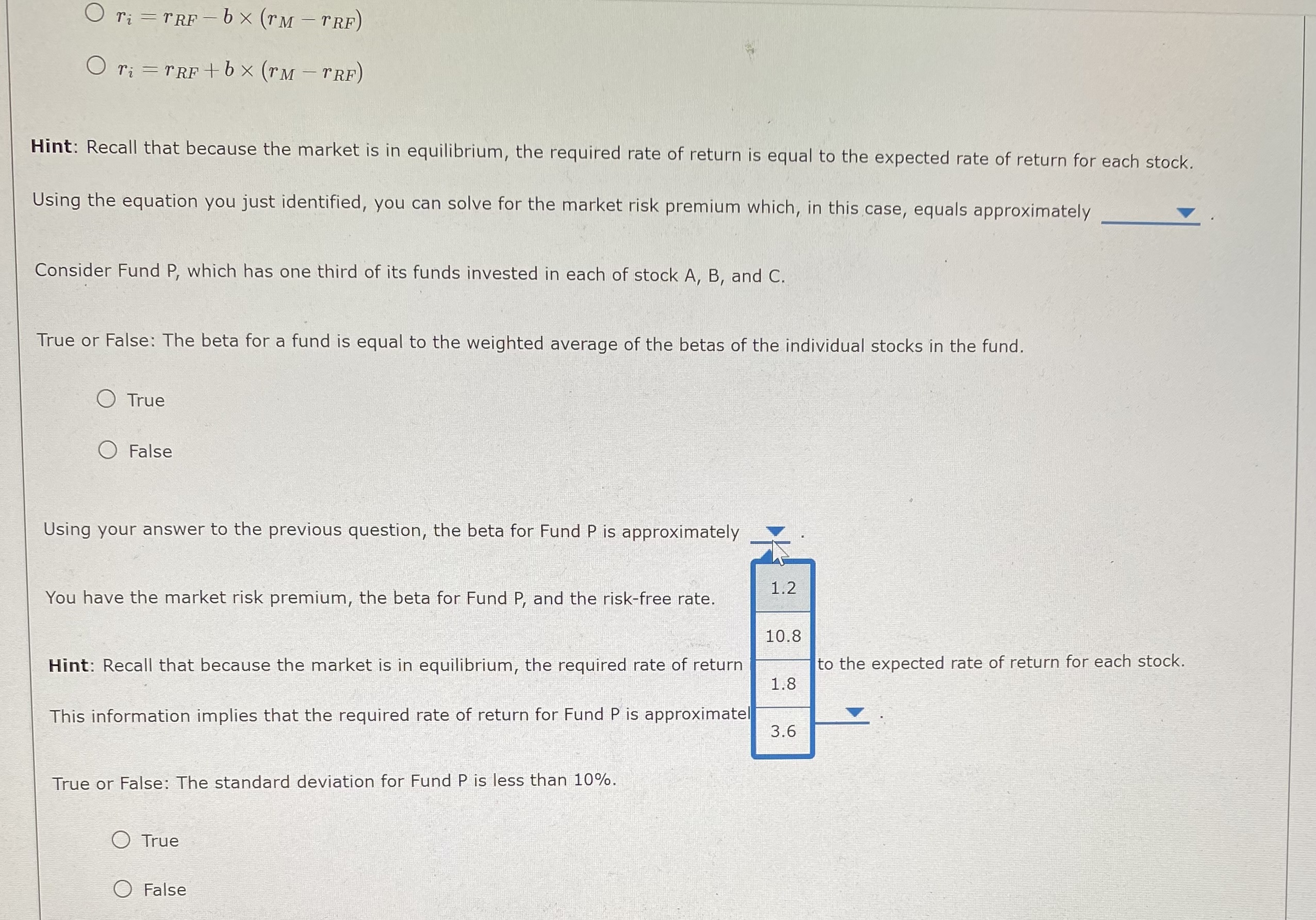
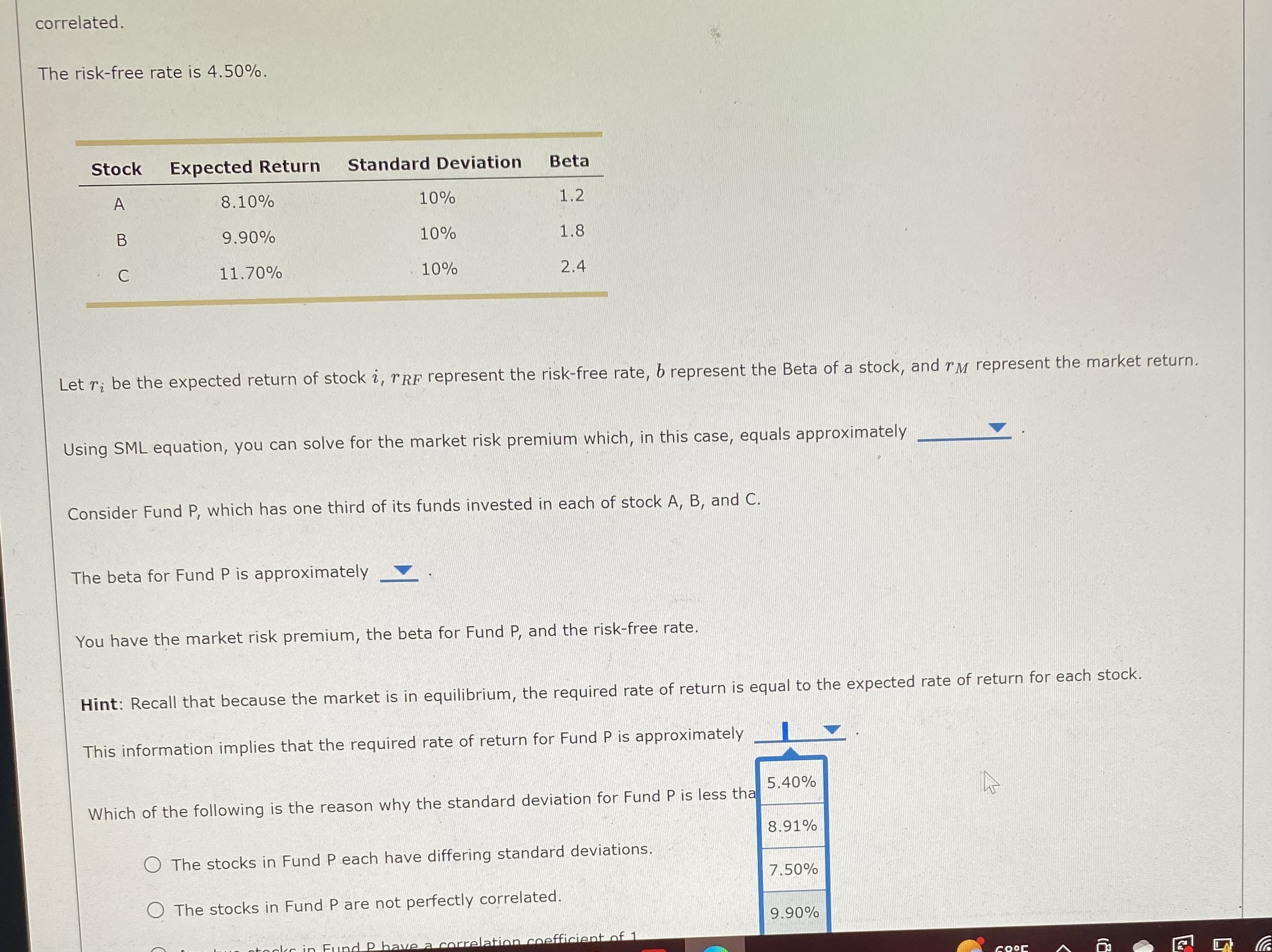
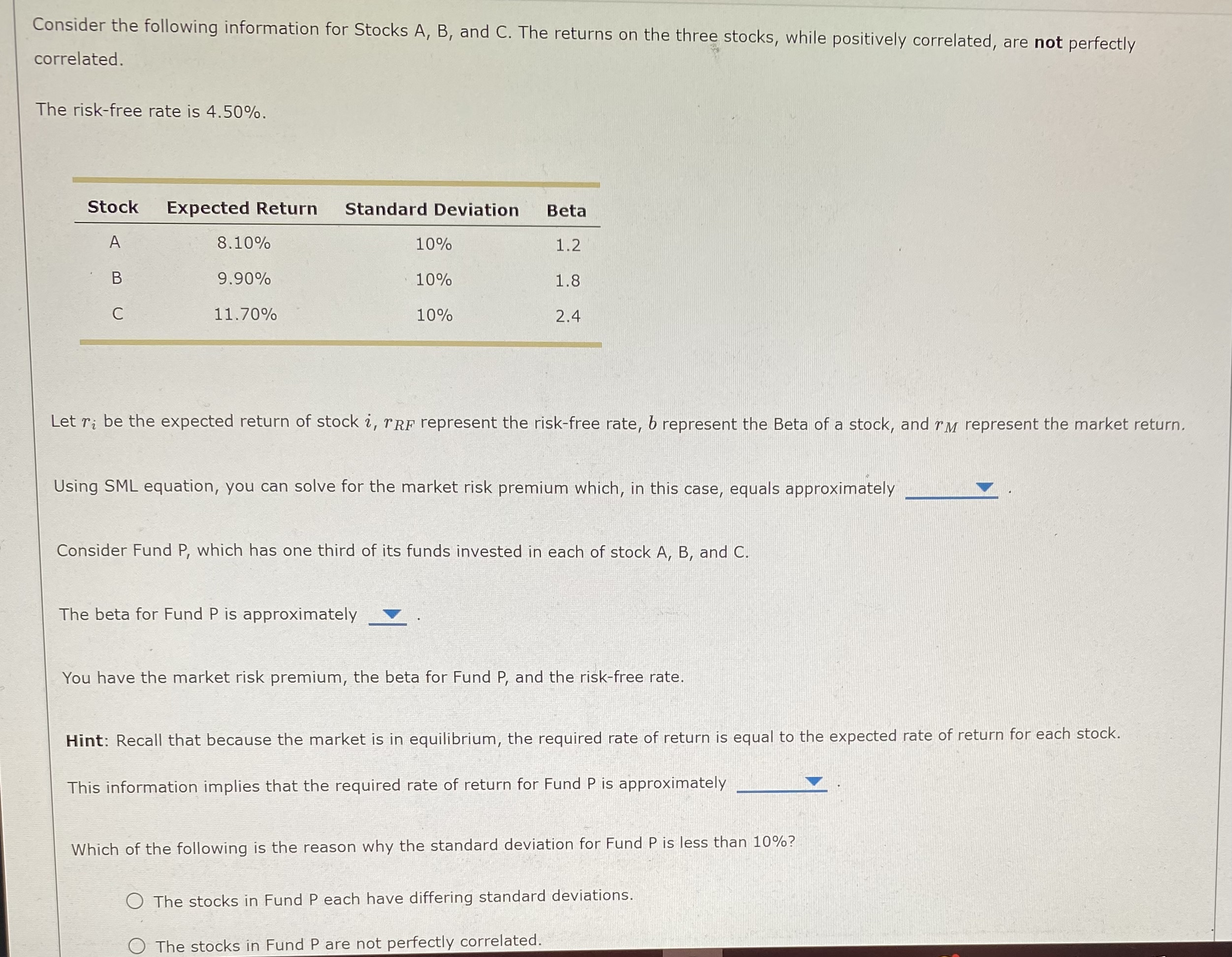
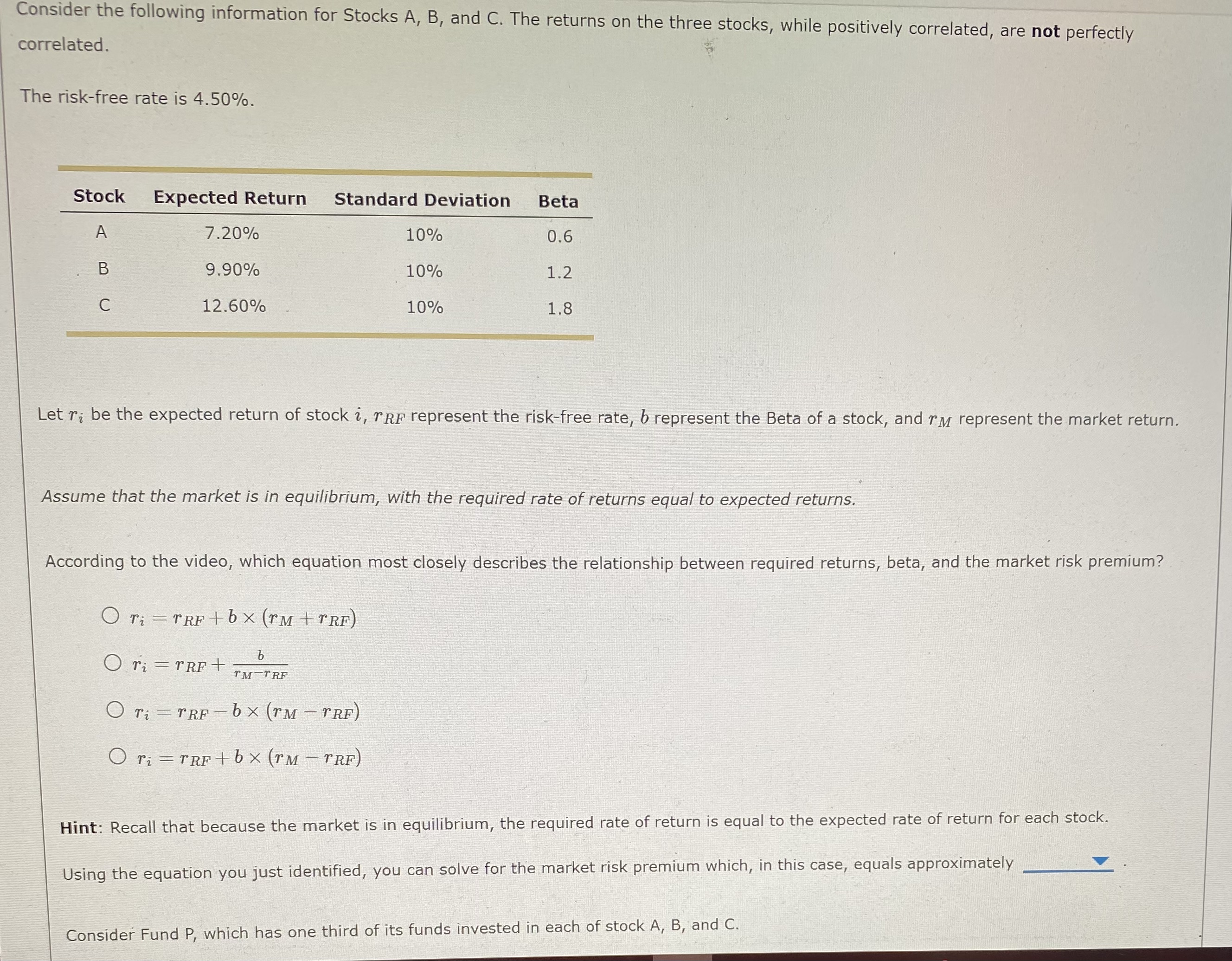
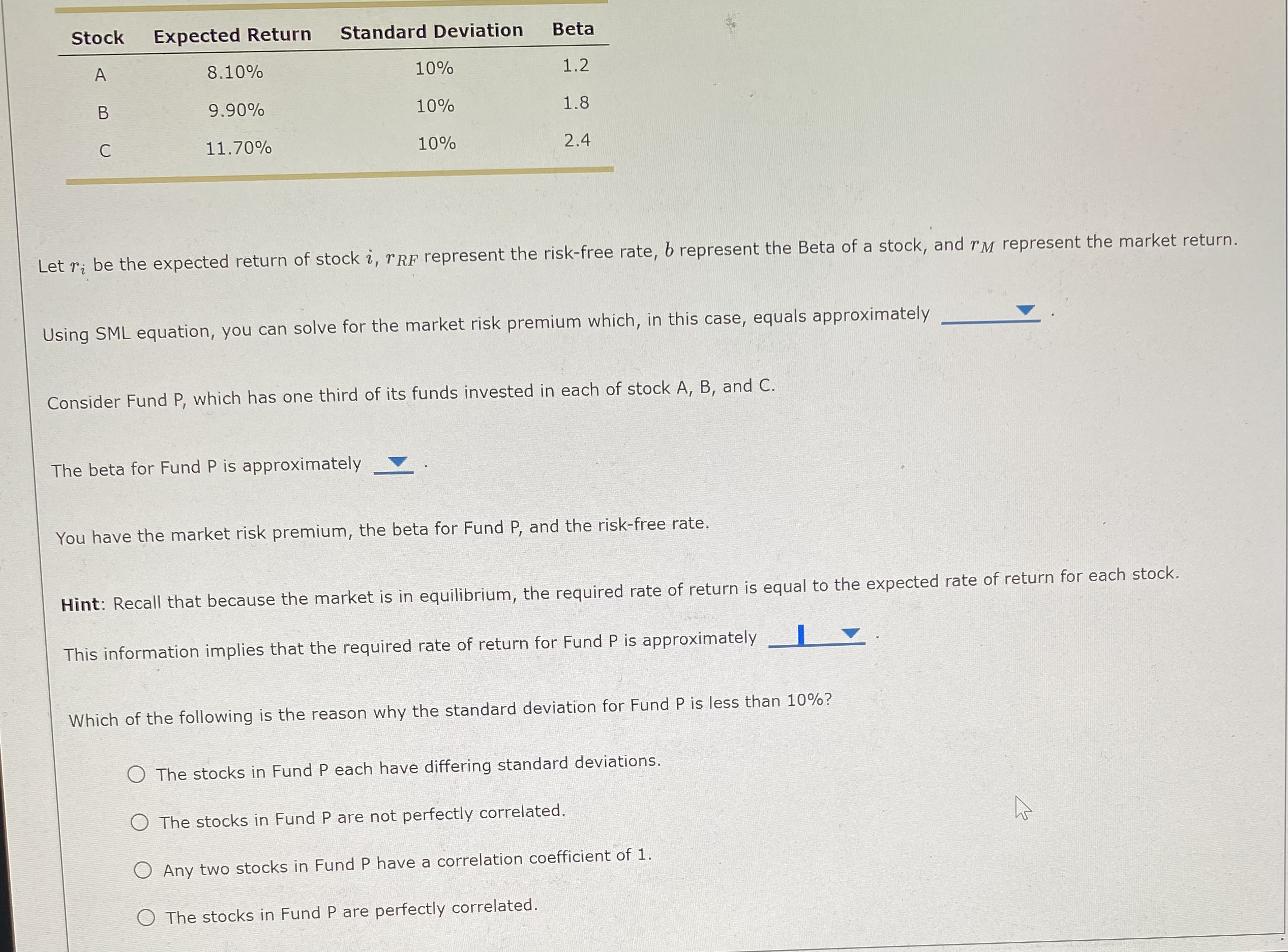
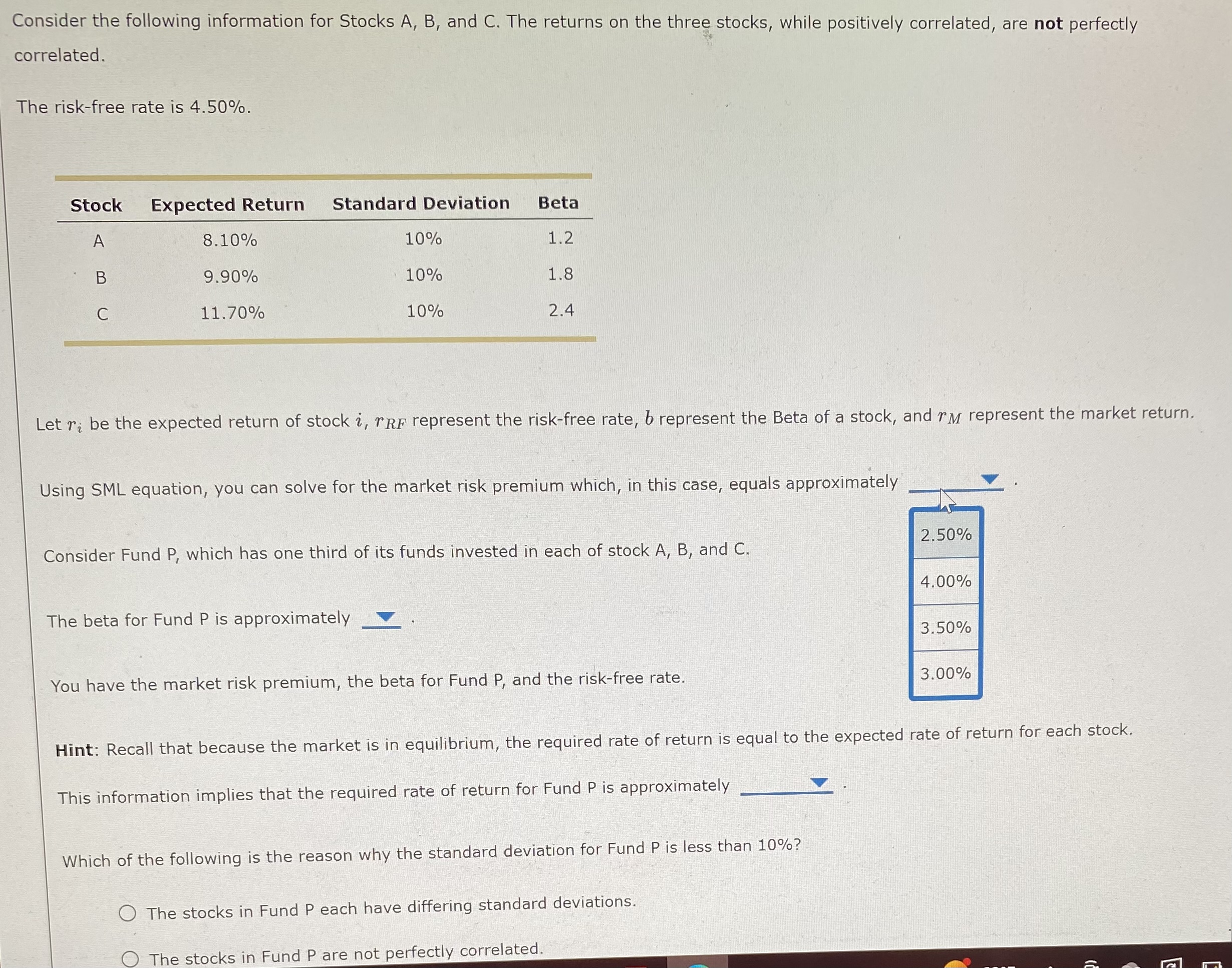
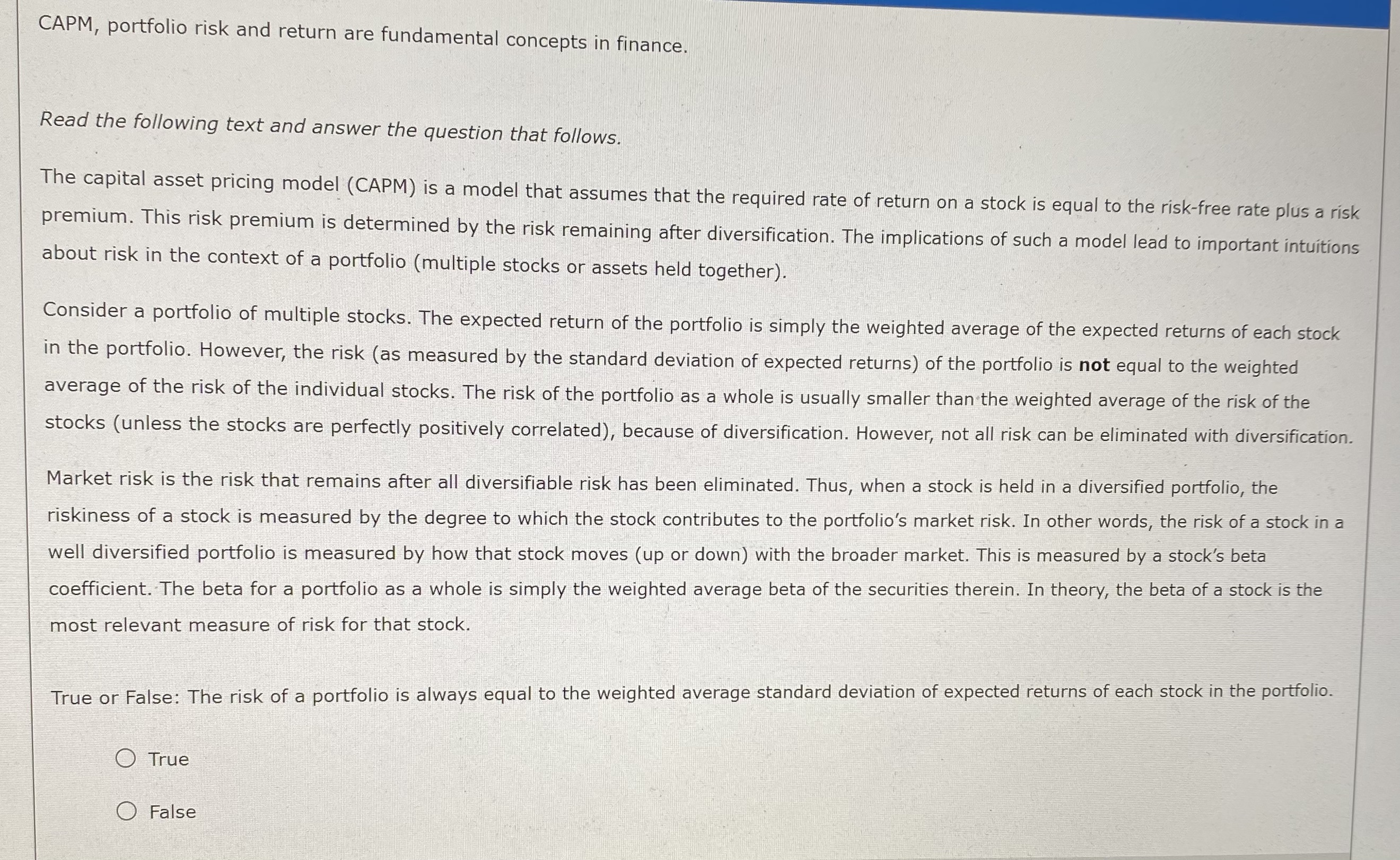
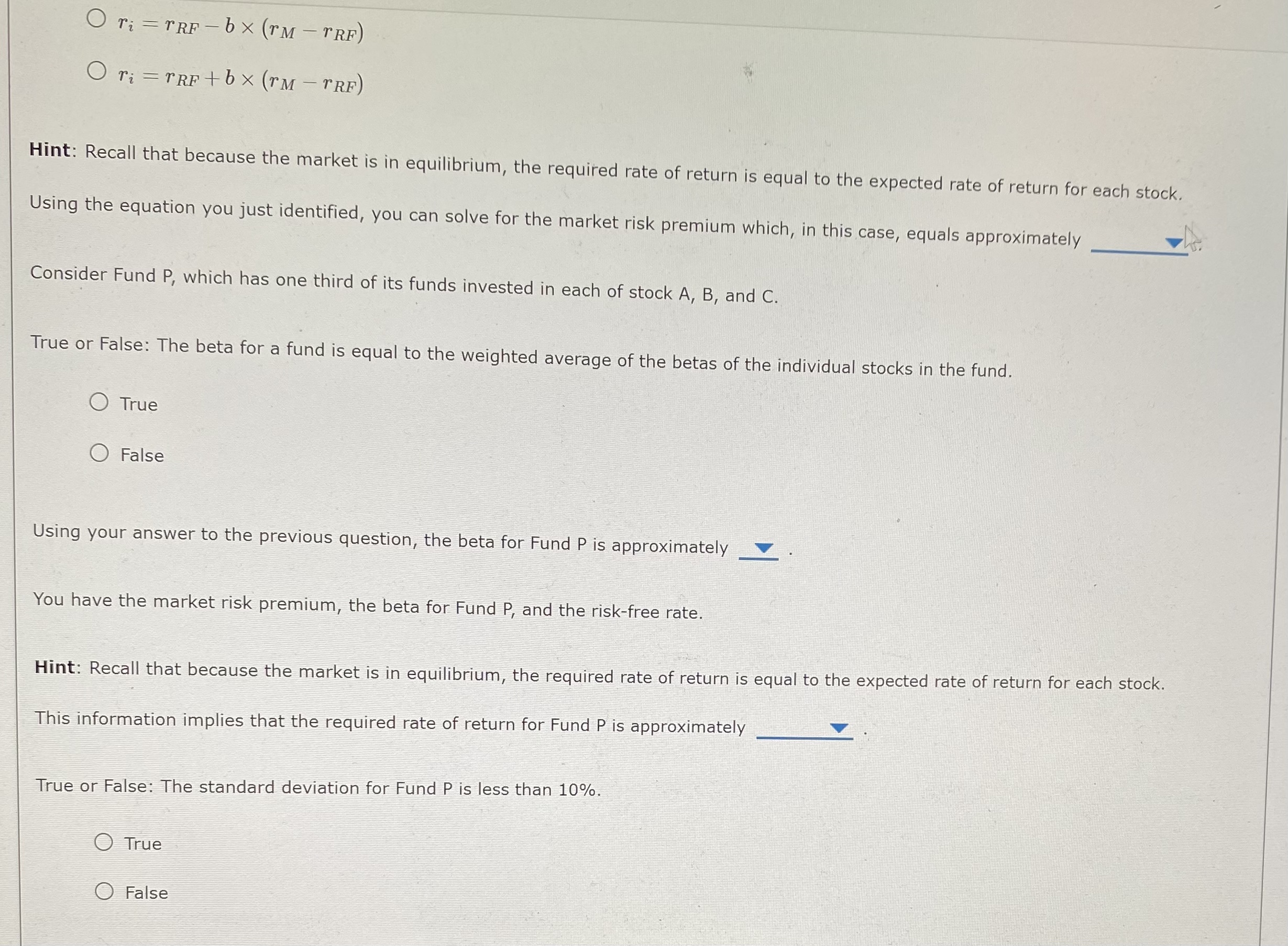
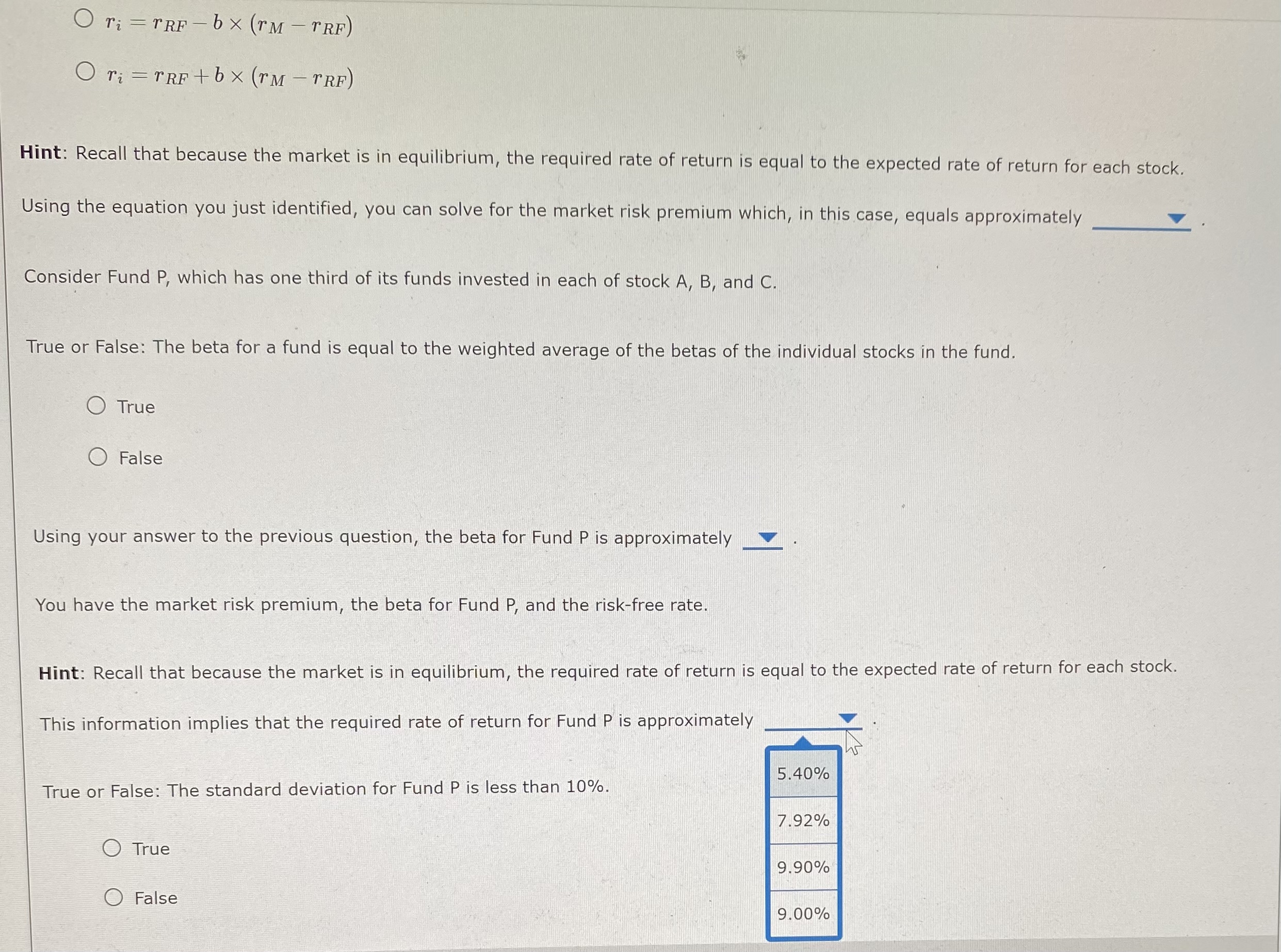
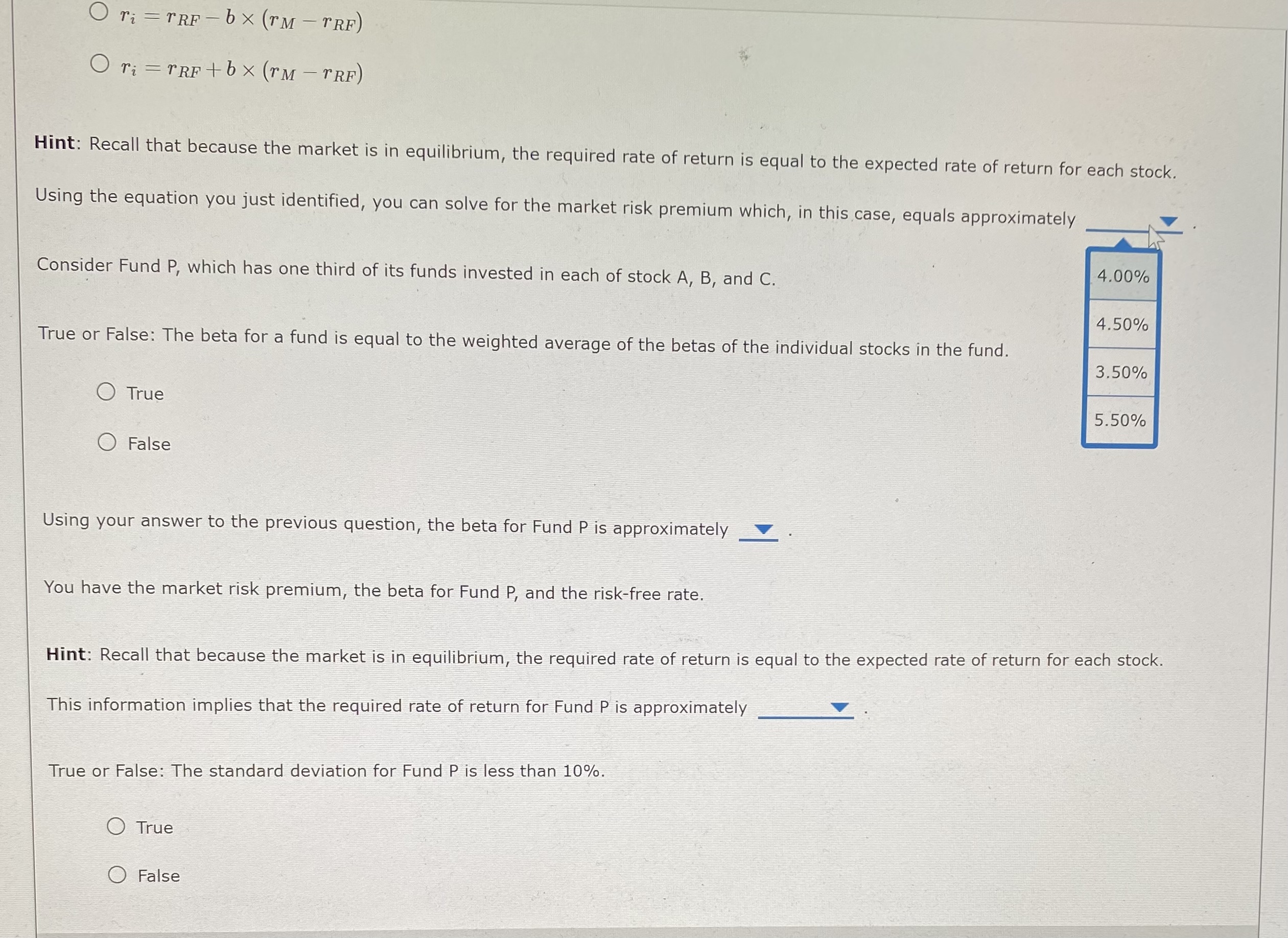
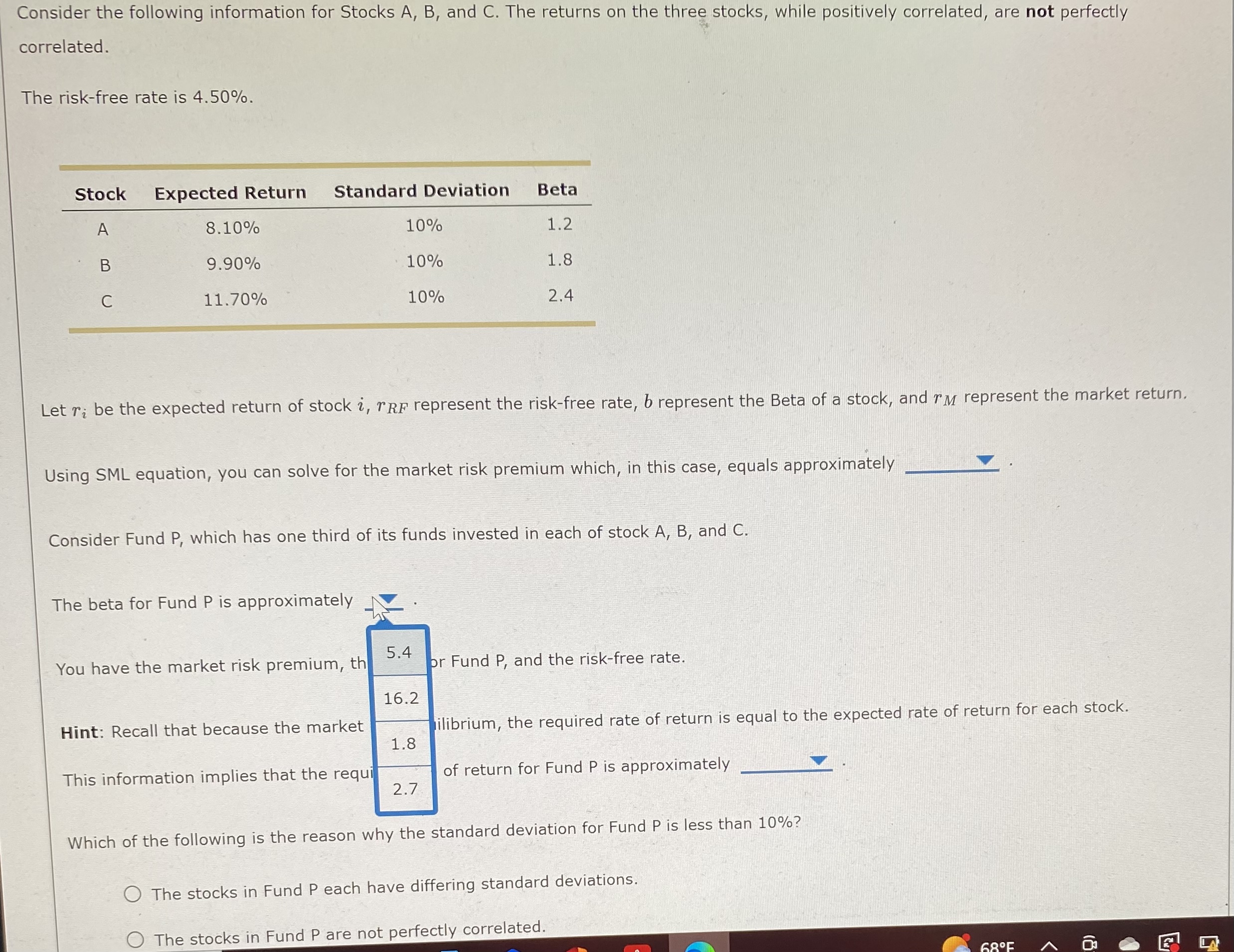
O Ti = TRF -bX (TM - TRF) O Ti = TRF +bx (rM - TRF) Hint: Recall that because the market is in equilibrium, the required rate of return is equal to the expected rate of return for each stock. Using the equation you just identified, you can solve for the market risk premium which, in this case, equals approximately Consider Fund P, which has one third of its funds invested in each of stock A, B, and C. True or False: The beta for a fund is equal to the weighted average of the betas of the individual stocks in the fund. O True O False Using your answer to the previous question, the beta for Fund P is approximately You have the market risk premium, the beta for Fund P, and the risk-free rate. 1.2 10.8 Hint: Recall that because the market is in equilibrium, the required rate of return to the expected rate of return for each stock. 1.8 This information implies that the required rate of return for Fund P is approximate 3.6 True or False: The standard deviation for Fund P is less than 10%. O True O Falsecorrelated. The riskfree rate is 4.50%. Stock Expected Return Standard Deviation Beta A 8.10% 10% 1.2 B 9.90% 10% 1.8 C 11.70% 10% 2.4 Let r,- be the expected return of stock 2', TRF represent the risk-free rate, b represent the Beta of a stock, and TM represent the market return. V Using SML equation, you can solve for the market risk premium which, in this case, equals approximately . Consider Fund P, which has one third of its funds invested in each of stock A, B, and C. The beta for Fund P is approximately V You have the market risk premium, the beta for Fund P, and the riskfree rate. uilibrium, the required rate of return is equal to the expected rate of return for each stock. urn for Fund P is approximately I Y . Hint: Recall that because the market is in eq This information implies that the required rate of ret Which of the following is the reason why the standard deviation for Fund P is less th 0 The stocks in Fund P each have differing standard deviations. O The stocks in Fund F are not perfectly correlated. A . L..- -pAnl/r in PM I Consider the following information for Stocks A, B, and C. The returns on the three stocks, while positively correlated, are not perfectly correlated. The risk-free rate is 4.50%. Stock Expected Return Standard Deviation Beta A 8.10% 10% 1.2 B 9.90% 10% 1.8 C 11.70% 10% 2.4 Let ri be the expected return of stock 2, TRF represent the risk-free rate, b represent the Beta of a stock, and I'M represent the market return. Using SML equation, you can solve for the market risk premium which, in this case, equals approximately Consider Fund P, which has one third of its funds invested in each of stock A, B, and C. The beta for Fund P is approximately _ You have the market risk premium, the beta for Fund P, and the risk-free rate. Hint: Recall that because the market is in equilibrium, the required rate of return is equal to the expected rate of return for each stock. This information implies that the required rate of return for Fund P is approximately Which of the following is the reason why the standard deviation for Fund P is less than 10%? O The stocks in Fund P each have differing standard deviations. O The stocks in Fund P are not perfectly correlated.Consider the following information for Stocks A, B, and C. The returns on the three stocks, while positively correlated, are not perfectly correlated. The risk-free rate is 4.50%. Stock Expected Return Standard Deviation Beta A 7.20% 10% 0.6 B 9.90% 10% 1.2 C 12.60% 10% 1.8 Let ri be the expected return of stock i, TRF represent the risk-free rate, b represent the Beta of a stock, and I'M represent the market return. Assume that the market is in equilibrium, with the required rate of returns equal to expected returns. According to the video, which equation most closely describes the relationship between required returns, beta, and the market risk premium? O Ti = TRF +bx (TM +TRF) O Ti = TRF + TM -T RF O Ti =TRF -bX (TM - TRF) O Ti = TRF+6x (TM - TRF) Hint: Recall that because the market is in equilibrium, the required rate of return is equal to the expected rate of return for each stock. Using the equation you just identified, you can solve for the market risk premium which, in this case, equals approximately Consider Fund P, which has one third of its funds invested in each of stock A, B, and C.Stock Expected Return Standard Deviation Beta A 8.10% 10% 1.2 B 9.90% 10% 1.8 C 11.70% 10% 2.4 Let ri be the expected return of stock i, TRF represent the risk-free rate, b represent the Beta of a stock, and I'M represent the market return. Using SML equation, you can solve for the market risk premium which, in this case, equals approximately Consider Fund P, which has one third of its funds invested in each of stock A, B, and C. The beta for Fund P is approximately You have the market risk premium, the beta for Fund P, and the risk-free rate. Hint: Recall that because the market is in equilibrium, the required rate of return is equal to the expected rate of return for each stock. This information implies that the required rate of return for Fund P is approximately Which of the following is the reason why the standard deviation for Fund P is less than 10%? The stocks in Fund P each have differing standard deviations. The stocks in Fund P are not perfectly correlated. W Any two stocks in Fund P have a correlation coefficient of 1. The stocks in Fund P are perfectly correlated.Consider the following information for Stocks A, B, and C. The returns on the three stocks, while positively correlated, are not perfectly correlated. The risk-free rate is 4.50%. Stock Expected Return Standard Deviation Beta A 8.10% 10% 1.2 B 9.90% 10% 1.8 C 11.70% 10% 2.4 Let ri be the expected return of stock , TRF represent the risk-free rate, b represent the Beta of a stock, and I'M represent the market return. Using SML equation, you can solve for the market risk premium which, in this case, equals approximately Consider Fund P, which has one third of its funds invested in each of stock A, B, and C. 2.50% 4.00% The beta for Fund P is approximately 3.50% You have the market risk premium, the beta for Fund P, and the risk-free rate. 3.00% Hint: Recall that because the market is in equilibrium, the required rate of return is equal to the expected rate of return for each stock. This information implies that the required rate of return for Fund P is approximately Which of the following is the reason why the standard deviation for Fund P is less than 10%? The stocks in Fund P each have differing standard deviations. The stocks in Fund P are not perfectly correlated.CAPM, portfolio risk and return are fundamental concepts in finance. Read the following text and answer the question that follows. The capital asset pricing model (CAPM) is a model that assumes that the required rate of return on a stock is equal to the risk-free rate plus a risk premium. This risk premium is determined by the risk remaining after diversification. The implications of such a model lead to important intuitions about risk in the context of a portfolio ( multiple stocks or assets held together). Consider a portfolio of multiple stocks. The expected return of the portfolio is simply the weighted average of the expected returns of each stock in the portfolio. However, the risk (as measured by the standard deviation of expected returns) of the portfolio is not equal to the weighted average of the risk of the individual stocks. The risk of the portfolio as a whole is usually smaller than the weighted average of the risk of the stocks (unless the stocks are perfectly positively correlated), because of diversification. However, not all risk can be eliminated with diversification. Market risk is the risk that remains after all diversifiable risk has been eliminated. Thus, when a stock is held in a diversified portfolio, the riskiness of a stock is measured by the degree to which the stock contributes to the portfolio's market risk. In other words, the risk of a stock in a well diversified portfolio is measured by how that stock moves (up or down) with the broader market. This is measured by a stock's beta coefficient. The beta for a portfolio as a whole is simply the weighted average beta of the securities therein. In theory, the beta of a stock is the most relevant measure of risk for that stock. True or False: The risk of a portfolio is always equal to the weighted average standard deviation of expected returns of each stock in the portfolio. O True O FalseO Ti = TRF -bX (rM - TRF) O ri = TRF +bx (TM - TRF) Hint: Recall that because the market is in equilibrium, the required rate of return is equal to the expected rate of return for each stock. Using the equation you just identified, you can solve for the market risk premium which, in this case, equals approximately Consider Fund P, which has one third of its funds invested in each of stock A, B, and C. True or False: The beta for a fund is equal to the weighted average of the betas of the individual stocks in the fund. O True O False Using your answer to the previous question, the beta for Fund P is approximately You have the market risk premium, the beta for Fund P, and the risk-free rate. Hint: Recall that because the market is in equilibrium, the required rate of return is equal to the expected rate of return for each stock. This information implies that the required rate of return for Fund P is approximately True or False: The standard deviation for Fund P is less than 10%. O True O FalseO Ti = TRF - bX (TM - TRF) O ri = TRF +6X (TM -TRF) Hint: Recall that because the market is in equilibrium, the required rate of return is equal to the expected rate of return for each stock. Using the equation you just identified, you can solve for the market risk premium which, in this case, equals approximately Consider Fund P, which has one third of its funds invested in each of stock A, B, and C. True or False: The beta for a fund is equal to the weighted average of the betas of the individual stocks in the fund. O True O False Using your answer to the previous question, the beta for Fund P is approximately You have the market risk premium, the beta for Fund P, and the risk-free rate. Hint: Recall that because the market is in equilibrium, the required rate of return is equal to the expected rate of return for each stock. This information implies that the required rate of return for Fund P is approximately 5.40% True or False: The standard deviation for Fund P is less than 10%. 7.92% O True 9.90% O False 9.00%Ori = TRF -bX (TM - TRF) O Ti = TRF +bx (rM - TRF) Hint: Recall that because the market is in equilibrium, the required rate of return is equal to the expected rate of return for each stock. Using the equation you just identified, you can solve for the market risk premium which, in this case, equals approximately Consider Fund P, which has one third of its funds invested in each of stock A, B, and C. 4.00% 4.50% True or False: The beta for a fund is equal to the weighted average of the betas of the individual stocks in the fund. 3.50% O True 5.50% O False Using your answer to the previous question, the beta for Fund P is approximately You have the market risk premium, the beta for Fund P, and the risk-free rate. Hint: Recall that because the market is in equilibrium, the required rate of return is equal to the expected rate of return for each stock. This information implies that the required rate of return for Fund P is approximately True or False: The standard deviation for Fund P is less than 10%. O True O FalseConsid th ' ' rm ' er e followmg Info ation for Stocks A, B, and C. The returns on the three stocks, while positively correlated are not perfectly K I correlated. The risk-free rate is 4.50%. Stock Expected Return Standard Deviation Beta A 8.10% 10% 1.2 B 9.90% 10% 1.8 C 11.70% 10% 2.4 Let r, be the expected return of stock 'i, er represent the risk-free rate, (2 represent the Beta of a stock, and TM represent the market return. 7 Using SML equation, you can solve for the market risk premium which, in this case, equals approximately . Consider Fund P, which has one third of its funds invested in each of stock A, B, and C. The beta for Fund P is approximately ilibrium, the required rate of return is equal to the expected rate of return for each stock. This information implies that the reqUI - of return for Fund P is approximately V . 2.7 Which of the following is the reason why the standard deviation for Fund P is less than 10%? O The stocks in Fund P each have differing standard deviations. O The stocks in Fund P are not perfectly correlated
Step by Step Solution
There are 3 Steps involved in it

Get step-by-step solutions from verified subject matter experts