



Question: OB 1. In 2019, when the COVID-19 virus first started to spread throughout the world, the experts had very little idea about this disease. They
OB
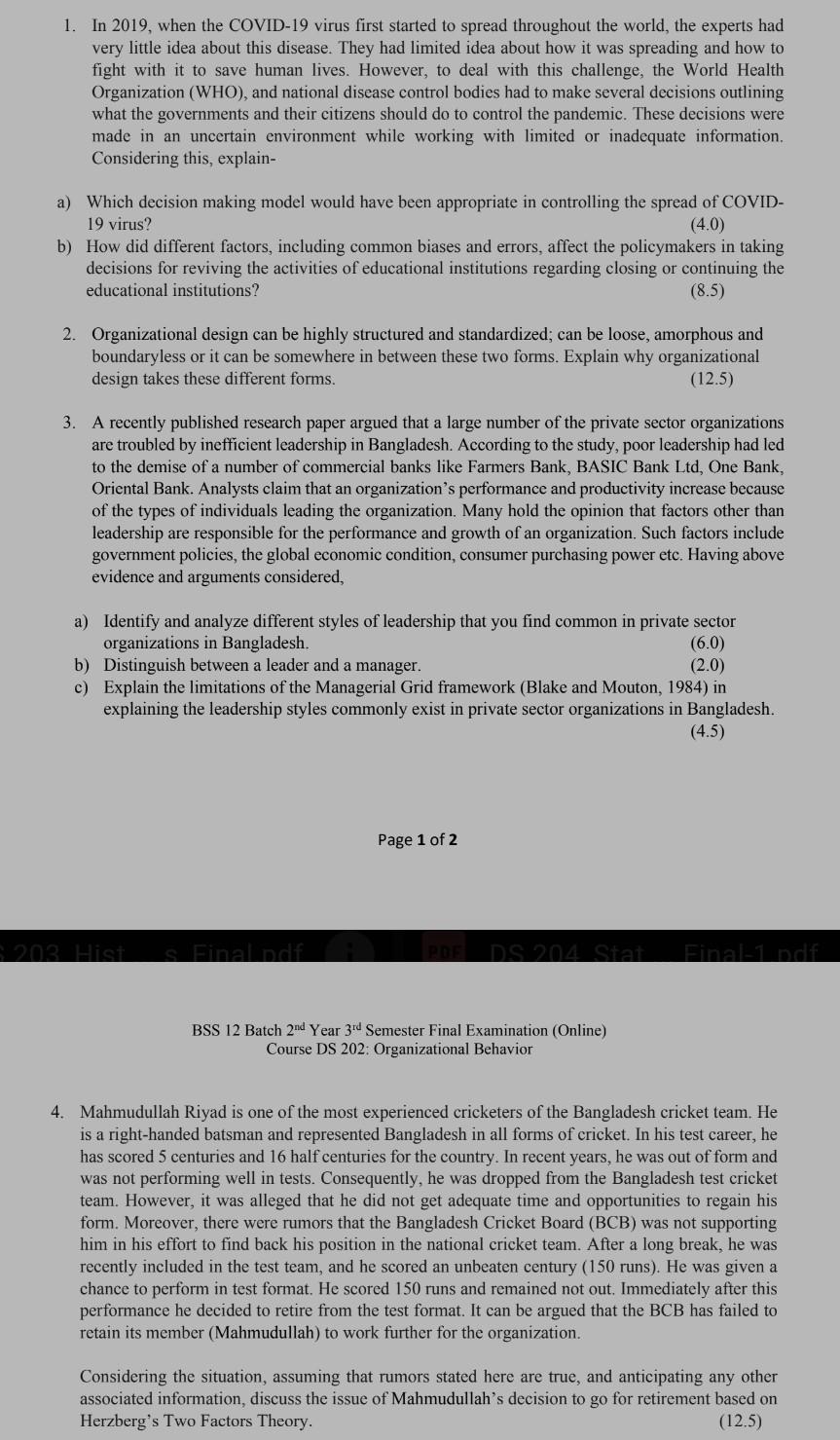
1. In 2019, when the COVID-19 virus first started to spread throughout the world, the experts had very little idea about this disease. They had limited idea about how it was spreading and how to fight with it to save human lives. However, to deal with this challenge, the World Health Organization (WHO), and national disease control bodies had to make several decisions outlining what the governments and their citizens should do to control the pandemic. These decisions were made in an uncertain environment while working with limited or inadequate information. Considering this, explain- a) Which decision making model would have been appropriate in controlling the spread of COVID19 virus? (4.0) b) How did different factors, including common biases and errors, affect the policymakers in taking decisions for reviving the activities of educational institutions regarding closing or continuing the educational institutions? (8.5) 2. Organizational design can be highly structured and standardized; can be loose, amorphous and boundaryless or it can be somewhere in between these two forms. Explain why organizational design takes these different forms. (12.5) 3. A recently published research paper argued that a large number of the private sector organizations are troubled by inefficient leadership in Bangladesh. According to the study, poor leadership had led to the demise of a number of commercial banks like Farmers Bank, BASIC Bank Ltd, One Bank, Oriental Bank. Analysts claim that an organization's performance and productivity increase because of the types of individuals leading the organization. Many hold the opinion that factors other than leadership are responsible for the performance and growth of an organization. Such factors include government policies, the global economic condition, consumer purchasing power etc. Having above evidence and arguments considered, a) Identify and analyze different styles of leadership that you find common in private sector organizations in Bangladesh. (6.0) b) Distinguish between a leader and a manager. (2.0) c) Explain the limitations of the Managerial Grid framework (Blake and Mouton, 1984) in explaining the leadership styles commonly exist in private sector organizations in Bangladesh. (4.5) Page 1 of 2 BSS 12 Batch 2 2nd Year 3rd Semester Final Examination (Online) Course DS 202: Organizational Behavior 4. Mahmudullah Riyad is one of the most experienced cricketers of the Bangladesh cricket team. He is a right-handed batsman and represented Bangladesh in all forms of cricket. In his test career, he has scored 5 centuries and 16 half centuries for the country. In recent years, he was out of form and was not performing well in tests. Consequently, he was dropped from the Bangladesh test cricket team. However, it was alleged that he did not get adequate time and opportunities to regain his form. Moreover, there were rumors that the Bangladesh Cricket Board (BCB) was not supporting him in his effort to find back his position in the national cricket team. After a long break, he was recently included in the test team, and he scored an unbeaten century (150 runs). He was given a chance to perform in test format. He scored 150 runs and remained not out. Immediately after this performance he decided to retire from the test format. It can be argued that the BCB has failed to retain its member (Mahmudullah) to work further for the organization. Considering the situation, assuming that rumors stated here are true, and anticipating any other associated information, discuss the issue of Mahmudullah's decision to go for retirement based on Herzberg's Two Factors Theory. (12.5)
Step by Step Solution
There are 3 Steps involved in it

Get step-by-step solutions from verified subject matter experts