







Question: Objective Develop an Excel spreadsheet to calculate and plot the SICP pressure at the choke against the depth to the top of a gas-kick column.
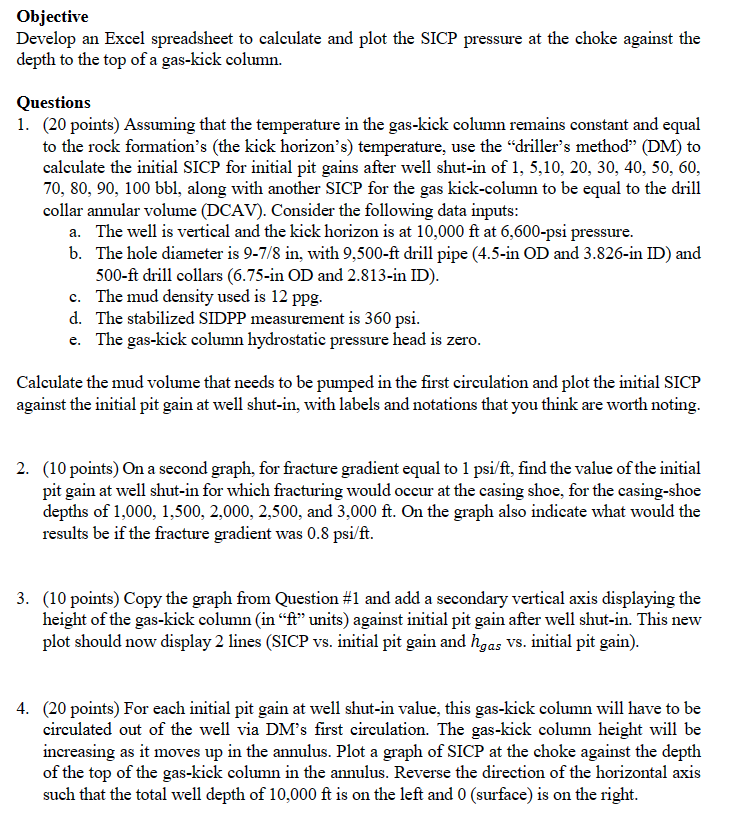
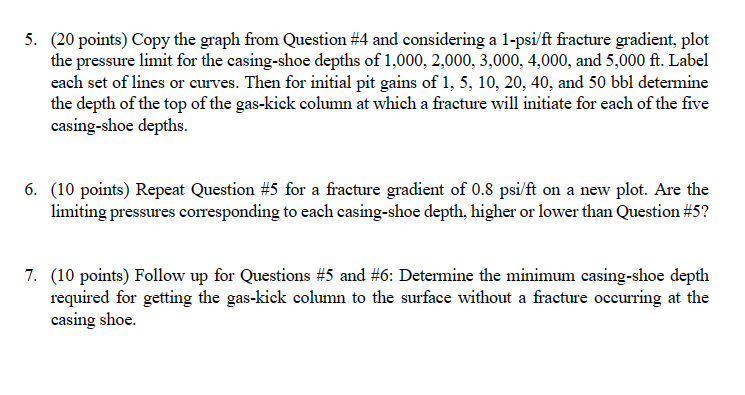
Objective Develop an Excel spreadsheet to calculate and plot the SICP pressure at the choke against the depth to the top of a gas-kick column. Questions 1. (20 points) Assuming that the temperature in the gas-kick column remains constant and equal to the rock formation's (the kick horizon's) temperature, use the "driller's method" (DM) to calculate the initial SICP for initial pit gains after well shut-in of 1, 5,10, 20, 30, 40, 50, 60, 70, 80, 90, 100 bbl, along with another SICP for the gas kick-column to be equal to the drill collar annular volume (DCAV). Consider the following data inputs: a. The well is vertical and the kick horizon is at 10,000 ft at 6,600-psi pressure. b. The hole diameter is 9-7/8 in, with 9,500-ft drill pipe (4.5-in OD and 3.826-in ID) and 500-ft drill collars (6.75-in OD and 2.813-in ID). . The mud density used is 12 ppg. d. The stabilized SIDPP measurement is 360 psi. e. The gas-kick column hydrostatic pressure head is zero. Calculate the mud volume that needs to be pumped in the first circulation and plot the initial SICP against the initial pit gain at well shut-in, with labels and notations that you think are worth noting. 2. (10 points) On a second graph, for fracture gradient equal to 1 psi/ft, find the value of the initial pit gain at well shut-in for which fracturing would occur at the casing shoe, for the casing-shoe depths of 1,000, 1,500, 2,000, 2,500, and 3,000 ft. On the graph also indicate what would the results be if the fracture gradient was 0.8 psi/ft. 3. (10 points) Copy the graph from Question #1 and add a secondary vertical axis displaying the height of the gas-kick column (in "ft" units) against initial pit gain after well shut-in. This new plot should now display 2 lines (SICP vs. initial pit gain and hgas vs. initial pit gain). 4. (20 points) For each initial pit gain at well shut-in value, this gas-kick column will have to be circulated out of the well via DM's first circulation. The gas-kick column height will be increasing as it moves up in the annulus. Plot a graph of SICP at the choke against the depth of the top of the gas-kick column in the annulus. Reverse the direction of the horizontal axis such that the total well depth of 10,000 ft is on the left and 0 (surface) is on the right.5. (20 points) Copy the graph from Question #4 and considering a 1-psv'ft fracture gradient, plot the pressure limit for the casing-shoe depths of 1,000, 2,000, 3,000. 4,000, and 5,000 ft. Label each set of lines or curves. Then for initial pit gains of 1, 5, 10. 20. 40, and 50 bbl determine the depth of the top of the gas-kick column at which a fracture will initiate for each of the five casing-shoe depths. 6. (10 points) Repeat Question #5 for a fracture gradient of 0.8 psi/ft on a new plot. Are the limiting pressures corresponding to each casing-shoe depth, higher or lower than Question #5? 7. (10 points) Follow up for Questions #5 and #6: Determine the minimum casing-shoe depth required for getting the gas-kick column to the surface without a fracture occurring at the casing shoe
Step by Step Solution
There are 3 Steps involved in it

Get step-by-step solutions from verified subject matter experts
 Study Help