







Question: Objective: Learning how apply Tabu Search (TS) manually to a small problem. Problem statement: Consider 10 Boolean variables, Bi, i=1, 2, ..., 10. Each variable
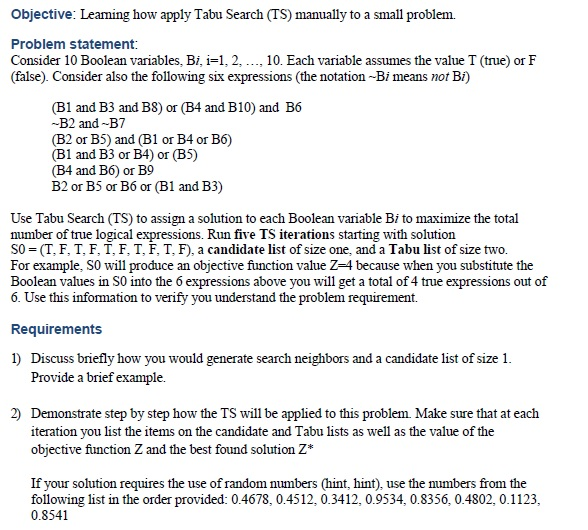
Objective: Learning how apply Tabu Search (TS) manually to a small problem. Problem statement: Consider 10 Boolean variables, Bi, i=1, 2, ..., 10. Each variable assumes the value T (true) or F (false). Consider also the following six expressions (the notation -Bi means not Bi) (B1 and B3 and B8) or (B4 and B10) and B6 --B2 and --B7 (B2 or B5) and (B1 or B4 or B6) (B1 and B3 or B4) or (B5) (B4 and B6) or B9 B2 or B5 or B6 or (B1 and B3) Use Tabu Search (TS) to assign a solution to each Boolean variable Bi to maximize the total number of true logical expressions. Run five TS iterations starting with solution SO = (T, F, T, F, T, F, T, F, T, F), a candidate list of size one, and a Tabu list of size two. For example, So will produce an objective function value Z=4 because when you substitute the Boolean values in SO into the 6 expressions above you will get a total of 4 true expressions out of 6. Use this information to verify you understand the problem requirement. Requirements 1) Discuss briefly how you would generate search neighbors and a candidate list of size 1. Provide a brief example. 2) Demonstrate step by step how the TS will be applied to this problem. Make sure that at each iteration you list the items on the candidate and Tabu lists as well as the value of the objective function Z and the best found solution Z* If your solution requires the use of random numbers (hint, hint), use the numbers from the following list in the order provided: 0.4678, 0.4512, 0.3412, 0.9534, 0.8356, 0.4802, 0.1123, 0.8541 Objective: Learning how apply Tabu Search (TS) manually to a small problem. Problem statement: Consider 10 Boolean variables, Bi, i=1, 2, ..., 10. Each variable assumes the value T (true) or F (false). Consider also the following six expressions (the notation -Bi means not Bi) (B1 and B3 and B8) or (B4 and B10) and B6 --B2 and --B7 (B2 or B5) and (B1 or B4 or B6) (B1 and B3 or B4) or (B5) (B4 and B6) or B9 B2 or B5 or B6 or (B1 and B3) Use Tabu Search (TS) to assign a solution to each Boolean variable Bi to maximize the total number of true logical expressions. Run five TS iterations starting with solution SO = (T, F, T, F, T, F, T, F, T, F), a candidate list of size one, and a Tabu list of size two. For example, So will produce an objective function value Z=4 because when you substitute the Boolean values in SO into the 6 expressions above you will get a total of 4 true expressions out of 6. Use this information to verify you understand the problem requirement. Requirements 1) Discuss briefly how you would generate search neighbors and a candidate list of size 1. Provide a brief example. 2) Demonstrate step by step how the TS will be applied to this problem. Make sure that at each iteration you list the items on the candidate and Tabu lists as well as the value of the objective function Z and the best found solution Z* If your solution requires the use of random numbers (hint, hint), use the numbers from the following list in the order provided: 0.4678, 0.4512, 0.3412, 0.9534, 0.8356, 0.4802, 0.1123, 0.8541
Step by Step Solution
There are 3 Steps involved in it

Get step-by-step solutions from verified subject matter experts
 Study Help