







Question: Objective Short Answer 11. Upon D's death, D: 1. owned $20,000,000 cash and securities; 2. was receiving $100,000 per year from an annuity D had
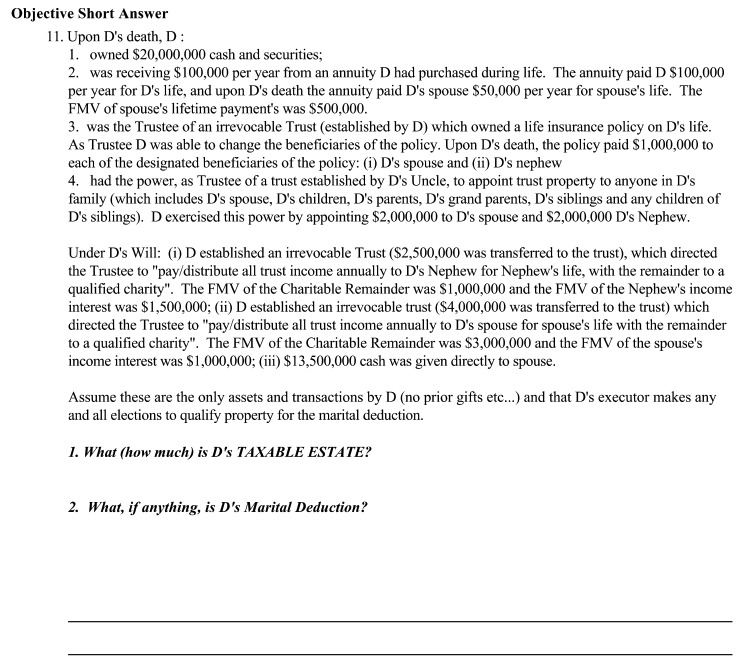
Objective Short Answer 11. Upon D's death, D: 1. owned $20,000,000 cash and securities; 2. was receiving $100,000 per year from an annuity D had purchased during life. The annuity paid D $100,000 per year for D's life, and upon D's death the annuity paid D's spouse $50,000 per year for spouse's life. The FMV of spouse's lifetime payment's was $500,000. 3. was the Trustee of an irrevocable Trust (established by D) which owned a life insurance policy on D's life. As Trustee D was able to change the beneficiaries of the policy. Upon D's death, the policy paid $1,000,000 to each of the designated beneficiaries of the policy: (i) D's spouse and (ii) D's nephew 4. had the power, as Trustee of a trust established by D's Uncle, to appoint trust property to anyone in D's family (which includes D's spouse, D's children, D's parents, D's grand parents, D's siblings and any children of D's siblings). Dexercised this power by appointing $2,000,000 to D's spouse and $2,000,000 D's Nephew. Under D's Will: (1) D established an irrevocable Trust ($2,500,000 was transferred to the trust), which directed the Trustee to "pay/distribute all trust income annually to D's Nephew for Nephew's life, with the remainder to a qualified charity". The FMV of the Charitable Remainder was $1,000,000 and the FMV of the Nephew's income interest was $1,500,000; (ii) D established an irrevocable trust ($4,000,000 was transferred to the trust) which directed the Trustee to "pay/distribute all trust income annually to D's spouse for spouse's life with the remainder to a qualified charity". The FMV of the Charitable Remainder was $3,000,000 and the FMV of the spouse's income interest was $1,000,000; (iii) $13,500,000 cash was given directly to spouse. Assume these are the only assets and transactions by D (no prior gifts etc...) and that D's executor makes any and all elections to qualify property for the marital deduction. 1. What (how much) is D's TAXABLE ESTATE? 2. What, if anything, is D's Marital Deduction? Objective Short Answer 11. Upon D's death, D: 1. owned $20,000,000 cash and securities; 2. was receiving $100,000 per year from an annuity D had purchased during life. The annuity paid D $100,000 per year for D's life, and upon D's death the annuity paid D's spouse $50,000 per year for spouse's life. The FMV of spouse's lifetime payment's was $500,000. 3. was the Trustee of an irrevocable Trust (established by D) which owned a life insurance policy on D's life. As Trustee D was able to change the beneficiaries of the policy. Upon D's death, the policy paid $1,000,000 to each of the designated beneficiaries of the policy: (i) D's spouse and (ii) D's nephew 4. had the power, as Trustee of a trust established by D's Uncle, to appoint trust property to anyone in D's family (which includes D's spouse, D's children, D's parents, D's grand parents, D's siblings and any children of D's siblings). Dexercised this power by appointing $2,000,000 to D's spouse and $2,000,000 D's Nephew. Under D's Will: (1) D established an irrevocable Trust ($2,500,000 was transferred to the trust), which directed the Trustee to "pay/distribute all trust income annually to D's Nephew for Nephew's life, with the remainder to a qualified charity". The FMV of the Charitable Remainder was $1,000,000 and the FMV of the Nephew's income interest was $1,500,000; (ii) D established an irrevocable trust ($4,000,000 was transferred to the trust) which directed the Trustee to "pay/distribute all trust income annually to D's spouse for spouse's life with the remainder to a qualified charity". The FMV of the Charitable Remainder was $3,000,000 and the FMV of the spouse's income interest was $1,000,000; (iii) $13,500,000 cash was given directly to spouse. Assume these are the only assets and transactions by D (no prior gifts etc...) and that D's executor makes any and all elections to qualify property for the marital deduction. 1. What (how much) is D's TAXABLE ESTATE? 2. What, if anything, is D's Marital Deduction
Step by Step Solution
There are 3 Steps involved in it

Get step-by-step solutions from verified subject matter experts
 Study Help