







Question: Objective: Students should be able to understand Hook's Law and calculate spring constant; observe simple harmonic motion and calculate period of simple harmonic motion. Data
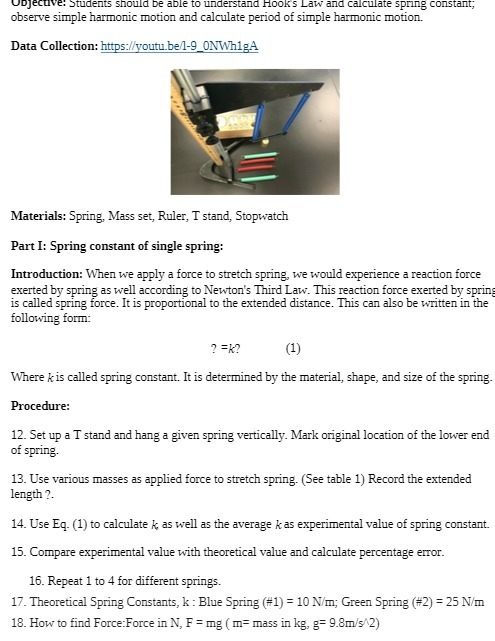
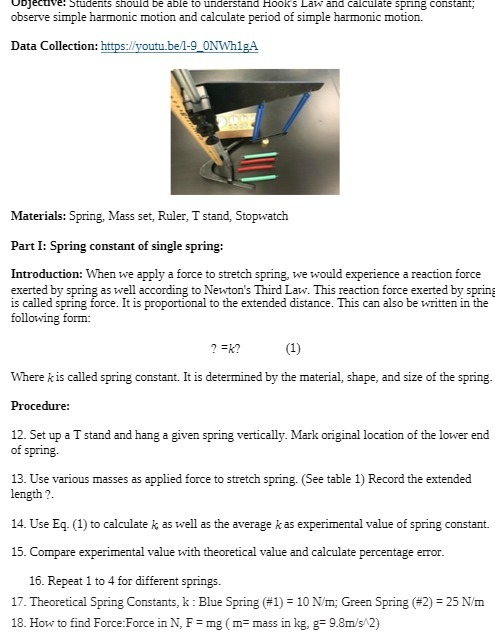
Objective: Students should be able to understand Hook's Law and calculate spring constant; observe simple harmonic motion and calculate period of simple harmonic motion. Data Collection: https://youtube/1-9_ONWhigA Materials: Spring, Mass set, Ruler, T stand, Stopwatch Part I: Spring constant of single spring: Introduction: When we apply a force to stretch spring, we would experience a reaction force exerted by spring as well according to Newton's Third Law. This reaction force exerted by spring is called spring force. It is proportional to the extended distance. This can also be written in the following form: ? =k? (1) Where k is called spring constant. It is determined by the material, shape, and size of the spring. Procedure: 12. Set up a T stand and hang a given spring vertically. Mark original location of the lower end of spring. 13. Use various masses as applied force to stretch spring. (See table 1) Record the extended length ?. 14. Use Eq. (1) to calculate * as well as the average kas experimental value of spring constant. 15. Compare experimental value with theoretical value and calculate percentage error. 16. Repeat 1 to 4 for different springs. 17. Theoretical Spring Constants, k : Blue Spring (#1) = 10 N/m; Green Spring (#2) = 25 N/m 18. How to find Force:Force in N, F = mg ( m= mass in kg, g= 9.8m/s 2)
Step by Step Solution
There are 3 Steps involved in it

Get step-by-step solutions from verified subject matter experts
 Study Help