







Question: Objective The objective of this lab is exploring Java Generics in more details. After completing the lab, you should be confident to undertake any project/assignment
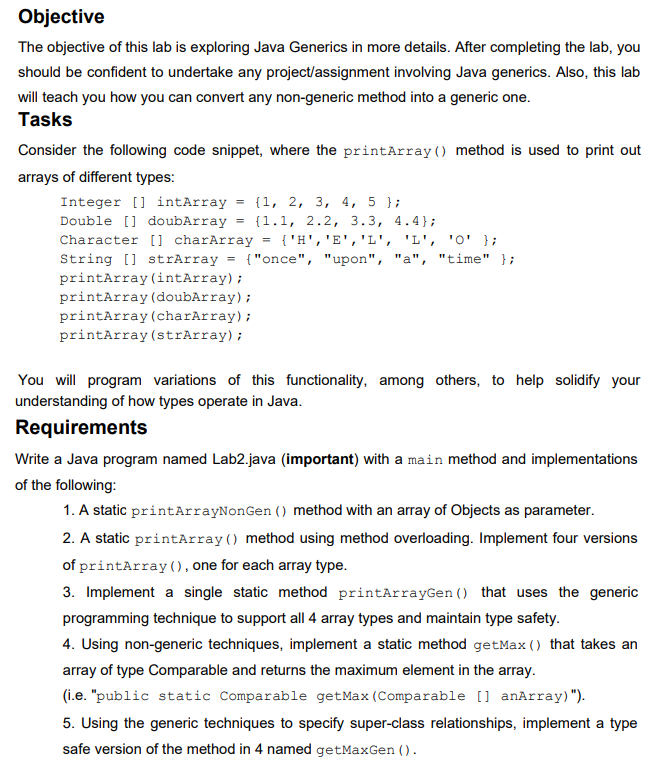
Objective The objective of this lab is exploring Java Generics in more details. After completing the lab, you should be confident to undertake any project/assignment involving Java generics. Also, this lab will teach you how you can convert any non-generic method into a generic one. Tasks Consider the following code snippet, where the printArray() method is used to print out arrays of different types: Integer [] intArray = {1, 2, 3, 4, 5 }; Double [] doubArray = {1.1, 2.2, 3.3, 4.4}; Character [] charArray = {'H','E','1', 'L', 'O' }; String [] strArray = { "once", "upon", "a", "time" }; printArray (intArray); printArray (doubArray); printArray (charArray); printArray (strArray); You will program variations of this functionality, among others, to help solidify your understanding of how types operate in Java. Requirements Write a Java program named Lab2.java (important) with a main method and implementations of the following: 1. A static printArrayNonGen() method with an array of Objects as parameter. 2. A static printArray () method using method overloading. Implement four versions of printArray (), one for each array type. 3. Implement a single static method printArrayGen() that uses the generic programming technique to support all 4 array types and maintain type safety. 4. Using non-generic techniques, implement a static method getMax () that takes an array of type Comparable and returns the maximum element in the array. (i.e. "public static Comparable getMax (Comparable [] anArray)"). 5. Using the generic techniques to specify super-class relationships, implement a type safe version of the method in 4 named getMaxGen()
Step by Step Solution
There are 3 Steps involved in it

Get step-by-step solutions from verified subject matter experts
 Study Help