







Question: Objective: This assignment aims to assess your ability to apply fluid mechanics principles in real - world engineering systems by analyzing fluid flow, performing dimensional
Objective: This assignment aims to assess your ability to apply fluid mechanics principles in realworld engineering systems by analyzing fluid flow, performing dimensional analysis, and evaluating viscous flow in engineering applications. Instructions: Select an engineering system or application that involves fluid flow eg water supply system, HVAC system, oil pipeline, hydraulic machinery, etc. You are required to analyse the system using the following tasks. Make sure to justify your assumptions and choices. Present your findings in a structured report format.Task : Fluid Flow Analysis Using Continuity, Momentum, and Energy Equations
marks
Discuss the importance of a specific equation continuity momentum or Bernoulli's
Equation of the application in the signed engineering sector to you. You required to provide,
General introduction on the application & equation that signed to you.
Importance of the Equation in your application.
The importance of the Equation on static and dynamic fluid condition
Latest equationrelated study in your application research study
Example calculation for selected application
Task : Viscous Flow Analysis in Pipes or Ducts Cont from task
marks
Identify a part of your application where viscous flow occurs eg flow through pipes,
channels, or ducts You required to provide,
Calculate the flow rate or pressure drop in this section of the system using the energy
balance principles, considering the effect of viscosity.
Discuss the role of viscosity in energy losses and how it impacts the efficiency of the
system.
Guidance: You can select either laminar or turbulent flow, depending on your system. Provide
reasoning for your selection and use relevant equations.
marks
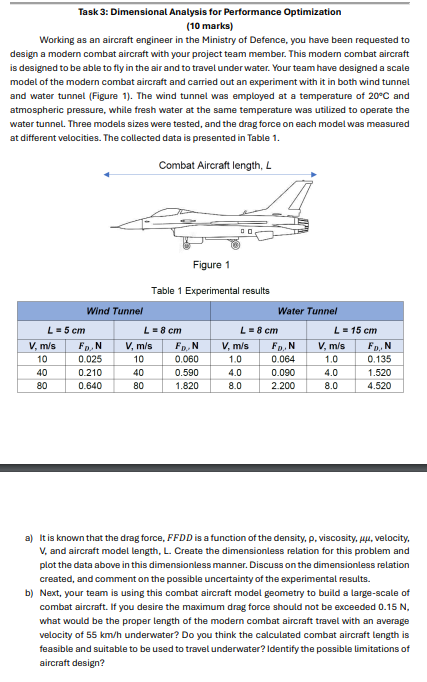
Working as an aircraft engineer in the Ministry of Defence, you have been requested to design a modern combat aircraft with your project team member. This modern combat aircraft is designed to be able to fly in the air and to travel under water. Your team have designed a scale model of the modern combat aircraft and carried out an experiment with it in both wind tunnel and water tunnel Figure The wind tunnel was employed at a temperature of circmathrmC and atmospheric pressure, while fresh water at the same temperature was utilized to operate the water tunnel. Three models sizes were tested, and the drag force on each model was measured at different velocities. The collected data is presented in Table
Table Experimental results
a It is known that the drag force, FFDD is a function of the density, rho viscosity, mu mu velocity, V and aircraft model length, L Create the dimensionless relation for this problem and plot the data above in this dimensionless manner. Discuss on the dimensionless relation created, and comment on the possible uncertainty of the experimental results.
b Next, your team is using this combat aircraft model geometry to build a largescale of combat aircraft. If you desire the maximum drag force should not be exceeded N what would be the proper length of the modern combat aircraft travel with an average velocity of mathrm~kmmathrmh underwater? Do you think the calculated combat aircraft length is feasible and suitable to be used to travel underwater? Identify the possible limitations of aircraft design?
Step by Step Solution
There are 3 Steps involved in it
1 Expert Approved Answer
Step: 1 Unlock

Question Has Been Solved by an Expert!
Get step-by-step solutions from verified subject matter experts
Step: 2 Unlock
Step: 3 Unlock
 Study Help