Question: Objective: To demonstrate how inventory carrying cost is calculated. Information: Inventory carrying cost (ICC) is a major logistics cost that reflects the cost of holding
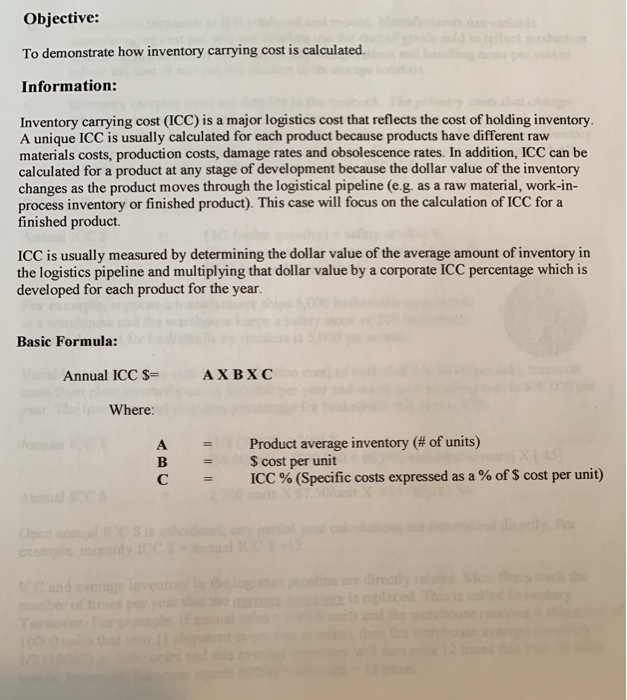
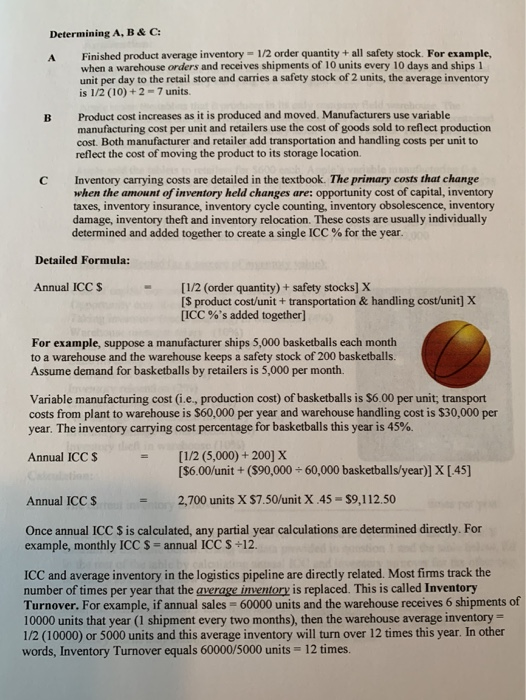
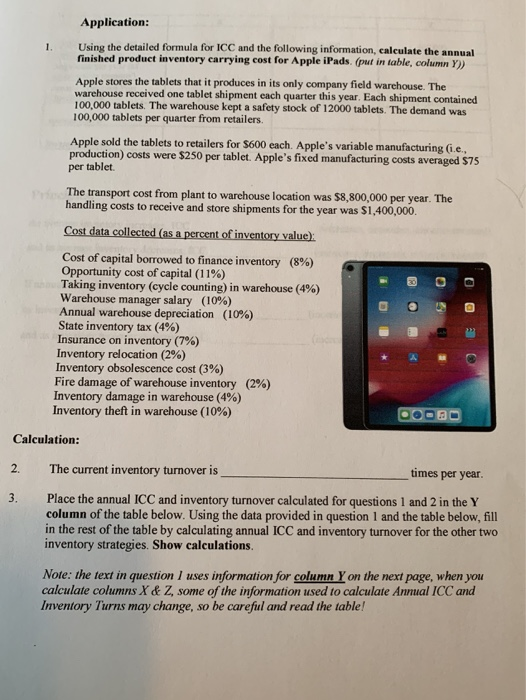
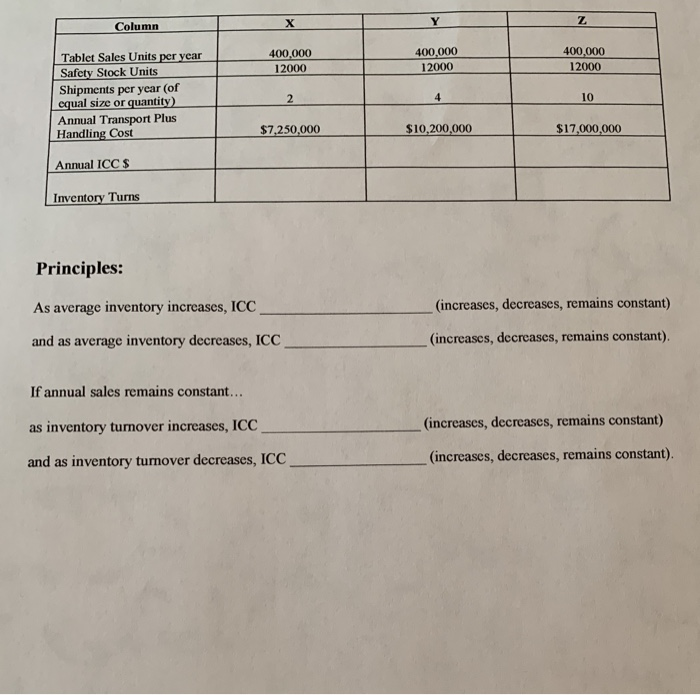
Objective: To demonstrate how inventory carrying cost is calculated. Information: Inventory carrying cost (ICC) is a major logistics cost that reflects the cost of holding inventory. A unique ICC is usually calculated for each product because products have different raw materials costs, production costs, damage rates and obsolescence rates. In addition, ICC can be calculated for a product at any stage of development because the dollar value of the inventory changes as the product moves through the logistical pipeline (e.g. as a raw material, work-in- process inventory or finished product). This case will focus on the calculation of ICC for a finished product. ICC is usually measured by determining the dollar value of the average amount of inventory in the logistics pipeline and multiplying that dollar value by a corporate ICC percentage which is developed for each product for the year. Basic Formula: Annual ICC $= AXBXC Where: Product average inventory (# of units) $ cost per unit ICC % (Specific costs expressed as a % of $ cost per unit) C = Determining A, B&C Finished product average inventory - 1/2 order quantity + all safety stock. For example, when a warehouse orders and receives shipments of 10 units every 10 days and ships 1 unit per day to the retail store and carries a safety stock of 2 units, the average inventory is 1/2 (10) + 2-7 units Product cost increases as it is produced and moved. Manufacturers use variable manufacturing cost per unit and retailers use the cost of goods sold to reflect production cost. Both manufacturer and retailer add transportation and handling costs per unit to reflect the cost of moving the product to its storage location. Inventory carrying costs are detailed in the textbook. The primary costs that change when the amount of inventory held changes are: opportunity cost of capital, inventory taxes, inventory insurance, inventory cycle counting, inventory obsolescence, inventory damage, inventory theft and inventory relocation. These costs are usually individually determined and added together to create a single ICC % for the year. Detailed Formula: Annual ICCS - [1/2 (order quantity) + safety stocks] X [s product cost/unit + transportation & handling cost/unit] X [ICC%'s added together) For example, suppose a manufacturer ships 5,000 basketballs each month to a warehouse and the warehouse keeps a safety stock of 200 basketballs. Assume demand for basketballs by retailers is 5,000 per month. Variable manufacturing cost (.e., production cost) of basketballs is $6.00 per unit; transport costs from plant to warehouse is $60,000 per year and warehouse handling cost is $30,000 per year. The inventory carrying cost percentage for basketballs this year is 45%. Annual ICCS [1/2 (5,000) + 200] X [$6.00/unit +(590,000 + 60,000 basketballs/year)] X[.45) Annual ICC $ 2,700 units X $7.50/unit X.45 - $9,112.50 Once annual ICC S is calculated any partial year calculations are determined directly. For example, monthly ICC $ - annual ICC $ +12. ICC and average inventory in the logistics pipeline are directly related. Most firms track the number of times per year that the average inventory is replaced. This is called Inventory Turnover. For example, if annual sales = 60000 units and the warehouse receives 6 shipments of 10000 units that year (1 shipment every two months), then the warehouse average inventory 1/2 (10000) or 5000 units and this average inventory will turn over 12 times this year. In other words, Inventory Turnover equals 60000/5000 units = 12 times. Application: Using the detailed formula for ICC and the following information, calculate the annual finished product inventory carrying cost for Apple iPads (pur in table, column Y) Apple stores the tablets that it produces in its only company field warehouse. The warehouse received one tablet shipment cach quarter this year. Each shipment contained 100,000 tablets. The warehouse kept a safety stock of 12000 tablets. The demand was 100,000 tablets per quarter from retailers. Apple sold the tablets to retailers for $600 each. Apple's variable manufacturing (ie, production) costs were $250 per tablet. Apple's fixed manufacturing costs averaged 575 per tablet The transport cost from plant to warehouse location was $8,800,000 per year. The handling costs to receive and store shipments for the year was $1,400,000. Cost data collected as a percent of inventory value) Cost of capital borrowed to finance inventory (8%) Opportunity cost of capital (11%) Taking inventory (cycle counting) in warehouse (4%) Warehouse manager salary (10%) Annual warehouse depreciation (10%) State inventory tax (4%) Insurance on inventory (7%) Inventory relocation (2%) Inventory obsolescence cost (3%) Fire damage of warehouse inventory (2%) Inventory damage in warehouse (4%) Inventory theft in warehouse (10%) Calculation: 2. The current inventory turnover is times per year. 3. Place the annual ICC and inventory turnover calculated for questions 1 and 2 in the Y column of the table below. Using the data provided in question I and the table below, fill in the rest of the table by calculating annual ICC and inventory turnover for the other two inventory strategies. Show calculations Note: the text in question / uses information for column Y on the next page, when you calculate columns X & Z, some of the information used to calculate Annual ICC and Inventory Turns may change, so be careful and read the table! Y Z Column 400,000 12000 400,000 12000 400,000 12000 Tablet Sales Units per year Safety Stock Units Shipments per year (of equal size or quantity) Annual Transport Plus Handling Cost 10 $7.250,000 $10,200,000 $17.000.000 Annual ICCS Inventory Turns Principles: As average inventory increases, ICC (increases, decreases, remains constant) and as average inventory decreases, ICC (increases, decreases, remains constant). If annual sales remains constant... as inventory turnover increases, ICC (increases, decreases, remains constant) and as inventory tumover decreases, ICC (increases, decreases, remains constant)









 Study Help