





Question: Objective: To help students understand how Aggregate Planning works in Supply Chain Management. Scenario: Innovative Craftsmen is a state of the art electronics manufacturing company
Objective: To help students understand howObjective: To help students understand how

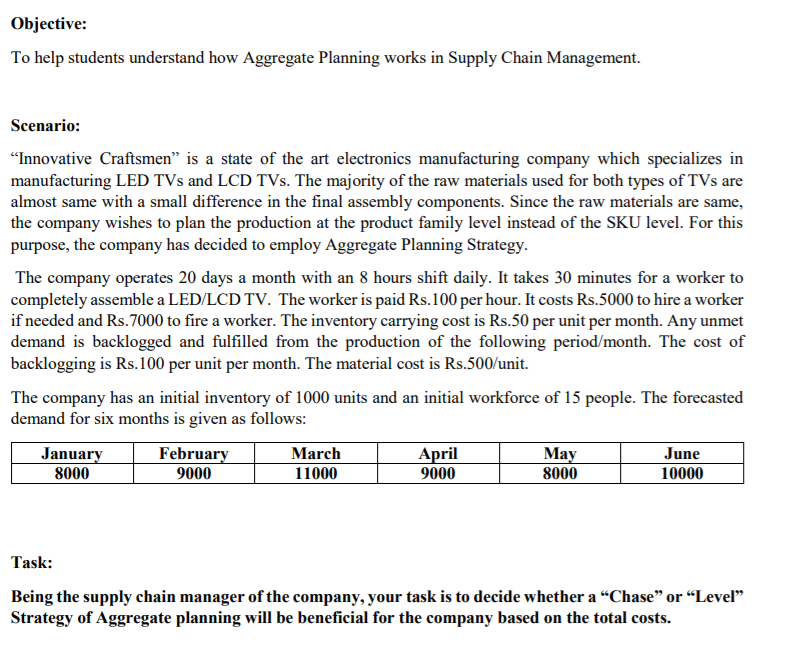
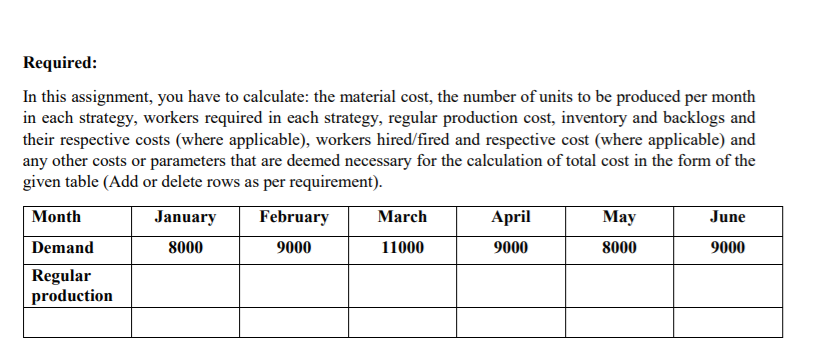
Objective: To help students understand how Aggregate Planning works in Supply Chain Management. Scenario: Innovative Craftsmen is a state of the art electronics manufacturing company which specializes in manufacturing LED TVs and LCD TVs. The majority of the raw materials used for both types of TVs are almost same with a small difference in the final assembly components. Since the raw materials are same, the company wishes to plan the production at the product family level instead of the SKU level. For this purpose, the company has decided to employ Aggregate Planning Strategy. The company operates 20 days a month with an 8 hours shift daily. It takes 30 minutes for a worker to completely assemble a LED/LCD TV. The worker is paid Rs.100 per hour. It costs Rs.5000 to hire a worker if needed and Rs.7000 to fire a worker. The inventory carrying cost is Rs.50 per unit per month. Any unmet demand is backlogged and fulfilled from the production of the following period/month. The cost of backlogging is Rs.100 per unit per month. The material cost is Rs.500/unit. The company has an initial inventory of 1000 units and an initial workforce of 15 people. The forecasted demand for six months is given as follows: January 8000 February 9000 March 11000 April 9000 May 8000 June 10000 Task: Being the supply chain manager of the company, your task is to decide whether a Chase or Level" Strategy of Aggregate planning will be beneficial for the company based on the total costs. Required: In this assignment, you have to calculate: the material cost, the number of units to be produced per month in each strategy, workers required in each strategy, regular production cost, inventory and backlogs and their respective costs (where applicable), workers hired/fired and respective cost (where applicable) and any other costs or parameters that are deemed necessary for the calculation of total cost in the form of the given table (Add or delete rows as per requirement). Month January February March April May June Demand 8000 9000 11000 9000 8000 9000 Regular production

Step by Step Solution

There are 3 Steps involved in it

1 Expert Approved Answer
Step: 1 Unlock blur-text-image

Question Has Been Solved by an Expert!

Get step-by-step solutions from verified subject matter experts

Step: 2 Unlock
Step: 3 Unlock

Students Have Also Explored These Related General Management Questions!