







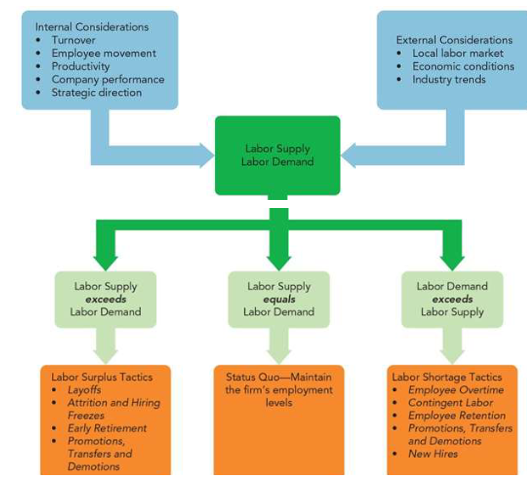
Question: Objective: To perform a workforce planning activity. Instructions: 1 . Use the Workforce Planning Framework ( pdf example ) . 2 . Apply the framework
Objective: To perform a workforce planning activity.
Instructions:
Use the Workforce Planning Framework pdf example
Apply the framework to the current state of the company.
Establish actions for the resulting situation supply is lower, equal, or greater than demand
Submit a report with your analysis resulting from using the workforce planning framework.
Internal Considerations
Turnover
Employee movement
Productivity
Company performance
Strategic direction
External Considerations
Local labor market
Economic conditions
Industry trends
Labor Demand
Labor Supply
Labor Supply
equals
exceeds
exceeds
Labor Supply
Labor Demand
Labor Demand
Labor Demand
Labor Supply
Labor Shortage Tactics
Employee Overtime
Contingent Labor
Employee Retention
Promotions, Transfers
and Demotions
New HiresInternal Factors
Turnover:
Voluntary and involuntary termination of employees.
Employee movements:
Promotions, transfers, and demotions.
Employee productivity.
Company performance.
Strategic direction:
Company evolution, mergers, and acquisitions.
Employee Movements
Promotions:
Moving employees to higher level positions, which often are associated with
increased levels of responsibility and authority.
Transfers:
Moving employees to other jobs with similar level of responsibility.
Demotions:
Moving employees to lower level positions within the company.
External Factors
Local Labor Market:
Size and composition of the local labor market.
Economic Conditions:
Unemployment rate, growth of economy, etc.
Industry Trends.
Labor Shortage Tactics
Overtime:
Having employees work extra hours beyond their regular work schedule.
Outsourcing and contingent labor:
Sending work to other companies payroll cafeteria, maintenance
Hiring workers to work on a temporary or non standard basis.
Retention:
Lowering turnover lowers a firms costs of recruiting, selecting, and training
new employees.
Employee satisfaction is a key predictor of turnover.
Labor Shortage Tactics
Promotion, transfers, and demotions:
Effective and fast way to deal with labor shortage.
New hires.
Labor Surplus Tactics
Layoffs:
Quickly reducing the number of workers employed.
Attrition and hiring freezes:
Decision not to fill vacant positions.
Ban on all hiring for a period of time.
Early retirement:
Financial incentive to have employees retire early can result in mass exodus
Employee promotions, transfers, demotions:
Move people to other areas of the firm facing shortages.
Workforce Planning in Practice: Organizational Demands
Strategy:
Required speed to deal with shortages and surpluses.
Criticality of employee groups.
Company characteristics:
The relative impact of labor shortages and surpluses.
Who carries out workforce planning.
Workforce Planning in Practice: Organizational Demands
Strategy:
Required speed to deal with shortages and surpluses.
Criticality of employee groups.
Company characteristics:
The relative impact of labor shortages and surpluses.
Who carries out workforce planning.
Workforce Planning in Practice: Organizational Demands
Culture:
Likelihood of using different tactics.
Employee reactions to workforce planning tactics.
Employee concerns:
Employee stress and worklife balance issues.
Perceptions of procedural and distributive justice.
Workforce Planning in Practice: Environmental Influences
Labor Force Trends:
Availability of internal and external workers.
Which tactics to use.
Technology:
The number of employees needed.
The types of workers needed.
The quality of workforce planning forecasts.
Globalization:
Where the workers are.
Which workforce planning tactics to use.
Ethics:
Community reactions to workforce planning tactics.
How companies help employees cope.
Workforce Planning in Practice: Environmental Influences
Globalization:
Where the workers are.
Which workforce planning tactics to use.
Ethics:
Community reactions to workforce planning tactics.
How companies help employees cope.
Workforce Planning in Practice: Environmental Influences
Workforce Planning in Practice: Regulatory Issues
Requirements for mass layoffs and plant closing: Worker Adjustment
and Retraining Notification Act WARN
Employers with employees.
days in advance.
Plant closings and mass layoffs.
Determining who is an employee versus an independent contractor.
Workforce Planning in Practice: Regulatory Issues
Requirements for mass layoffs and plant closing: Worker Adjustment
and Retraining Notification Act WARN
Employers with employees.
days in advance.
Plant closings and mass layoffs.
Determining who is an employee versus an independent contractor.
Step by Step Solution
There are 3 Steps involved in it
1 Expert Approved Answer
Step: 1 Unlock

Question Has Been Solved by an Expert!
Get step-by-step solutions from verified subject matter experts
Step: 2 Unlock
Step: 3 Unlock
 Study Help