



Question: Objectives: 1. Show that for a perfectly elastic collision both momentum and energy are conserved. 2. Show that the velocity of center of mass of
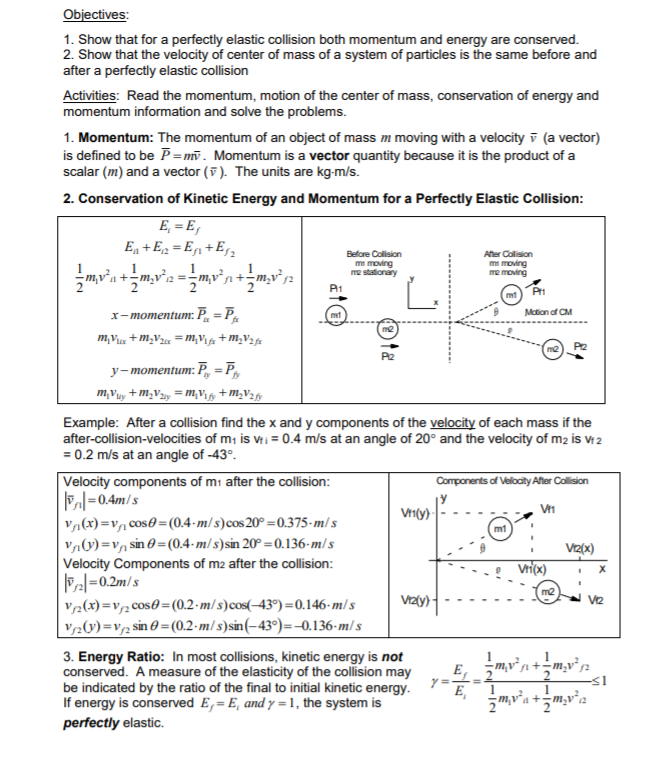
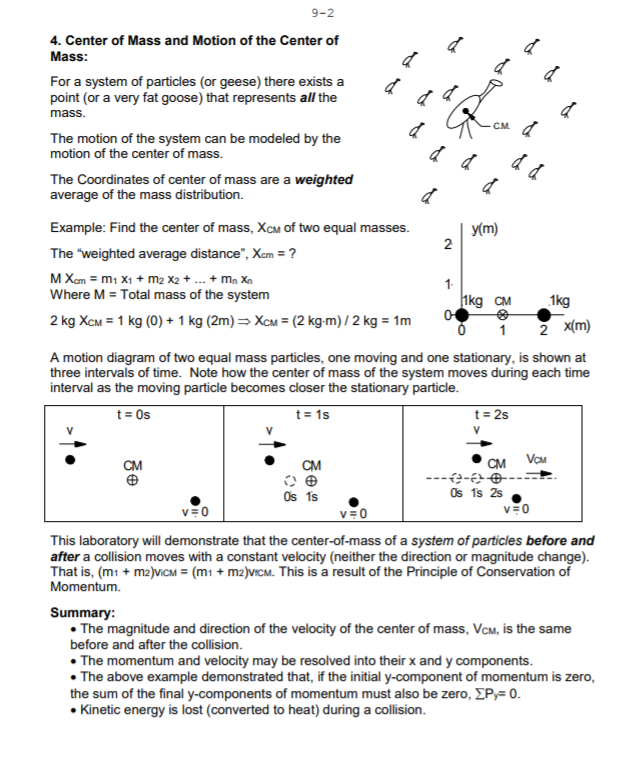
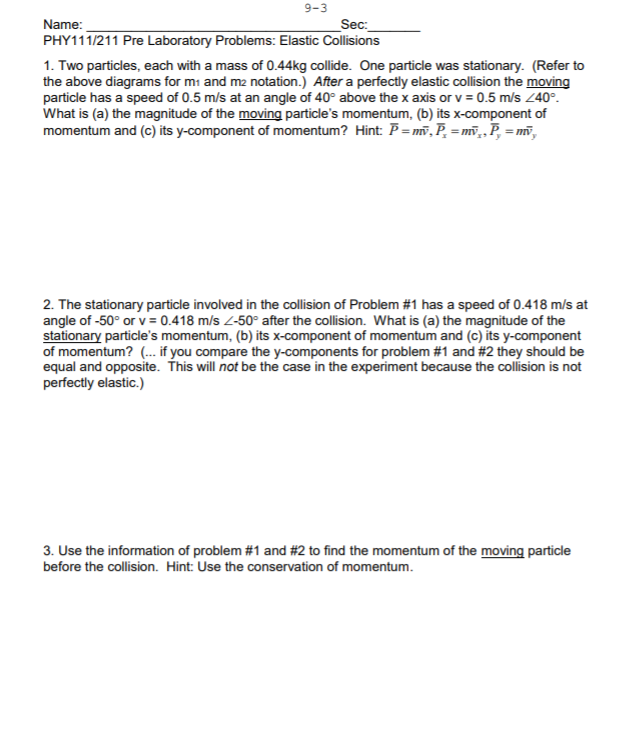
Objectives: 1. Show that for a perfectly elastic collision both momentum and energy are conserved. 2. Show that the velocity of center of mass of a system of particles is the same before and after a perfectly elastic collision Activities: Read the momentum, motion of the center of mass, conservation of energy and momentum information and solve the problems. 1. Momentum: The momentum of an object of mass m moving with a velocity v (a vector) is defined to be P=mv. Momentum is a vector quantity because it is the product of a scalar (m) and a vector (v ). The units are kg-m/s. 2. Conservation of Kinetic Energy and Momentum for a Perfectly Elastic Collision: E, = E, EntEn = En+E,, Before Colision After Collision mi moving -munt-mun =-munt-mug re stationary me moving x - momentum: P. = P Motion of CM m, Vix + my Vax = MVig + myV2fx P2 m2 y - momentum: P, = P. Example: After a collision find the x and y components of the velocity of each mass if the after-collision-velocities of m, is vri = 0.4 m/s at an angle of 20 and the velocity of m2 is V1 2 = 0.2 m/s at an angle of -43. Velocity components of mi after the collision: Components of Velocity After Collision | =0.Am/s VH1(y) V,(x) =VAI cose = (0.4.m/s)cos20 =0.375-m/s Va(v) = Vn sin 0 = (0.4. m/s)sin 20 =0.136-m/s Viz(x) Velocity Components of ma after the collision: Vri(x) X W/2 =0.2m/s V/2(x) = V/2 cos0 = (0.2-m/s)cos(-43) =0.146-m/s Viz(y) m2 V2 V/2 (v) =V/2 sin 0 = (0.2-m/s)sin(-430)=-0.136-m/s 3. Energy Ratio: In most collisions, kinetic energy is not conserved. A measure of the elasticity of the collision may -munt - mug be indicated by the ratio of the final to initial kinetic energy. 1, If energy is conserved E, = E, and y = 1, the system is 5mVatamva perfectly elastic.9-2 4. Center of Mass and Motion of the Center of Mass: For a system of particles (or geese) there exists a d point (or a very fat goose) that represents all the mass. CM The motion of the system can be modeled by the d motion of the center of mass. d d The Coordinates of center of mass are a weighted average of the mass distribution. Example: Find the center of mass, Xom of two equal masses. y(m) 2 The "weighted average distance", Xcm = ? M Xom = m1 X1 + m2 X2 + ... + mn Xn 1- Where M = Total mass of the system 1kg CM .1kg 2 kg XCM = 1 kg (0) + 1 kg (2m) => Xcm = (2 kg-m) / 2 kg = 1m 2 x(m) A motion diagram of two equal mass particles, one moving and one stationary, is shown at three intervals of time. Note how the center of mass of the system moves during each time interval as the moving particle becomes closer the stationary particle. t = 0s t = 1s t = 2s CM CM CM VOM 0s 1s Os 1's 2s V= 0 V= 0 V= 0 This laboratory will demonstrate that the center-of-mass of a system of particles before and after a collision moves with a constant velocity (neither the direction or magnitude change). That is, (m1 + m2)vicM = (mi + m2)VICM. This is a result of the Principle of Conservation of Momentum. Summary: . The magnitude and direction of the velocity of the center of mass, Vem, is the same before and after the collision. . The momentum and velocity may be resolved into their x and y components. . The above example demonstrated that, if the initial y-component of momentum is zero, the sum of the final y-components of momentum must also be zero, EPy= 0. . Kinetic energy is lost (converted to heat) during a collision.9-3 Name: Sec: PHY111/211 Pre Laboratory Problems: Elastic Collisions 1. Two particles, each with a mass of 0.44kg collide. One particle was stationary. (Refer to the above diagrams for mi and me notation.) After a perfectly elastic collision the moving particle has a speed of 0.5 m/s at an angle of 40 above the x axis or v = 0.5 m/s 240. What is (a) the magnitude of the moving particle's momentum, (b) its x-component of momentum and (c) its y-component of momentum? Hint: P = mv, P, =mv,, P = mv, 2. The stationary particle involved in the collision of Problem #1 has a speed of 0.418 m/s at angle of -50 or v = 0.418 m/s
Step by Step Solution
There are 3 Steps involved in it

Get step-by-step solutions from verified subject matter experts