







Question: Objectives Apply ergonomic analysis tools (NIOSH Lifting Equation Multiple Task) Evaluate the risk of injury. Job Description Cartons dimensions are 16inches x 16inches x 16inches
 Objectives
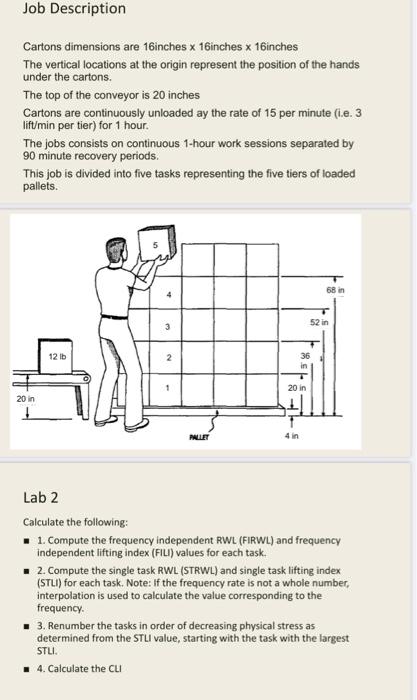
Job Description Cartons dimensions are 16inches x 16inches x 16inches The vertical locations at the origin represent the position of the hands under the cartons. The top of the conveyor is 20 inches Cartons are continuously unloaded ay the rate of 15 per minute (i.e. 3 lift/min per tier) for 1 hour The jobs consists on continuous 1-hour work sessions separated by 90 minute recovery periods. This job is divided into five tasks representing the five tiers of loaded pallets. 68 in 52 in 12 lb 36 in 20 in 20 in + PALLET Lab 2 Calculate the following: 1. Compute the frequency independent RWL (FIRWL) and frequency independent lifting index (FILI) values for each task. 2. Compute the single task RWL (STRWL) and single task lifting index (STLI) for each task. Note: If the frequency rate is not a whole number, interpolation is used to calculate the value corresponding to the frequency 3. Renumber the tasks in order of decreasing physical stress as determined from the STLI value, starting with the task with the largest STLI. 4. Calculate the CLI Job Description Cartons dimensions are 16inches x 16inches x 16inches The vertical locations at the origin represent the position of the hands under the cartons. The top of the conveyor is 20 inches Cartons are continuously unloaded ay the rate of 15 per minute (i.e. 3 lift/min per tier) for 1 hour The jobs consists on continuous 1-hour work sessions separated by 90 minute recovery periods. This job is divided into five tasks representing the five tiers of loaded pallets. 68 in 52 in 12 lb 36 in 20 in 20 in + PALLET Lab 2 Calculate the following: 1. Compute the frequency independent RWL (FIRWL) and frequency independent lifting index (FILI) values for each task. 2. Compute the single task RWL (STRWL) and single task lifting index (STLI) for each task. Note: If the frequency rate is not a whole number, interpolation is used to calculate the value corresponding to the frequency 3. Renumber the tasks in order of decreasing physical stress as determined from the STLI value, starting with the task with the largest STLI. 4. Calculate the CLI
Step by Step Solution
There are 3 Steps involved in it

Get step-by-step solutions from verified subject matter experts
 Study Help