







Question: Objectives Apply OO design technique: allocation of classes and responsibilities. Use OO features: class, instance variable, constructor and method to implement the solution. Adopt
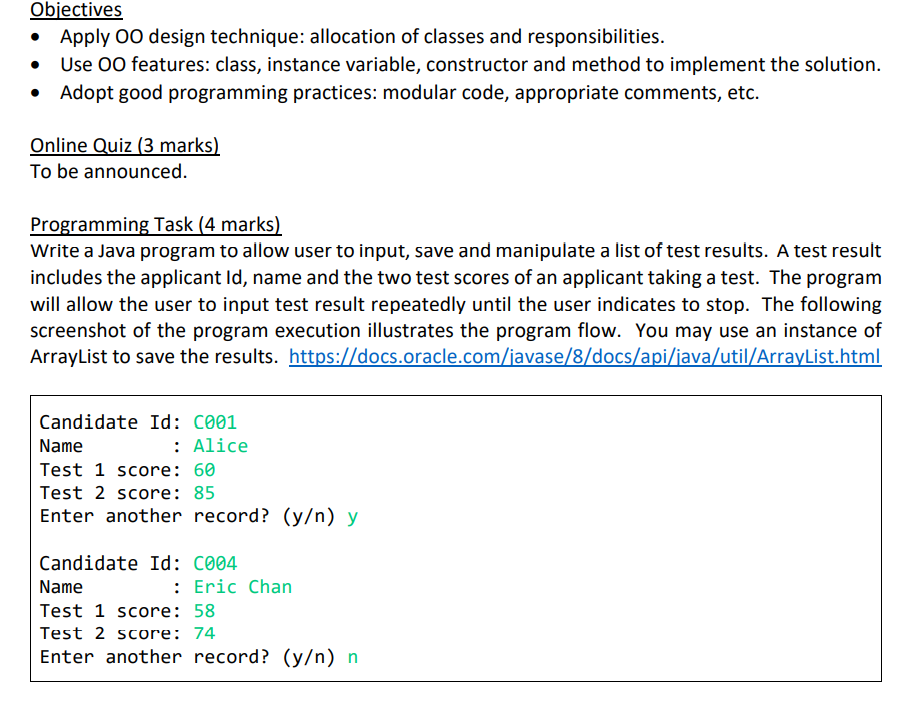
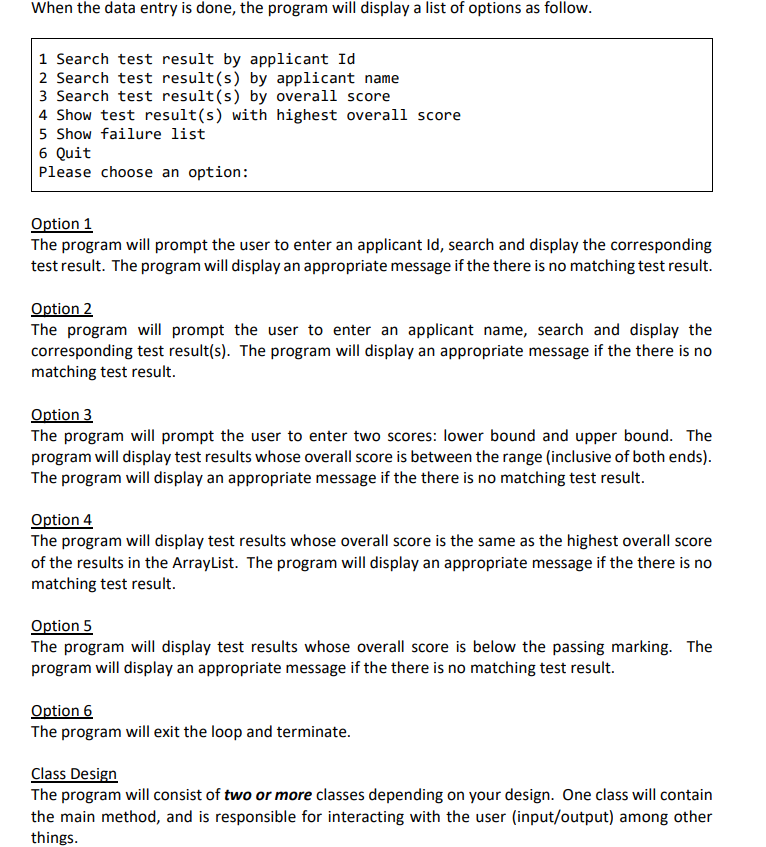
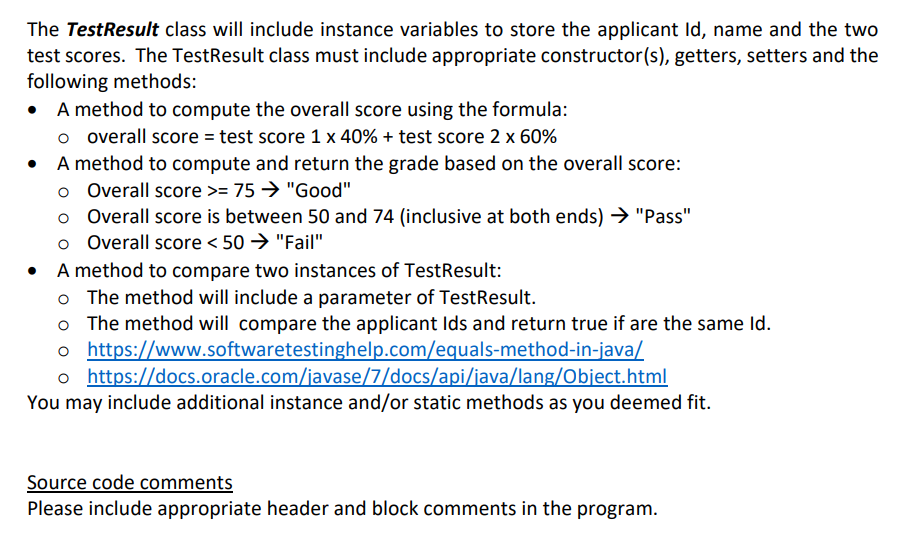
Objectives Apply OO design technique: allocation of classes and responsibilities. Use OO features: class, instance variable, constructor and method to implement the solution. Adopt good programming practices: modular code, appropriate comments, etc. Online Quiz (3 marks) To be announced. Programming Task (4 marks) Write a Java program to allow user to input, save and manipulate a list of test results. A test result includes the applicant Id, name and the two test scores of an applicant taking a test. The program will allow the user to input test result repeatedly until the user indicates to stop. The following screenshot of the program execution illustrates the program flow. You may use an instance of ArrayList to save the results. https://docs.oracle.com/javase/8/docs/api/java/util/ArrayList.html Candidate Id: C001 : Alice Name Test 1 score: 60 Test 2 score: 85 Enter another record? (y/n) y Candidate Id: C004 : Eric Chan Name Test 1 score: 58 Test 2 score: 74 Enter another record? (y/n) n When the data entry is done, the program will display a list of options as follow. 1 Search test result by applicant Id 2 Search test result(s) by applicant name 3 Search test result(s) by overall score 4 Show test result(s) with highest overall score 5 Show failure list 6 Quit Please choose an option: Option 1 The program will prompt the user to enter an applicant Id, search and display the corresponding test result. The program will display an appropriate message if the there is no matching test result. Option 2 The program will prompt the user to enter an applicant name, search and display the corresponding test result(s). The program will display an appropriate message if the there is no matching test result. Option 3 The program will prompt the user to enter two scores: lower bound and upper bound. The program will display test results whose overall score is between the range (inclusive of both ends). The program will display an appropriate message if the there is no matching test result. Option 4 The program will display test results whose overall score is the same as the highest overall score of the results in the ArrayList. The program will display an appropriate message if the there is no matching test result. Option 5 The program will display test results whose overall score is below the passing marking. The program will display an appropriate message if the there is no matching test result. Option 6 The program will exit the loop and terminate. Class Design The program will consist of two or more classes depending on your design. One class will contain the main method, and is responsible for interacting with the user (input/output) among other things. The TestResult class will include instance variables to store the applicant Id, name and the two test scores. The TestResult class must include appropriate constructor(s), getters, setters and the following methods: A method to compute the overall score using the formula: o overall score = test score 1 x 40% + test score 2 x 60% A method to compute and return the grade based on the overall score: o Overall score >= 75 "Good" o Overall score is between 50 and 74 (inclusive at both ends) "Pass" o Overall score < 50 "Fail" A method to compare two instances of TestResult: o The method will include a parameter of TestResult. o The method will compare the applicant Ids and return true if are the same ld. o https://www.softwaretestinghelp.com/equals-method-in-java/ o https://docs.oracle.com/javase/7/docs/api/java/lang/Object.html You may include additional instance and/or static methods as you deemed fit. Source code comments Please include appropriate header and block comments in the program.
Step by Step Solution
3.40 Rating (150 Votes )
There are 3 Steps involved in it
Below is a simple implementation in Java based on the requirements youve provided Ive created two cl... View full answer

Get step-by-step solutions from verified subject matter experts
 Study Help