







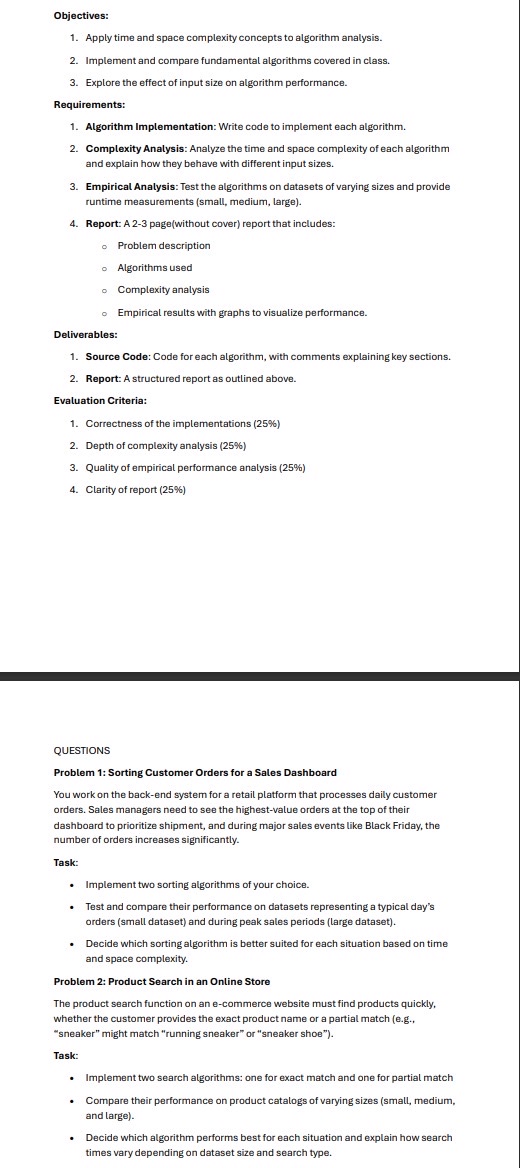
Question: Objectives: Apply time and space complexity concepts to algorithm analysis. Implement and compare fundamental algorithms covered in class. Explore the effect of input size on
Objectives:
Apply time and space complexity concepts to algorithm analysis.
Implement and compare fundamental algorithms covered in class.
Explore the effect of input size on algorithm performance.
Requirements:
Algorithm Implementation: Write code to implement each algorithm.
Complexity Analysis: Analyze the time and space complexity of each algorithm and explain how they behave with different input sizes.
Empirical Analysis: Test the algorithms on datasets of varying sizes and provide runtime measurements small medium, large
Report: A pagewithout cover report that includes:
Problem description
Algorithms used
Complexity analysis
Empirical results with graphs to visualize performance.
Deliverables:
Source Code: Code for each algorithm, with comments explaining key sections.
Report: A structured report as outlined above.
Evaluation Criteria:
Correctness of the implementations
Depth of complexity analysis
Quality of empirical performance analysis
Clarity of report
QUESTIONS
Problem : Sorting Customer Orders for a Sales Dashboard
You work on the backend system for a retail platform that processes daily customer orders. Sales managers need to see the highestvalue orders at the top of their dashboard to prioritize shipment, and during major sales events like Black Friday, the number of orders increases significantly.
Task:
Implement two sorting algorithms of your choice.
Test and compare their performance on datasets representing a typical day's orders small dataset and during peak sales periods large dataset
Decide which sorting algorithm is better suited for each situation based on time and space complexity.
Problem : Product Search in an Online Store
The product search function on an ecommerce website must find products quickly, whether the customer provides the exact product name or a partial match eg "sneaker" might match "running sneaker" or "sneaker shoe"
Task:
Implement two search algorithms: one for exact match and one for partial match
Compare their performance on product catalogs of varying sizes small medium, and large
Decide which algorithm performs best for each situation and explain how search times vary depending on dataset size and search type.
Step by Step Solution
There are 3 Steps involved in it
1 Expert Approved Answer
Step: 1 Unlock

Question Has Been Solved by an Expert!
Get step-by-step solutions from verified subject matter experts
Step: 2 Unlock
Step: 3 Unlock
 Study Help