







Question: Objectives Identify key entities relationships: Determine how entities interact with each other. Incorporate inheritance: Utilize inheritance to represent common attributes and behaviors of entities. Define
Objectives
Identify key entities relationships: Determine how entities interact with each other.
Incorporate inheritance: Utilize inheritance to represent common attributes and behaviors of entities.
Define constraints and additional attributes: Specify any constraints related to the entities, such as cardinalities and mandatoryoptional attributes.
Facilitate future expansion: Design the EERD to allow for future additions of new entities or features.
Implementation. Implement database, add initial data, and run multiple test queries.
Project Phases
Requirement Analysis
Objective: Understand the data needs of the university and Identify the Stakeholders:
Key Entities
Student
Attributes: StudentID PK FirstName, LastName, Email, DateOfBirth, EnrollmentDate
Relationships: Enrolls in Courses, Has Grades
Course
Attributes: CourseID PK CourseName, Credits, Semester
Relationships: Has Students, Has Instructors
Instructor
Attributes: InstructorID PK FirstName, LastName, Email, HireDate
Relationships: Teaches Courses
Department
Attributes: DepartmentID PK DepartmentName, Budget
Relationships: Contains Courses, Has Instructors
Grade
Attributes: GradeID PK GradeValue, DateAssigned
Relationships: Belongs to Student, Related to Course
Inheritance Structure
Person Superclass
Attributes: PersonID PK FirstName, LastName, Email
Subclasses: Student, Instructor
Relationships and Cardinalities
A Student can enroll in one or many Courses.
A Course can have zero or many Students enrolled.
An Instructor can teach one or many Courses.
A Department can have zero or Instructors and Courses.
Extended Attributes and Constraints
Course:
Attributes: Prerequisites optional MaxEnrollment mandatory
Grade:
Constraints: GradeValue must be between and
Conceptual Design
Objective: Create a highlevel model of the database.
Design an ExtendedEntityRelationship ERR Diagram
Logical Design
Objective: Map the conceptual model to a logical schema.
Normalize the data to avoid redundancy and ensure data integrity:
First Normal Form NF: Ensure each attribute has atomic values.
Second Normal Form NF: Ensure no partial dependencies.
Third Normal Form NF: Ensure no transitive dependencies.
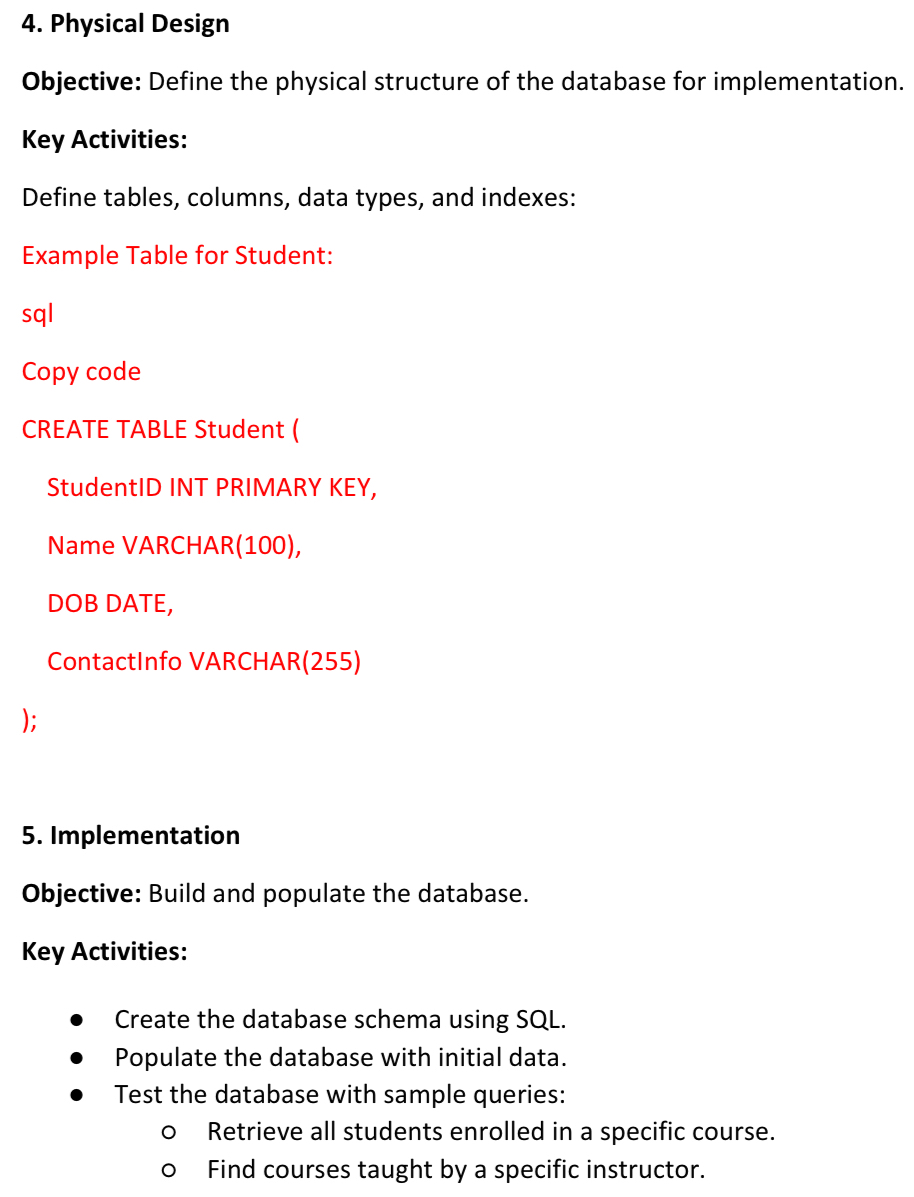
Physical Design
Objective: Define the physical structure of the database for implementation.
Key Activities:
Define tables, columns, data types, and indexes:
Example Table for Student:
sql
Copy code
CREATE TABLE Student
StudentID INT PRIMARY KEY,
Name VARCHAR
DOB DATE,
ContactInfo VARCHAR
;
Implementation
Objective: Build and populate the database.
Key Activities:
Create the database schema using SQL
Populate the database with initial data.
Test the database with sample queries:
Retrieve all students enrolled in a specific course.
Find courses taught by a specific instructor.
Step by Step Solution
There are 3 Steps involved in it
1 Expert Approved Answer
Step: 1 Unlock

Question Has Been Solved by an Expert!
Get step-by-step solutions from verified subject matter experts
Step: 2 Unlock
Step: 3 Unlock
 Study Help