







Question: Objectives: To acquire a hands-on experience with the YANG data modeling language. Problem Statement: In this assignment, you will be writing a mock-up data model
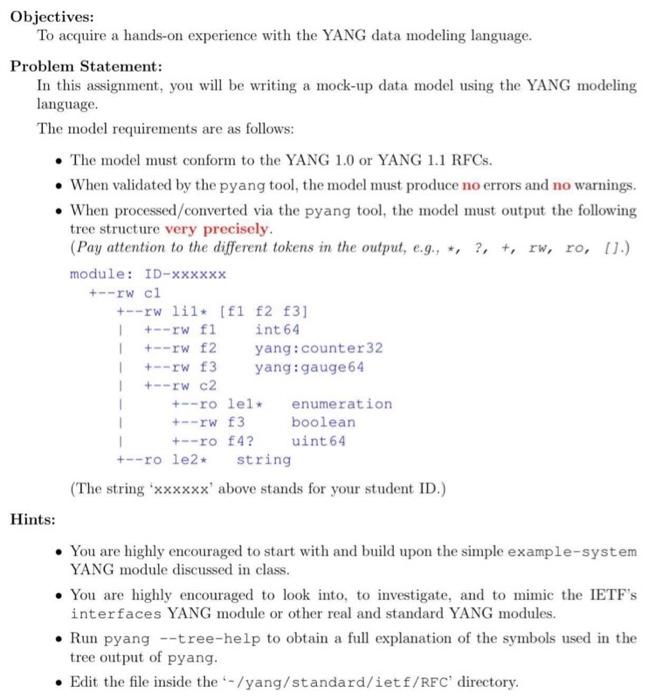
Objectives: To acquire a hands-on experience with the YANG data modeling language. Problem Statement: In this assignment, you will be writing a mock-up data model using the YANG modeling language. The model requirements are as follows: The model must conform to the YANG 1.0 or YANG 1.1 RFCs. . When validated by the pyang tool, the model must produce no errors and no warnings. When processed/converted via the pyang tool, the model must output the following tree structure very precisely. (Pay attention to the different tokens in the output, e.g., *, ?, +, rw, ro, 01.) module: ID-XXXXXX +--rw cl +--rw lil. [1 2 3] 1 +--IW f1 int64 1 +--rw f2 yang:counter 32 1 +--rw f3 yang:gauge 64 1 +--rw c2 1 +--ro lel enumeration 1 +--rw f3 boolean +--ro f4? uint64 +--ro le 2* string (The string 'xxxxxx' above stands for your student ID.) Hints: You are highly encouraged to start with and build upon the simple example-system YANG module discussed in class. You are highly encouraged to look into, to investigate, and to mimic the IETF's interfaces YANG module or other real and standard YANG modules. Run pyang --tree-help to obtain a full explanation of the symbols used in the tree output of pyang. Edit the file inside the -/yang/standard/ietf/RFC directory. Objectives: To acquire a hands-on experience with the YANG data modeling language. Problem Statement: In this assignment, you will be writing a mock-up data model using the YANG modeling language. The model requirements are as follows: The model must conform to the YANG 1.0 or YANG 1.1 RFCs. . When validated by the pyang tool, the model must produce no errors and no warnings. When processed/converted via the pyang tool, the model must output the following tree structure very precisely. (Pay attention to the different tokens in the output, e.g., *, ?, +, rw, ro, 01.) module: ID-XXXXXX +--rw cl +--rw lil. [1 2 3] 1 +--IW f1 int64 1 +--rw f2 yang:counter 32 1 +--rw f3 yang:gauge 64 1 +--rw c2 1 +--ro lel enumeration 1 +--rw f3 boolean +--ro f4? uint64 +--ro le 2* string (The string 'xxxxxx' above stands for your student ID.) Hints: You are highly encouraged to start with and build upon the simple example-system YANG module discussed in class. You are highly encouraged to look into, to investigate, and to mimic the IETF's interfaces YANG module or other real and standard YANG modules. Run pyang --tree-help to obtain a full explanation of the symbols used in the tree output of pyang. Edit the file inside the -/yang/standard/ietf/RFC directory
Step by Step Solution
There are 3 Steps involved in it

Get step-by-step solutions from verified subject matter experts
 Study Help