Question: . Objectives: To formulate a linear programming model to determine the optimal product mix for the refinery. To express the formulation using LINGO sets. To
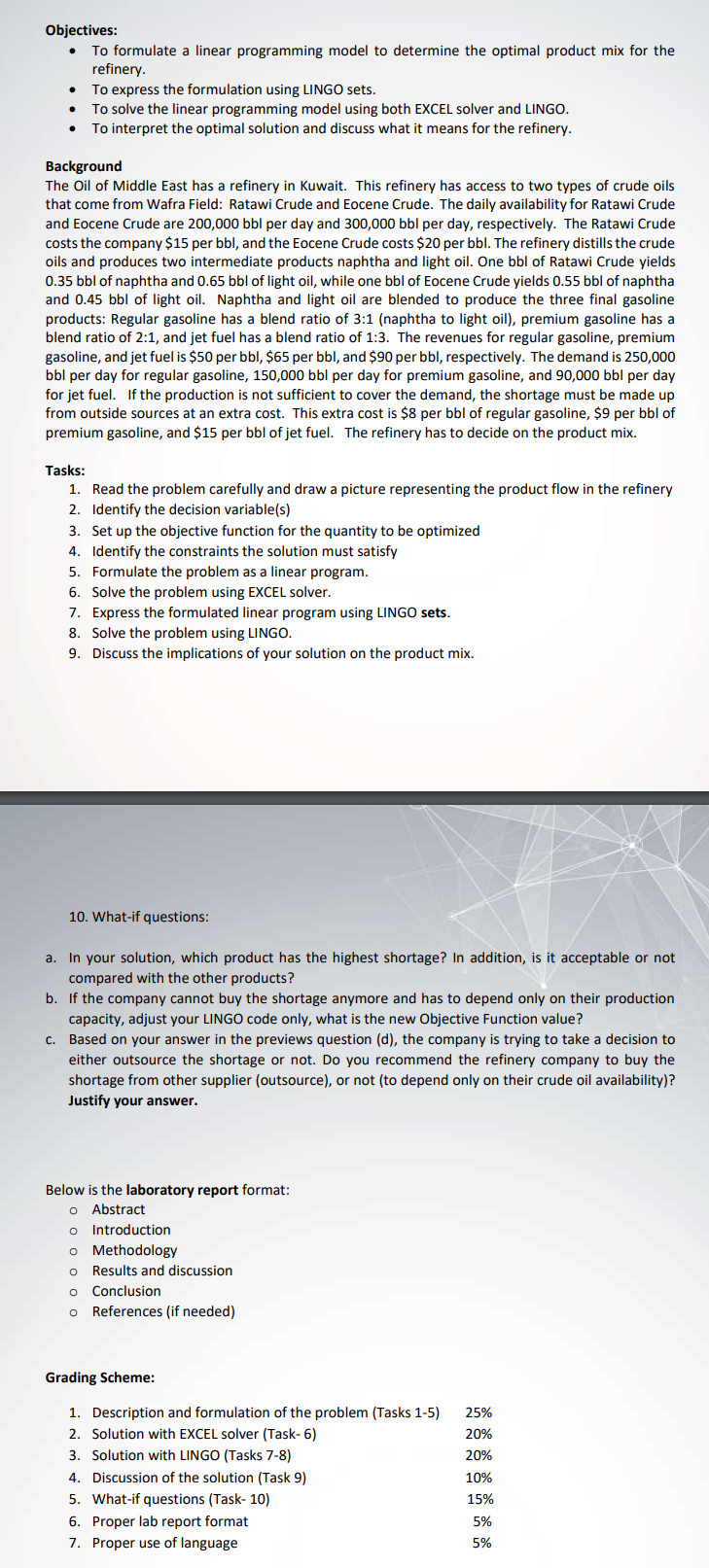
. Objectives: To formulate a linear programming model to determine the optimal product mix for the refinery. To express the formulation using LINGO sets. To solve the linear programming model using both EXCEL solver and LINGO. To interpret the optimal solution and discuss what it means for the refinery. . . Background The Oil of Middle East has a refinery in Kuwait. This refinery has access to two types of crude oils that come from Wafra Field: Ratawi Crude and Eocene Crude. The daily availability for Ratawi Crude and Eocene Crude are 200,000 bbl per day and 300,000 bbl per day, respectively. The Ratawi Crude costs the company $15 per bbl, and the Eocene Crude costs $20 per bbl. The refinery distills the crude oils and produces two intermediate products naphtha and light oil. One bbl of Ratawi Crude yields 0.35 bbl of naphtha and 0.65 bbl of light oil, while one bbl of Eocene Crude yields 0.55 bbl of naphtha and 0.45 bbl of light oil. Naphtha and light oil are blended to produce the three final gasoline products: Regular gasoline has a blend ratio of 3:1 (naphtha to light oil), premium gasoline has a blend ratio of 2:1, and jet fuel has a blend ratio of 1:3. The revenues for regular gasoline, premium gasoline, and jet fuel is $50 per bbl, $65 per bbl, and $90 per bbl, respectively. The demand is 250,000 bbl per day for regular gasoline, 150,000 bbl per day for premium gasoline, and 90,000 bbl per day for jet fuel. If the production is not sufficient to cover the demand, the shortage must be made up from outside sources at an extra cost. This extra cost is $8 per bbl of regular gasoline, $9 per bbl of premium gasoline, and $15 per bbl of jet fuel. The refinery has to decide on the product mix. Tasks: 1. Read the problem carefully and draw a picture representing the product flow in the refinery 2. Identify the decision variable(s) 3. Set up the objective function for the quantity to be optimized 4. Identify the constraints the solution must satisfy 5. Formulate the problem as a linear program. 6. Solve the problem using EXCEL solver. 7. Express the formulated linear program using LINGO sets. 8. Solve the problem using LINGO. 9. Discuss the implications of your solution on the product mix. 10. What-if questions: a. In your solution, which product has the highest shortage? In addition, is it acceptable or not compared with the other products? b. If the company cannot buy the shortage anymore and has to depend only on their production capacity, adjust your LINGO code only, what is the new Objective Function value? C. Based on your answer in the previews question (d), the company is trying to take a decision to either outsource the shortage or not. Do you recommend the refinery company to buy the shortage from other supplier (outsource), or not (to depend only on their crude oil availability)? Justify your answer. o o Below is the laboratory report format: Abstract Introduction o Methodology o Results and discussion o Conclusion References (if needed) o Grading Scheme: 1. Description and formulation of the problem (Tasks 1-5) 2. Solution with EXCEL solver (Task-6) 3. Solution with LINGO (Tasks 7-8) 4. Discussion of the solution (Task 9) 5. What-if questions (Task- 10) 6. Proper lab report format 7. Proper use of language 25% 20% 20% 10% 15% 5% 5%









 Study Help