





Question: Observations: Data table Material/Object Mass Normal Force Force Coefficient Coefficient characteristics (kg) Force of of of Kinetic of Static (N) Static Kinetic Friction Friction Friction
Observations: Data table Material/Object Mass
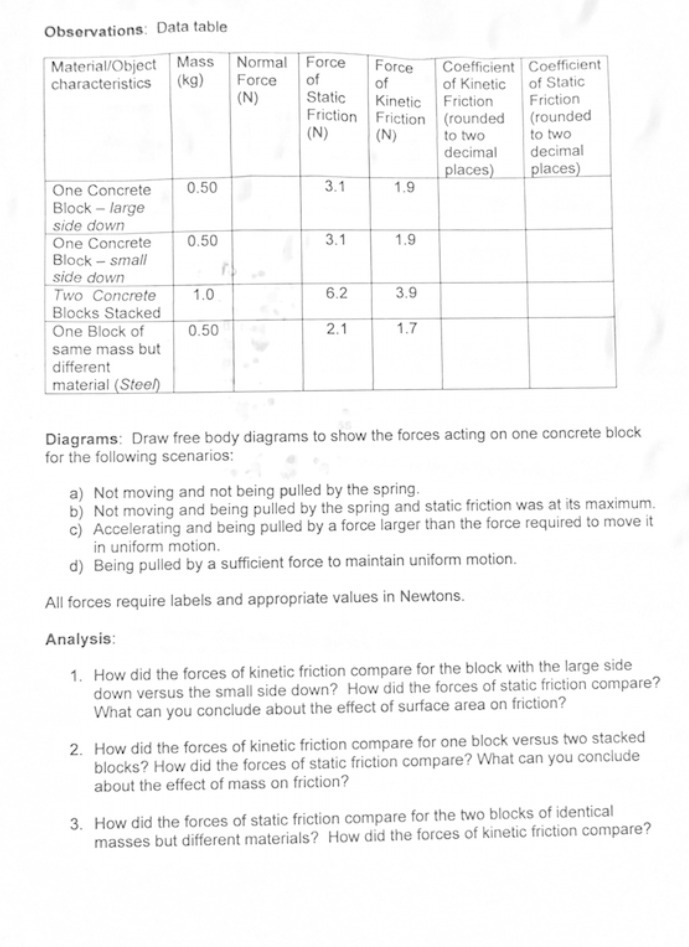
Observations: Data table Material/Object Mass Normal Force Force Coefficient Coefficient characteristics (kg) Force of of of Kinetic of Static (N) Static Kinetic Friction Friction Friction Friction (rounded (rounded (N) (N) to two to two decimal decimal places) places) One Concrete 0.50 3.1 1.9 Block - large side down One Concrete 0.50 3.1 1.9 Block - small side down Two Concrete 1.0 6.2 3.9 Blocks Stacked One Block of 0.50 2.1 1.7 same mass but different material (Steel) Diagrams: Draw free body diagrams to show the forces acting on one concrete block for the following scenarios: a) Not moving and not being pulled by the spring. b) Not moving and being pulled by the spring and static friction was at its maximum. c) Accelerating and being pulled by a force larger than the force required to move it in uniform motion. d) Being pulled by a sufficient force to maintain uniform motion. All forces require labels and appropriate values in Newtons. Analysis: 1. How did the forces of kinetic friction compare for the block with the large side down versus the small side down? How did the forces of static friction compare? What can you conclude about the effect of surface area on friction? 2. How did the forces of kinetic friction compare for one block versus two stacked blocks? How did the forces of static friction compare? What can you conclude about the effect of mass on friction? 3. How did the forces of static friction compare for the two blocks of identical masses but different materials? How did the forces of kinetic friction compare

Step by Step Solution

There are 3 Steps involved in it

1 Expert Approved Answer
Step: 1 Unlock blur-text-image

Question Has Been Solved by an Expert!

Get step-by-step solutions from verified subject matter experts

Step: 2 Unlock
Step: 3 Unlock

Students Have Also Explored These Related Mathematics Questions!