







Question: Observe that for a random variable Y that takes on values 0 and 1, the expected value of Y is defined as follows: E(Y)=0times Pr(Y
Observe that for a random variable
Ythat takes on values 0 and 1, the expected value of
Yis defined as follows:\
E(Y)=0\\\\times Pr(Y)
=(
0)+1\\\\times Pr(Y)
=(
1)\ Now, suppose that
xis a Bernoull random variable with success probability
Pr(x)
=(
1)=p. Use the information above to answer the following questions.\ Show that
E(x^(2))=p.\
{(
:E(x^(2))=,x+1,xp)=}\ (Use the tool palette on the right to insert superscripts. Enter you answer in the same format as above)
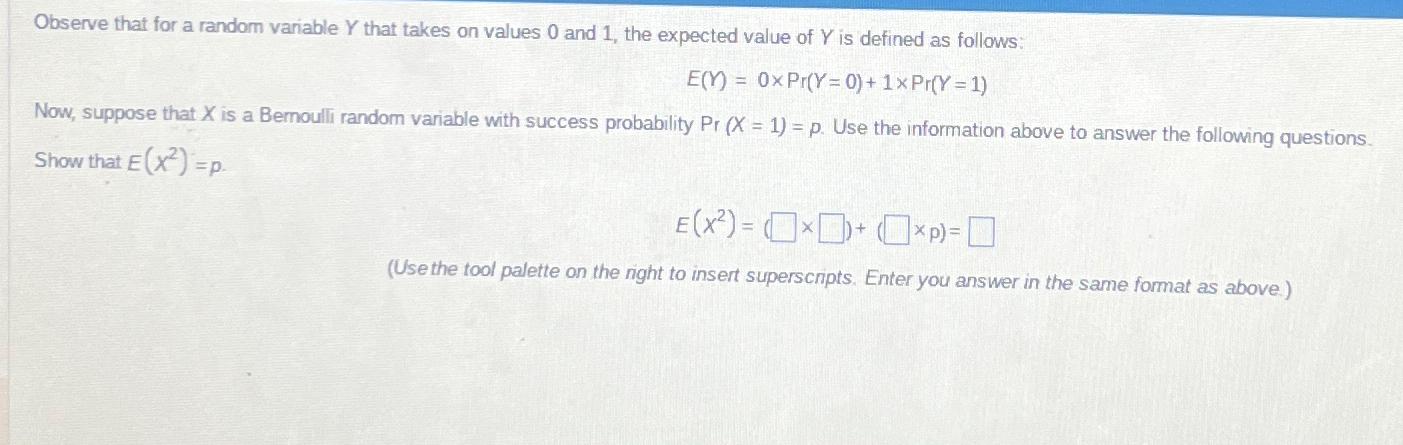
Observe that for a random variable Y that takes on values 0 and 1 , the expected value of Y is defined as follows: E(Y)=0Pr(Y=0)+1Pr(Y=1) Now, suppose that X is a Bernoulli random variable with success probability Pr(X=1)=p. Use the information above to answer the following questions. Show that E(x2)=p. E(x2)=x+1xp)= (Use the tool palette on the right to insert superscripts. Enter you answer in the same format as above) Observe that for a random variable Y that takes on values 0 and 1 , the expected value of Y is defined as follows: E(Y)=0Pr(Y=0)+1Pr(Y=1) Now, suppose that X is a Bernoulli random variable with success probability Pr(X=1)=p. Use the information above to answer the following questions. Show that E(x2)=p. E(x2)=x+1xp)= (Use the tool palette on the right to insert superscripts. Enter you answer in the same format as above)
Step by Step Solution
There are 3 Steps involved in it

Get step-by-step solutions from verified subject matter experts
 Study Help