







Question: (Observed-Lab) Velocity Lab 300,000 km/s * *Note: if the answer comes out negative, that means it is moving towards us (Blueshift), and you can drop
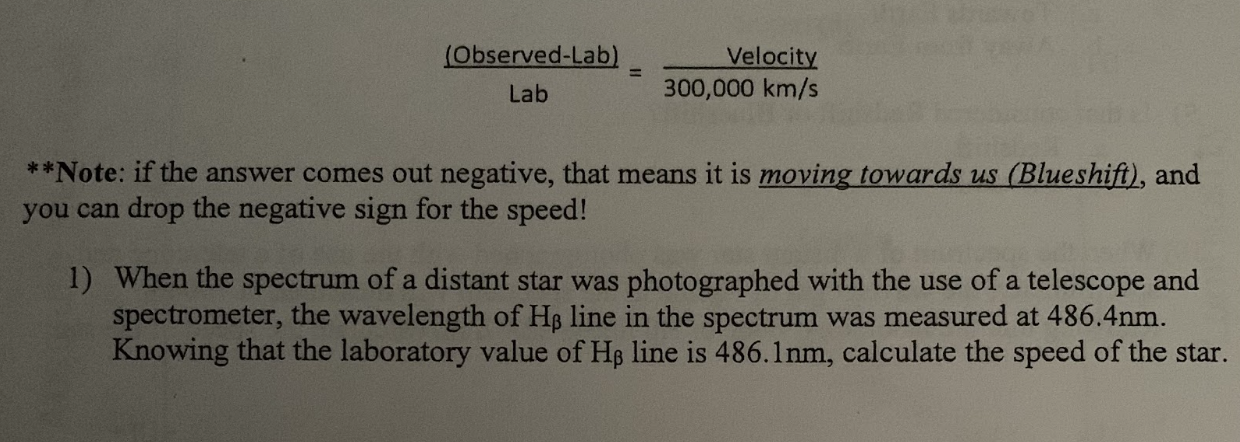




(Observed-Lab) Velocity Lab 300,000 km/s * *Note: if the answer comes out negative, that means it is moving towards us (Blueshift), and you can drop the negative sign for the speed! 1) When the spectrum of a distant star was photographed with the use of a telescope and spectrometer, the wavelength of HB line in the spectrum was measured at 486.4nm. Knowing that the laboratory value of He line is 486.1nm, calculate the speed of the star.4) A particular emission line of hydrogen from a gas cloud is originally emitted with a wavelength of 656.3 nm. With a telescope, we observe the wavelength of the line to be 656.6 nm. What is the speed of the gas cloud?7) Suppose a spectral line of hydrogen, normally known to be 500 nm, is observed in the spectrum of a star at 500.1 nm. How fast is the star moving toward or away from Earth?10) When the spectrum of a distant star was photographed with the use of a telescope and spectrometer, the wavelength of H line in the spectrum was measured at 700nm. Knowing that the laboratory value of HB line is 523.7nm, calculate the speed of the star.13) The Andromeda Galaxy (M31) emits some light that we observe at a wavelength of 479nm, however we know that this light should be 590nm in a lab. Calculate the speed of the Andromeda Galaxy
Step by Step Solution
There are 3 Steps involved in it

Get step-by-step solutions from verified subject matter experts
 Study Help