







Question: OCS Assignment This assignment follows from your previous WACC project. Here, you must determine what the optimum capital structure is for your firm. A sample
OCS Assignment
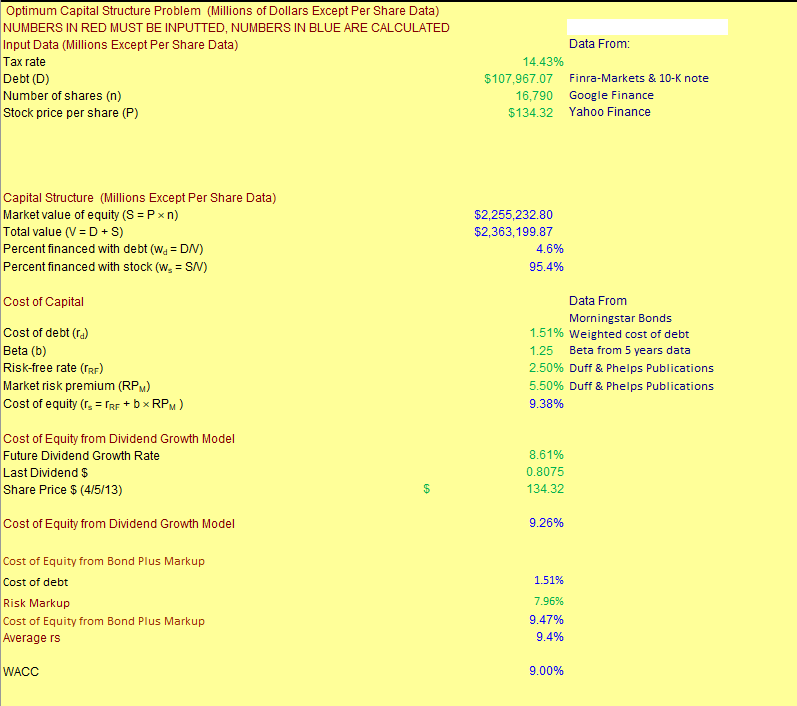
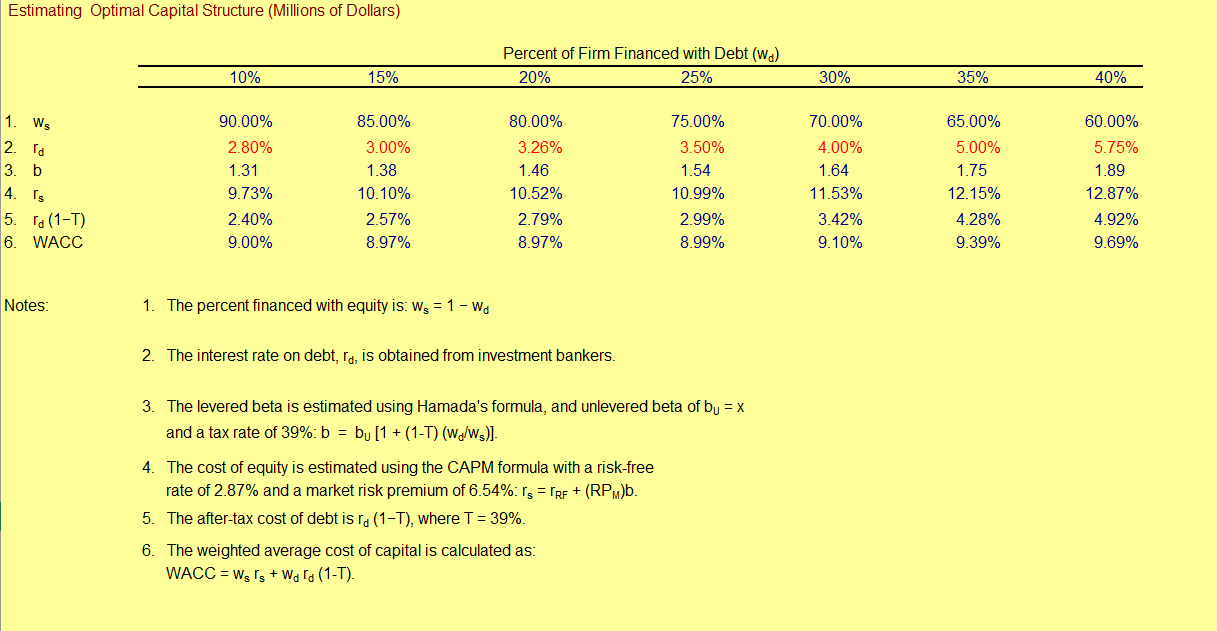
This assignment follows from your previous WACC project. Here, you must determine what the optimum capital structure is for your firm. A sample spreadsheet is provided where you may input the data that you have already found for the WACC. The spreadsheet will use Hamadas Equation to recalculate the levered betas based on the weights that you choose.
NOTE: You cannot just assume that your weights and your bond values are the same as the sample. You must choose the appropriate weights first based on the market value weights your firm currently has. Then, you must choose appropriate bond rates as you increase or decrease the weight for debt.
You must explain and reference how you chose your numbers and attach a copy of the spreadsheet.
Note that the spreadsheet has all the calculations for the WACC on the top portion, but Hamadas Equation only uses the CAPM to refigure the levered beta and the new WACC for that beta.
*****The top portion is the data I have done on Apple Inc. The second portion is what I need help with in the math portion. I need help with number 2. The rd answers. I, also, need help with the explanation. Please help!*****
Optimum Capital Structure Problem (Millions of Dollars Except Per Share Data) NUMBERS IN RED MUST BE INPUTTED, NUMBERS IN BLUE ARE CALCULATED Input Data (Millions Except Per Share Data) Tax rate Debt (D) Number of shares (n) Stock price per share (P) Data From: 14.43% $107,967.07 Finra-Markets & 10-K note 16,790 Google Finance $134.32 Yahoo Finance Capital Structure (Millions Except Per Share Data) Market value of equity (S = P xn) Total value (V = D + S) Percent financed with debt (wa = DN) Percent financed with stock (w. = SNV) $2,255,232.80 $2,363,199.87 4.6% 95.4% Cost of Capital Cost of debt (ra) Beta (b) Risk-free rate (CRF) Market risk premium (RPM) Cost of equity (Ts = lrf+bx RPM) Data From Morningstar Bonds 1.51% Weighted cost of debt 1.25 Beta from 5 years data 2.50% Duff & Phelps Publications 5.50% Duff & Phelps Publications 9.38% Cost of Equity from Dividend Growth Model Future Dividend Growth Rate Last Dividend $ Share Price $ (4/5/13) 8.61% 0.8075 134.32 $ Cost of Equity from Dividend Growth Model 9.26% 1.51% Cost of Equity from Bond Plus Markup Cost of debt Risk Markup Cost of Equity from Bond Plus Markup Averagers 7.96% 9.47% 9.4% WACC 9.00% Estimating Optimal Capital Structure (Millions of Dollars) Percent of Firm Financed with Debt (w.) 20% 25% 10% 15% 30% 35% 40% 1. Ws 80.00% 60.00% 2. ro 3. b 4. 5. rd (1-T) 6. WACC 90.00% 2.80% 1.31 9.73% 2.40% 9.00% 85.00% 3.00% 1.38 10.10% 2.57% 8.97% 3.26% 1.46 10.52% 2.79% 8.97% 75.00% 3.50% 1.54 10.99% 70.00% 4.00% 1.64 11.53% 3.42% 9.10% 65.00% 5.00% 1.75 12.15% 4.28% 9.39% 5.75% 1.89 12.87% 4.92% 9.69% 2.99% 8.99% Notes: 1. The percent financed with equity is: Wg = 1 - Wd 2. The interest rate on debt, rd, is obtained from investment bankers. 3. The levered beta is estimated using Hamada's formula, and unlevered beta of bu = x and a tax rate of 39%: b = bu [1 + (1-T) (w/w)]. 4. The cost of equity is estimated using the CAPM formula with a risk-free rate of 2.87% and a market risk premium of 6.54%: 13 = 'RE+ (RPM)b. 5. The after-tax cost of debt is rd (1-T), where T = 39%. 6. The weighted average cost of capital is calculated as: WACC = Ws Is + Wald (1-T). Optimum Capital Structure Problem (Millions of Dollars Except Per Share Data) NUMBERS IN RED MUST BE INPUTTED, NUMBERS IN BLUE ARE CALCULATED Input Data (Millions Except Per Share Data) Tax rate Debt (D) Number of shares (n) Stock price per share (P) Data From: 14.43% $107,967.07 Finra-Markets & 10-K note 16,790 Google Finance $134.32 Yahoo Finance Capital Structure (Millions Except Per Share Data) Market value of equity (S = P xn) Total value (V = D + S) Percent financed with debt (wa = DN) Percent financed with stock (w. = SNV) $2,255,232.80 $2,363,199.87 4.6% 95.4% Cost of Capital Cost of debt (ra) Beta (b) Risk-free rate (CRF) Market risk premium (RPM) Cost of equity (Ts = lrf+bx RPM) Data From Morningstar Bonds 1.51% Weighted cost of debt 1.25 Beta from 5 years data 2.50% Duff & Phelps Publications 5.50% Duff & Phelps Publications 9.38% Cost of Equity from Dividend Growth Model Future Dividend Growth Rate Last Dividend $ Share Price $ (4/5/13) 8.61% 0.8075 134.32 $ Cost of Equity from Dividend Growth Model 9.26% 1.51% Cost of Equity from Bond Plus Markup Cost of debt Risk Markup Cost of Equity from Bond Plus Markup Averagers 7.96% 9.47% 9.4% WACC 9.00% Estimating Optimal Capital Structure (Millions of Dollars) Percent of Firm Financed with Debt (w.) 20% 25% 10% 15% 30% 35% 40% 1. Ws 80.00% 60.00% 2. ro 3. b 4. 5. rd (1-T) 6. WACC 90.00% 2.80% 1.31 9.73% 2.40% 9.00% 85.00% 3.00% 1.38 10.10% 2.57% 8.97% 3.26% 1.46 10.52% 2.79% 8.97% 75.00% 3.50% 1.54 10.99% 70.00% 4.00% 1.64 11.53% 3.42% 9.10% 65.00% 5.00% 1.75 12.15% 4.28% 9.39% 5.75% 1.89 12.87% 4.92% 9.69% 2.99% 8.99% Notes: 1. The percent financed with equity is: Wg = 1 - Wd 2. The interest rate on debt, rd, is obtained from investment bankers. 3. The levered beta is estimated using Hamada's formula, and unlevered beta of bu = x and a tax rate of 39%: b = bu [1 + (1-T) (w/w)]. 4. The cost of equity is estimated using the CAPM formula with a risk-free rate of 2.87% and a market risk premium of 6.54%: 13 = 'RE+ (RPM)b. 5. The after-tax cost of debt is rd (1-T), where T = 39%. 6. The weighted average cost of capital is calculated as: WACC = Ws Is + Wald (1-T)
Step by Step Solution
There are 3 Steps involved in it

Get step-by-step solutions from verified subject matter experts
 Study Help