







Question: Off - center annular flow D ( C ) . A liquid flows under a pressure gradient p / z through the narrow annular space
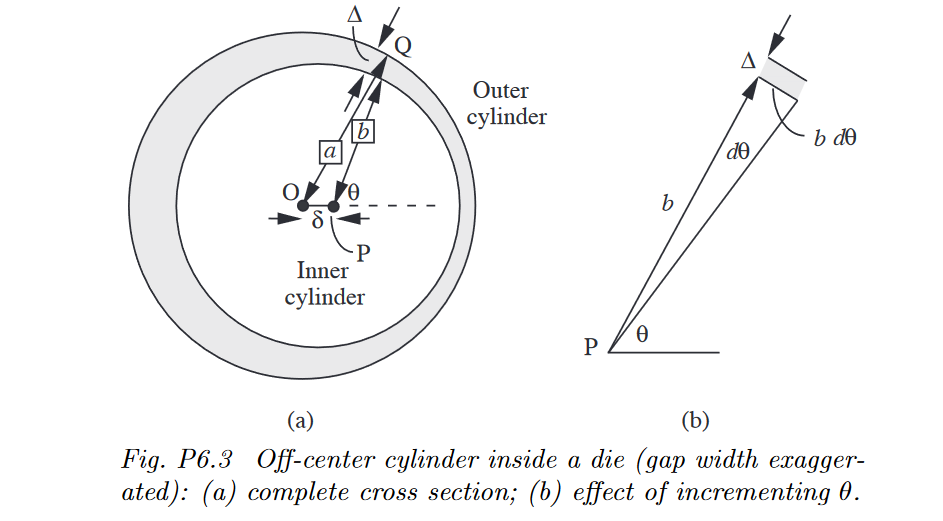
Offcenter annular flowD C A liquid flows under a pressure gradient pz through the narrow annular space of a die, a cross section of which is shown in Fig. Pa The coordinate z is in the axial direction, normal to the plane of the diagram. The die consists of a solid inner cylinder with center P and radius b inside a hollow outer cylinder with center O and radius a The points O and P were intended to coincide but, due to an imperfection of assembly, are separated by a small distance
By a simple geometrical argument based on the triangle OPQ, show that the gap width between the two cylinders is given approximately by: a b cos where the angle is defined in the diagram. Now consider the radius arm b swung through an angle d so that it traces an arc of length bd The flow rate dQ through the shaded element in b is approximately that between parallel plates of width bd and separation Hence, prove that the flow rate through the die is given approximately by: Q bc in which: c p z and a b Assume from Eqn. E that the flow rate per unit width between two flat plates separated by a distance h is: h p z What is the ratio of the flow rate if the two cylinders are touching at one point to the flow rate if they are concentric? a
b
Fig. P Offcenter cylinder inside a die gap width exaggerated: a complete cross section; b effect of incrementing theta
Step by Step Solution
There are 3 Steps involved in it
1 Expert Approved Answer
Step: 1 Unlock

Question Has Been Solved by an Expert!
Get step-by-step solutions from verified subject matter experts
Step: 2 Unlock
Step: 3 Unlock
 Study Help