



Question: Ohm's Law The current passing through a conductor is directly proportional to the volt drop and inversely proportional to the conductor's resistance. so that:
Ohm's Law
The current passing through a conductor is directly proportional to the volt drop and inversely proportional to the conductor's resistance.
so that:
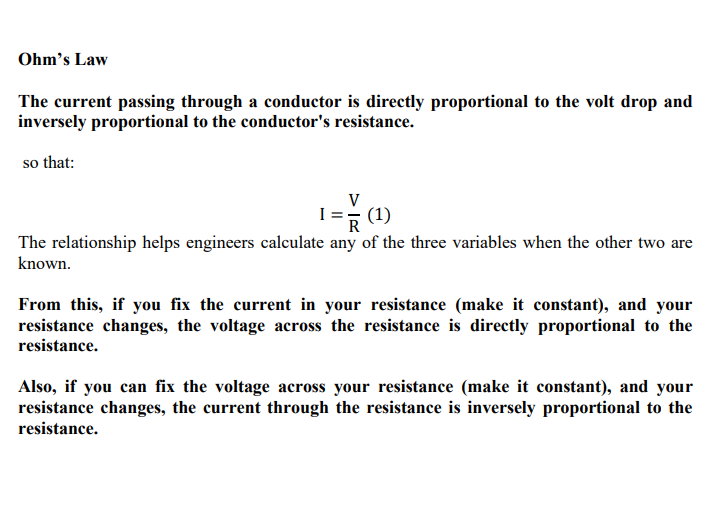
mathrmIfracmathrmVmathrmR
The relationship helps engineers calculate any of the three variables when the other two are known.
From this, if you fix the current in your resistance make it constant and your resistance changes, the voltage across the resistance is directly proportional to the resistance.
Also, if you can fix the voltage across your resistance make it constant and your resistance changes, the current through the resistance is inversely proportional to the resistance.
Step by Step Solution
There are 3 Steps involved in it
1 Expert Approved Answer
Step: 1 Unlock

Question Has Been Solved by an Expert!
Get step-by-step solutions from verified subject matter experts
Step: 2 Unlock
Step: 3 Unlock