Question: ok so here is a full explanation for both questions The first question is: On the second image it asks But what if the Pepsi
ok so here is a full explanation for both questions
The first question is: On the second image it asks "But what if the Pepsi points contract required only a promise from contestants to send in Pepsi points on a certain date and PepsiCo would send the prize up front? Would the second scenario be a unilateral or a bilateral contract? the second question is: On the fourth image the critical thinking and ethical thinking, you just have to answer the questions there.
THE DISCUSSION QUESTION IS DOWN EXPLAINING EVERYTHING AND I AM GONNA POST THE PHOTOS YOU NEED TO USE DOWN BELOW. PLEASE JUST USE THE NOTES I'LL GIVE YOU A REALLY GOOD REVIEW.
This is Discussion Question 2 for the week and will be related to the material in (Chapters 9, and 11).
Chapter 9: After reviewing the chapter, Return to the Case Opener (Pepsi) on page 196 (You do not have to answer the 3 questions But, you must become familiar with the content of the case; However, you will want to look for those answers within the body of the case opener so you can become familiar with the Problematic Promotion discussed. Now see below:
Refer to page 200 (Read the: 'But What If' section) Next, comment on the 2 questions asked for the Pepsi case opener)... discussing chapter content that you must become familiar with: (bilateral/unilateral contracts).
Chapter 11:
Capacity and Legality Read Case 11.1 Respond to the case by reviewing the elements of the case: Issue, Facts, History, Holding, and Reasoning. Only answer the (2) questions as we typically do: Critical Thinking and the Ethical Decision Making. Format your answers accordingly.
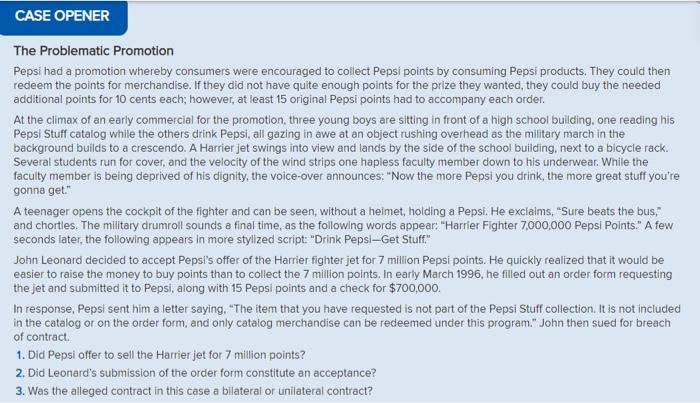
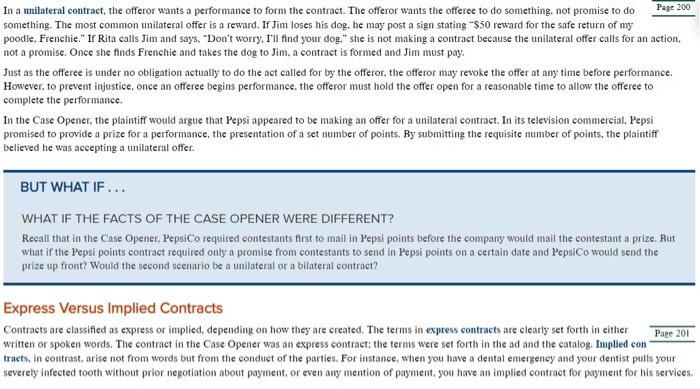
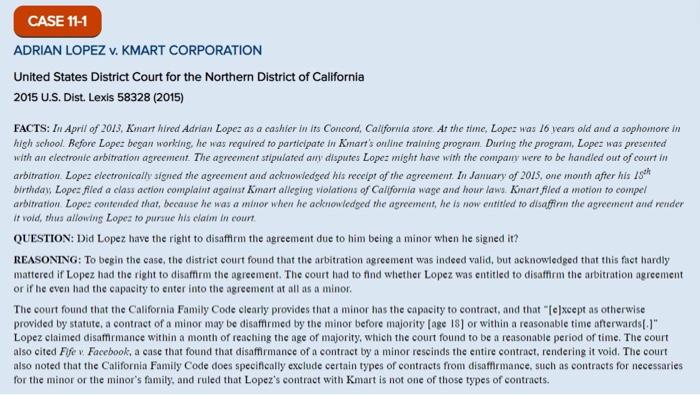
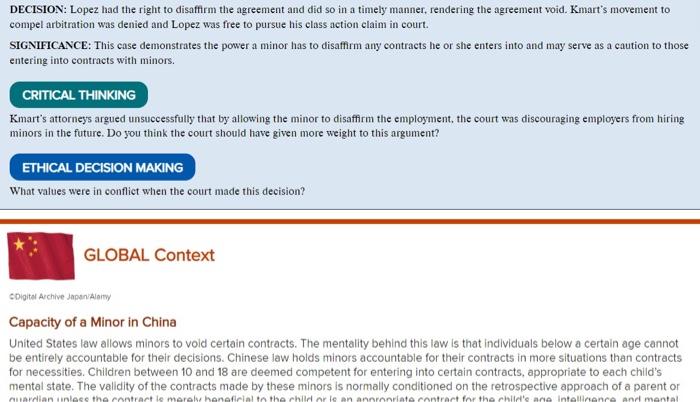
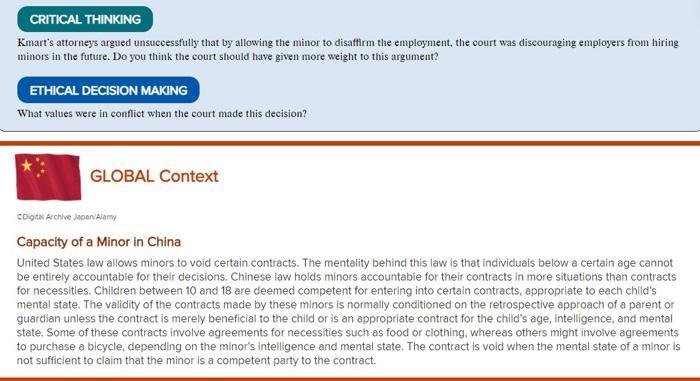
CASE OPENER The Problematic Promotion Pepsi had a promotion whereby consumers were encouraged to collect Pepsi points by consuming Pepsi products. They could then redeem the points for merchandise. If they did not have quite enough points for the prize they wanted, they could buy the needed additional points for 10 cents each; however, at least 15 original Pepsi points had to accompany each order. At the climax of an early commercial for the promotion, three young boys are sitting in front of a high school building, one reading his Pepsi Stuff catalog while the others drink Pepsi, all gazing in awe at an object rushing overhead as the military march in the background builds to a crescendo. A Harrier jet swings into view and lands by the side of the school building, next to a bicycle rack. Several students run for cover, and the velocity of the wind strips one hapless faculty member down to his underwear. While the faculty member is being deprived of his dignity, the voice-over announces: "Now the more Pepsi you drink, the more great stuff you're gonna get." A teenager opens the cockpit of the fighter and can be seen, without a helmet, holding a Pepsi. He exclaims, "Sure beats the bus," and chortles. The military drumroll sounds a final time, as the following words appear: "Harrier Fighter 7,000,000 Pepsi Points." A few seconds later, the following appears in more stylized script: "Drink Pepsi-Get Stuff." John Leonard decided to accept Pepsi's offer of the Harrier fighter jet for 7 million Pepsi points. He quickly realized that it would be easier to raise the money to buy points than to collect the 7 million points. In early March 1996, he filled out an order form requesting the jet and submitted it to Pepsi, along with 15 Pepsi points and a check for $700,000. In response, Pepsi sent him a letter saying, "The item that you have requested is not part of the Pepsi Stuff collection. It is not included in the catalog or on the order form, and only catalog merchandise can be redeemed under this program." John then sued for breach of contract. 1. Did Pepsi offer to sell the Harrier jet for 7 million points? 2. Did Leonard's submission of the order form constitute an acceptance? 3. Was the alleged contract in this case a bilateral or unilateral contract? Page 200 In a unilateral contract, the offeror wants a performance to form the contract. The offeror wants the offeree to do something, not promise to do something. The most common unilateral offer is a reward. If Jim loses his dog, he may post a sign stating "$50 reward for the safe return of my poodle, Frenchie." If Rita calls Jim and says. "Don't worry. I'll find your dog," she is not making a contract because the unilateral offer calls for an action, not a promise. Once she finds Frenchie and takes the dog to Jim, a contract is formed and Jim must pay. Just as the offeree is under no obligation actually to do the act called for by the offeror, the offeror may revoke the offer at any time before performance. However, to prevent injustice, once an offeree begins performance, the offeror must hold the offer open for a reasonable time to allow the offeree to complete the performance In the Case Opener, the plaintiff would argue that Pepsi appeared to be making an offer for a unilateral contract. In its television commercial, Pepsi promised to provide a prize for a performance, the presentation of a set number of points. By submitting the requisite number of points, the plaintiff believed he was accepting a unilateral offer. BUT WHAT IF... WHAT IF THE FACTS OF THE CASE OPENER WERE DIFFERENT? Recall that in the Case Opener, PepsiCo required contestants first to mail in Pepsi points before the company would mail the contestant a prize. But what if the Pepsi points contract required only a promise from contestants to send in Pepsi points on a certain date and PepsiCo would send the prize up front? Would the second scenario be a unilateral or a bilateral contract? Express Versus Implied Contracts Contracts are classified as express or implied, depending on how they are created. The terms in express contracts are clearly set forth in either Page 201 written or spoken words. The contract in the Case Opener was an express contract; the terms were set forth in the ad and the catalog. Implied con tracts, in contrast, arise not from words but from the conduct of the parties. For instance, when you have a dental emergency and your dentist pulls your severely infected tooth without prior negotiation about payment, or even any mention of payment, you have an implied contract for payment for his services. CASE 11-1 ADRIAN LOPEZ V. KMART CORPORATION United States District Court for the Northern District of California 2015 U.S. Dist. Lexis 58328 (2015) FACTS: In April of 2013, Kmart hired Adrian Lopez as a cashier in its Concord, California store At the time. Lopez was 16 years old and a sophomore in high school. Before Lopez began working, he was required to participate in Kmart's online training program. During the program, Lopez was presented with an electronic arbitration agreement. The agreement stipulated any disputes Lopez might have with the company were to be handled out of court in arbitration. Lopez electronically signed the agreement and acknowledged his receipt of the agreement. In January of 2015, one month after his Ish birthday. Lopez filed a class action complaint against Kmart alleging Wolations of California wage and hour laws. Kmart filed a motion to compel arbitration Lopez contended thar, because he was a minor when he acknowledged the agreement, he is now entitled to disaffirm the agreement and render it vold, thus allowing Lopez to pursue his claim in court QUESTION: Did Lopez have the right to disaffirm the agreement due to him being a minor when he signed it? REASONING: To begin the case, the district court found that the arbitration agreement was indeed valid, but acknowledged that this fact hardly mattered if Lopez had the right to disaffirm the agreement. The court had to find whether Lopez was entitled to disaffirm the arbitration agreement or if he even had the capacity to enter into the agreement at all as a minor. The court found that the California Family Code clearly provides that a minor has the capacity to contract, and that "te]xcept as otherwise provided by statute, a contract of a minor may be disaffirmed by the minor before majority (age 18) or within a reasonable time afterwards[:)" Lopez claimed disamrmance within a month of reaching the age of majority, which the court found to be a reasonable period of time. The court also cited Fife Facebook, a case that found that disaffirmance of a contract by a minor rescinds the entire contract, rendering it void. The court also noted that the California Family Code does specifically exclude certain types of contracts from disaffirmance, such as contracts for necessaries for the minor or the minor's family, and ruled that Lopez's contract with Kmart is not one of those types of contracts. DECISION: Lopez had the right to disaffirm the agreement and did so in a timely manner, rendering the agreement void. Kmart's movement to compel arbitration was denied and Lopez was free to pursue his class action claim in court. SIGNIFICANCE: This case demonstrates the power a minor has to disaffirm any contracts he or she enters into and may serve as a caution to those entering into contracts with minors. CRITICAL THINKING Kmart's attorneys argued unsuccessfully that by allowing the minor to disaffirm the employment, the court was discouraging employers from hiring minors in the future. Do you think the court should have given more weight to this argument? ETHICAL DECISION MAKING What values were in conflict when the court made this decision? GLOBAL Context Digital Archive JapanAlamy Capacity of a Minor in China United States law allows minors to vold certain contracts. The mentality behind this law is that individuals below a certain age cannot be entirely accountable for their decisions. Chinese law holds minors accountable for their contracts in more situations than contracts for necessities. Children between 10 and 18 are deemed competent for entering into certain contracts, appropriate to each child's mental state. The validity of the contracts made by these minors is normally conditioned on the retrospective approach of a parent or ardian cinless the contract le merely honeficial to the childarle an annorlate contract for the child's ane Intelligence and mental CRITICAL THINKING Kmart's attorneys argued unsuccessfully that by allowing the minor to disaffirm the employment, the court was discouraging employers from hiring minors in the future. Do you think the court should have given more weight to this argument? ETHICAL DECISION MAKING What values were in conflict when the court made this decision? GLOBAL Context CDigital Archive Japan/Alamy Capacity of a Minor in China United States law allows minors to void certain contracts. The mentality behind this law is that individuals below a certain age cannot be entirely accountable for their decisions. Chinese law holds minors accountable for their contracts in more situations than contracts for necessities. Children between 10 and 18 are deemed competent for entering into certain contracts, appropriate to each child's mental state. The validity of the contracts made by these minors is normally conditioned on the retrospective approach of a parent or guardian unless the contract is merely beneficial to the child or is an appropriate contract for the child's age, Intelligence, and mental state. Some of these contracts involve agreements for necessities such as food or clothing, whereas others might involve agreements to purchase a bicycle, depending on the minor's intelligence and mental state. The contract is vold when the mental state of a minor is not sufficient to claim that the minor is a competent party to the contract




