







Question: olatility in the Global Business Environment ource: based on the Unit Textbook, page 152) One of the main factors that can affect the performance of
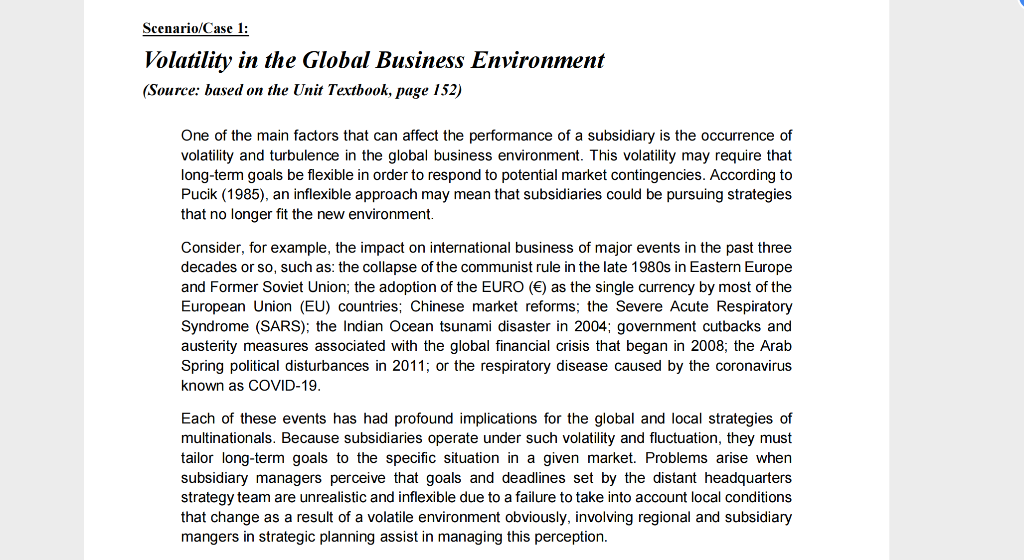

olatility in the Global Business Environment ource: based on the Unit Textbook, page 152) One of the main factors that can affect the performance of a subsidiary is the occurrence of volatility and turbulence in the global business environment. This volatility may require that long-term goals be flexible in order to respond to potential market contingencies. According to Pucik (1985), an inflexible approach may mean that subsidiaries could be pursuing strategies that no longer fit the new environment. Consider, for example, the impact on international business of major events in the past three decades or so, such as: the collapse of the communist rule in the late 1980s in Eastern Europe and Former Soviet Union; the adoption of the EURO () as the single currency by most of the European Union (EU) countries; Chinese market reforms; the Severe Acute Respiratory Syndrome (SARS); the Indian Ocean tsunami disaster in 2004; government cutbacks and austerity measures associated with the global financial crisis that began in 2008; the Arab Spring political disturbances in 2011 ; or the respiratory disease caused by the coronavirus known as COVID-19. Each of these events has had profound implications for the global and local strategies of multinationals. Because subsidiaries operate under such volatility and fluctuation, they must tailor long-term goals to the specific situation in a given market. Problems arise when subsidiary managers perceive that goals and deadlines set by the distant headquarters strategy team are unrealistic and inflexible due to a failure to take into account local conditions that change as a result of a volatile environment obviously, involving regional and subsidiary mangers in strategic planning assist in managing this perception. b. Using theories and concepts from this unit, devise ONE relevant policy or solution for EACH of these implications/concerns and critically discuss how each of these policies/solutions can address these implications or concerns
Step by Step Solution
There are 3 Steps involved in it

Get step-by-step solutions from verified subject matter experts
 Study Help