







Question: Old MathJax webview 1. Describe how we could use Figures 6.1 and 6.2 to develop a questionnaire that could be used to measure attitudes and
Old MathJax webview
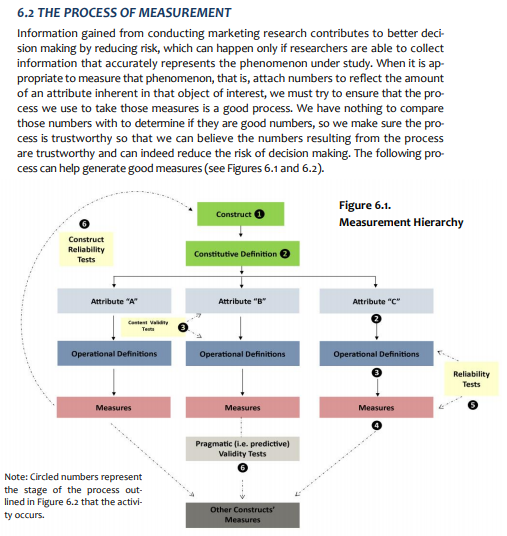
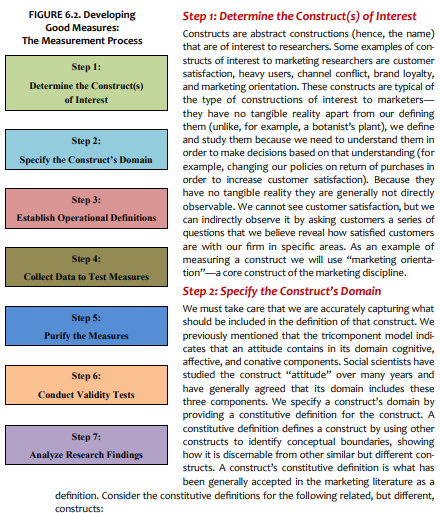
1. Describe how we could use Figures 6.1 and 6.2 to develop a questionnaire that could be used to measure attitudes and behavior toward a healthy diet. Provide examples of questions that could be generated from this process. Discuss how we would test the questionnaire for reliability and validity.
Topic: Essentials of marketing research (Measurement)
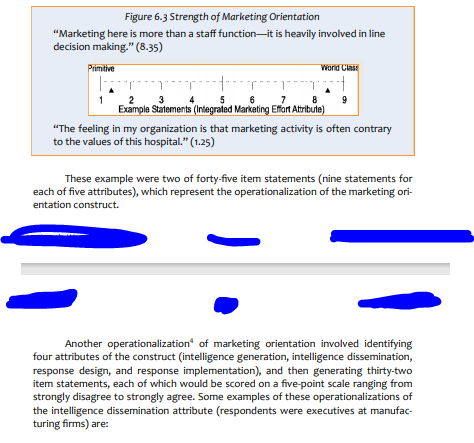
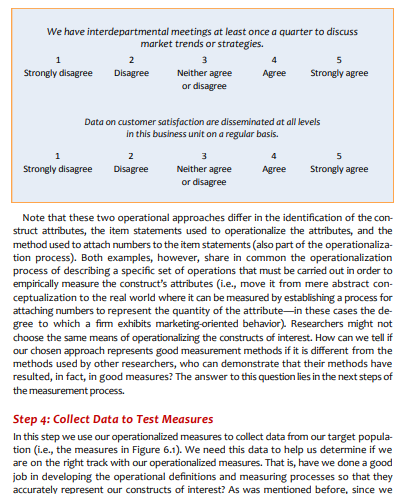
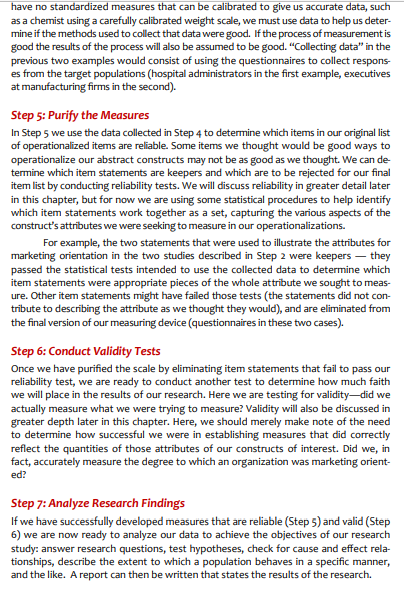
6.2 THE PROCESS OF MEASUREMENT Information gained from conducting marketing research contributes to better deci- sion making by reducing risk, which can happen only if researchers are able to collect information that accurately represents the phenomenon under study. When it is ap- propriate to measure that phenomenon, that is, attach numbers to reflect the amount of an attribute inherent in that object of interest, we must try to ensure that the pro- cess we use to take those measures is a good process. We have nothing to compare those numbers with to determine if they are good numbers, so we make sure the pro cess is trustworthy so that we can believe the numbers resulting from the process are trustworthy and can indeed reduce the risk of decision making. The following pro- cess can help generate good measures (see Figures 6.1 and 6.2). Construct Figure 6.1. Measurement Hierarchy Construct Reliability Tests Constitutive Definition Attribute "A Attribute "B" Attribute "C" Teste Operational Definitions Operational Definitions Operational Definitions Reliability Tests Measures Measures Measures Pragmatic fie predictive) Validity Tests Note: Circled numbers represent the stage of the process out- lined in Figure 6.2 that the activi- ty occurs. Other Constructs' Measures of Interest FIGURE 6.2. Developing Step 1: Determine the Construct(s) of Interest Good Measures: Constructs are abstract constructions (hence, the name) The Measurement Process that are of interest to researchers. Some examples of con- structs of interest to marketing researchers are customer Step 1: satisfaction, heavy users, channel conflict, brand loyalty, Determine the Construct(s) and marketing orientation. These constructs are typical of the type of constructions of interest to marketers, they have no tangible reality apart from our defining them (unlike, for example, a botanist's plant), we define Step 2: and study them because we need to understand them in order to make decisions based on that understanding (for Specify the Construct's Domain example, changing our policies on retum of purchases in order to increase customer satisfaction). Because they have no tangible reality they are generally not directly Step 3: observable. We cannot see customer satisfaction, but we Establish Operational Definitions can indirectly observe it by asking customers a series of questions that we believe reveal how satisfied customers are with our firm in specific areas. As an example of Step 4: measuring a construct we will use "marketing orienta- tion"a core construct of the marketing discipline. Step 2: Specify the Construct's Domain We must take care that we are accurately capturing what Step 5: should be included in the definition of that construct. We Purify the Measures previously mentioned that the tricomponent model indi- cates that an attitude contains in its domain cognitive, affective, and conative components. Social scientists have Step 6: studied the construct "attitude" over many years and have generally agreed that its domain includes these Conduct Validity Tests three components. We specify a construct's domain by providing a constitutive definition for the construct. A constitutive definition defines a construct by using other Step 7: constructs to identify conceptual boundaries, showing Analyze Research Findings how it is discemable from other similar but different con- structs. A construct's constitutive definition is what has been generally accepted in the marketing literature as a definition. Consider the constitutive definitions for the following related, but different, Collect Data to Test Measures constructs: Marketing orientation is the attention to identifying and satisfying customer needs, integration of effort by all areas of the organization to satisfying those needs, and focusing on the means by which an organization can achieve its goals most effi- ciently while satisfying those needs. Market orientation is the systematic gathering of information on customers and competitors, both present and potential, the systematic analysis of the information for the purpose of developing marketing knowledge, and the systematic use of such knowledge to guide strategy recognition, understanding, creation, selection, implementation, and modification. The definition of market orientation is distinguished from marketing orienta- tion by what it adds (a focus on potential customers as well as present customers and on competitors as well as customers), and subtracts (an interfunctional coordi- nation). Step 3: Establish Operational Definitions The constitutive definition makes it possible to better define the construct's domain by use of an operational definition. An operational definition indicates what observa- ble attributes of the construct will be measured and the process that will be used to at- tach numbers to those attributes so as to represent the quantity of the attributes. Of- ten, a construct's attributes are identified in the constitutive definition. We need to establish operational definitions of our constructs to move them from the world of abstract concepts into the empirical world where we can measure them. Marketing orientation remains an abstract concept until we say exactly what its attributes are and how, specifically, we intend to measure those attributes. One example of operationalizing the marketing orientation construct in a hos- pital setting involved identifying five attributes of the construct (customer philoso- phy, marketing information systems, integrated marketing effort, strategic orientation, and operational efficiency), and then generating a set of nine statements for each attrib- ute which fell along a strength of marketing orientation continuum anchored by the end points of "primitive" to "world class." These statements were assigned a score on the nine-point scale by a panel of expert judges. The following are two examples of statements whose average score by the judges fell at different points on the scale. Respondents (hospital administrators) would choose which statements most accu- rately reflected the marketing practices at their hospital. Figure 6.3 Strength of Marketing Orientation "Marketing here is more than a staff functionit is heavily involved in line decision making." (8.35) Primtive World Class 8 2 3 5 6 7 9 Example Statements (Integrated Marketing EffortAttribute) "The feeling in my organization is that marketing activity is often contrary to the values of this hospital." (1.25) These example were two of forty-five item statements (nine statements for each of five attributes), which represent the operationalization of the marketing ori- entation construct. Another operationalization of marketing orientation involved identifying four attributes of the construct (intelligence generation, intelligence dissemination, response design, and response implementation), and then generating thirty-two item statements, each of which would be scored on a five-point scale ranging from strongly disagree to strongly agree. Some examples of these operationalizations of the intelligence dissemination attribute (respondents were executives at manufac- turing firms) are: We have interdepartmental meetings at least once a quarter to discuss market trends or strategies. 1 2 3 4 5 Strongly disagree Disagree Agree Strongly agree Neither agree or disagree Data on customer satisfaction are disseminated at all levels in this business unit on a regular basis. 2 3 4 5 Strongly disagree Disagree Agree Strongly agree Neither agree or disagree Note that these two operational approaches differ in the identification of the con- struct attributes, the item statements used to operationalize the attributes, and the method used to attach numbers to the item statements (also part of the operationaliza- tion process). Both examples, however, share in common the operationalization process of describing a specific set of operations that must be carried out in order to empirically measure the construct's attributes (i.e., move it from mere abstract con- ceptualization to the real world where it can be measured by establishing a process for attaching numbers to represent the quantity of the attributein these cases the de gree to which a firm exhibits marketing-oriented behavior). Researchers might not choose the same means of operationalizing the constructs of interest. How can we tell if our chosen approach represents good measurement methods if it is different from the methods used by other researchers, who can demonstrate that their methods have resulted, in fact, in good measures? The answer to this question lies in the next steps of the measurement process. Step 4: Collect Data to Test Measures In this step we use our operationalized measures to collect data from our target popula- tion (i.e., the measures in Figure 6.1). We need this data to help us determine if we are on the right track with our operationalized measures. That is, have we done a good job in developing the operational definitions and measuring processes so that they accurately represent our constructs of interest? As was mentioned before, since we have no standardized measures that can be calibrated to give us accurate data, such as a chemist using a carefully calibrated weight scale, we must use data to help us deter- mine if the methods used to collect that data were good. If the process of measurement is good the results of the process will also be assumed to be good. "Collecting data" in the previous two examples would consist of using the questionnaires to collect respons- es from the target populations (hospital administrators in the first example, executives at manufacturing firms in the second). Step 5: Purify the Measures In Step 5 we use the data collected in Step 4 to determine which items in our original list of operationalized items are reliable. Some items we thought would be good ways to operationalize our abstract constructs may not be as good as we thought. We can de termine which item statements are keepers and which are to be rejected for our final item list by conducting reliability tests. We will discuss reliability in greater detail later in this chapter, but for now we are using some statistical procedures to help identify which item statements work together as a set, capturing the various aspects of the construct's attributes we were seeking to measure in our operationalizations. For example, the two statements that were used to illustrate the attributes for marketing orientation in the two studies described in Step 2 were keepers they passed the statistical tests intended to use the collected data to determine which item statements were appropriate pieces of the whole attribute we sought to meas- ure. Other item statements might have failed those tests (the statements did not con- tribute to describing the attribute as we thought they would), and are eliminated from the final version of our measuring device (questionnaires in these two cases). Step 6: Conduct Validity Tests Once we have purified the scale by eliminating item statements that fail to pass our reliability test, we are ready to conduct another test to determine how much faith we will place in the results of our research. Here we are testing for validitydid we actually measure what we were trying to measure? Validity will also be discussed in greater depth later in this chapter. Here, we should merely make note of the need to determine how successful we were in establishing measures that did correctly reflect the quantities of those attributes of our constructs of interest. Did we, in fact, accurately measure the degree to which an organization was marketing orient- ed? Step 7: Analyze Research Findings If we have successfully developed measures that are reliable (Step 5) and valid (Step 6) we are now ready to analyze our data to achieve the objectives of our research study: answer research questions, test hypotheses, check for cause and effect rela- tionships, describe the extent to which a population behaves in a specific manner, and the like. A report can then be written that states the results of the researchStep by Step Solution
There are 3 Steps involved in it
1 Expert Approved Answer
Step: 1 Unlock

Question Has Been Solved by an Expert!
Get step-by-step solutions from verified subject matter experts
Step: 2 Unlock
Step: 3 Unlock
 Study Help